
Third Party Gallery opened its first exhibition with a group show (the curator isn’t listed, but I assume it was Wyatt Niehaus, one of the co-founders) called Reductio ad Absurdum. According to the press release, the curator claims that its artists have “composed a dialogue between their work and a preexisting ideology, convention or concept that they feel at odds with. The exhibited work acts as an absurd analogy intended to show the perceived error of these preexisting concepts that we find embedded in contemporary culture.” This statement confused me, despite the recognizeability of some of the jargon. Reductio ad Absurdum is traditionally a rhetorical device for challenging argumentation, and the idea of curating a show in which artists attempt to do this in their work is certainly ambitious. Whether the resulting works serve as “analogies” remains unclear.
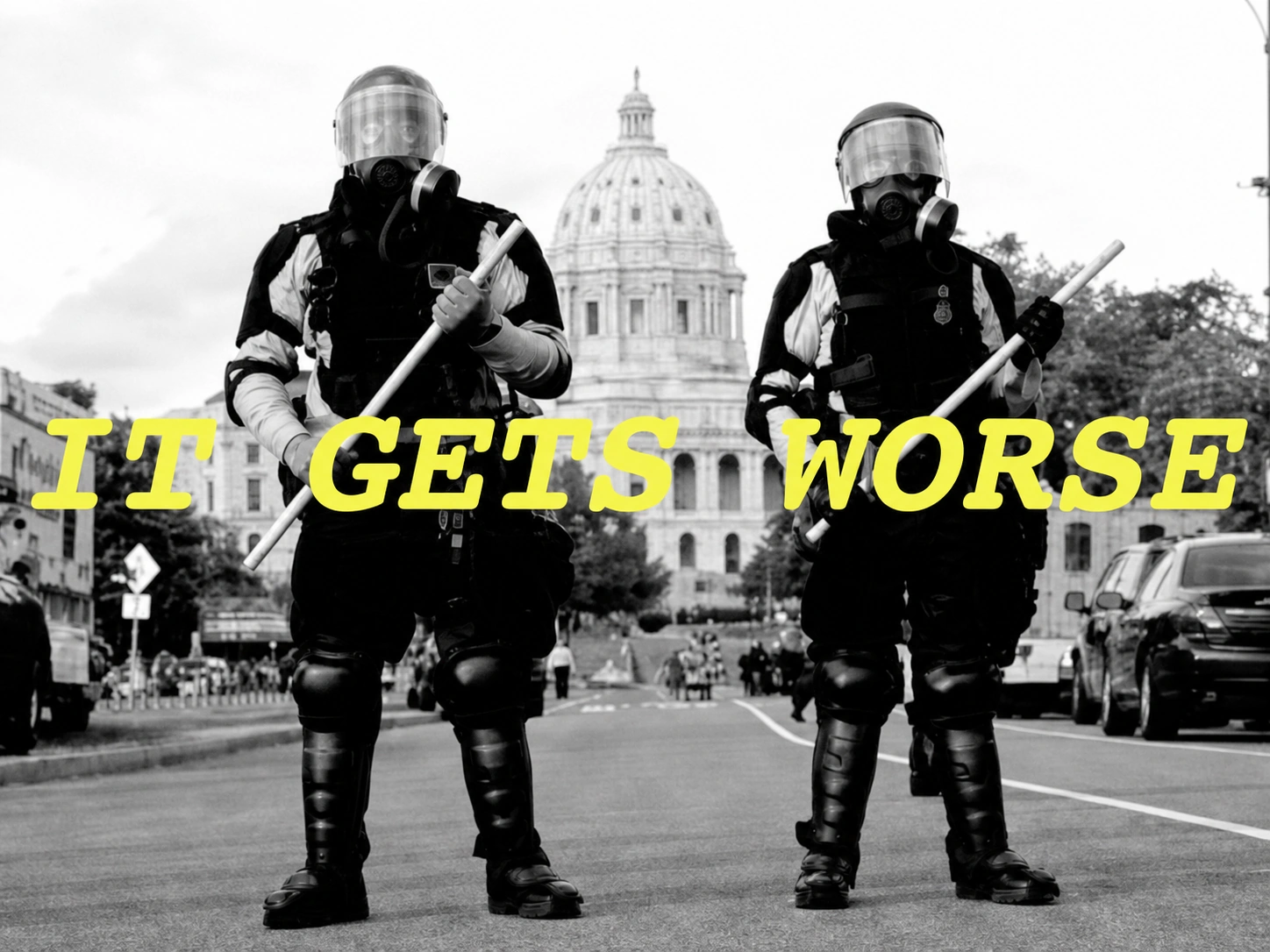
Entering the exhibition, I was immediately greeted by the prominently placed, politically-charged work of Aay Preston-Myint. A black & white banner of US Representative John Boehner hung on the ceiling in the center of the room, as if looking directly upon entering viewers. The words “IT GETS WORSE,” printed in orange lettering, leap out as well. A smaller version of the poster appears on the left wall on a ledge with three other images–an external prison wall, a couple of police in riot gear, and a religious fanatic holding ominous signs. All have the phrase “IT GETS WORSE” prominently featured on them. They are also mass-produced copies, with the idea that visitors can take the posters and put them up elsewhere. The art reference is to Barbara Kruger, but I was unclear of how these fit into the R.A.A. theme.
Equally ideologically blatant were two canvases by John Knight on the wall opposite Preston-Myint’s posters. One features a two-toned large pink Nazi swastika, while the other the German word “weltschmerz” broken into three lines. A swastika is a shocking, racist symbol and not to be used lightly; no doubt this shock effect was part of the intention of the artist. Yet, I refused to be shocked, as it seemed too obvious. Presumably the pink color is meant to reflect the persecution of homosexuals. On the other hand, “Weltschmerz,” meaning “world-weariness,” refers to sorrow from the inability to realize one’s ideals in the face of reality. I suppose that one is expected to read the canvases left to right; hence, one feels “world-weariness” in the face of repeated, relentless, ceaseless ideological persecution. This also did not seem clearly to fit into the R.A.A. theme, unless their titles allowed this: Bob Dylan 1 and Bob Dylan 2 (2011). Presumably the work refers to the melancholy of the artist and his political activity; possibly, the artist proposes a transcendent cultural weariness because of the repetitiveness of such representations over the past one and a half centuries.
I mention these two artists first simply because their work used an in-your-face approach. They eclipsed, for example, Haley Silverman’s print called Life-raft (2009); having seen Preston-Myint’s prints, I had assumed, wrongly, that this was also some spin-off of his work, since they were placed near his prints.
The other artworks drew me in more closely. On the back wall was a video website projection called I am Google (2011) by Dina Kelberman. It depicted a screen of thumbnail images. As one scrolled down the images with the interactive mouse, new thumbnails continuously appeared with thematic and formal connections amongst them. For example, a series appeared of surveillance-like aerial views of stadiums, all cropped in a similar way; subsequently, thumbnails appeared of video links following the same method; this continued for some time. It was an unusual way to take the Google search function and play with it. I thought that some algorithm had been programmed into the browser. I pondered how this functioned for a while, until one of the show’s attendants explained to me that the thumbnails were all manually entered by the artist (the latest ones in real-time at some other location). Unfortunately, a gallery visitor clicked on an image (or something similar) in which the hypnotic thumbnail progressions were replaced by a single-image slideshow. The same attendant struggled with the technology to get it back to the artist’s intended format. This is an inevitable result of technological installations; they don’t always work. Yet the break somehow fit in with the show’s narrative.









Comments powered by Talkyard.