Sara Pearce, Hands Across the Water.
Sara Caswell Pearce makes art with verve, gusto and infinite care. She delights in doing it. This artist is most regularly a print maker and collage artist, and she works in two smallish rooms across the hallway from one another on the upper floor of Brazee Studios in Oakley. Pearce and her husband live only a short walk or bicycle ride away, so her commute from home to work space is brief.
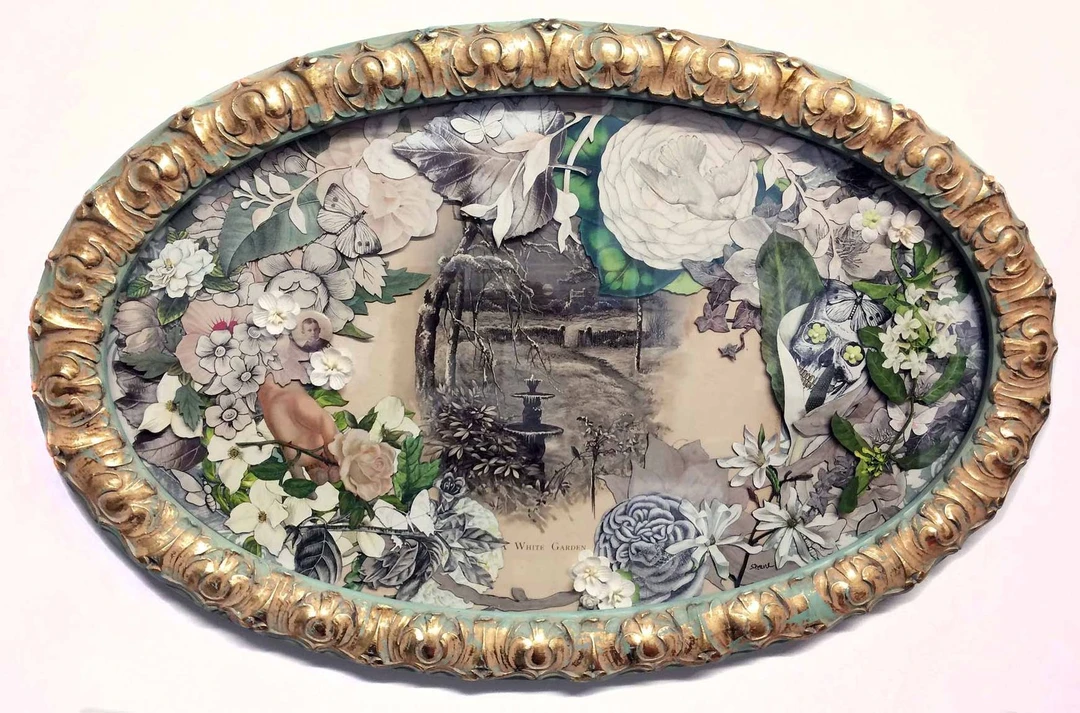
Cincinnati knew Pearce first as a staffer at the Enquirer, where she went from reporter to critic, features editor and assistant managing editor, in the fields of arts and literature, during her more than twenty years there. Before coming to Cincinnati she had been a journalist at papers as varied as the Orlando Sentinel and USA TODAY. There is a kinship between Pearce’s two fields of endeavor as one puts words (often about art) on paper and the other makes an art object of paper itself.
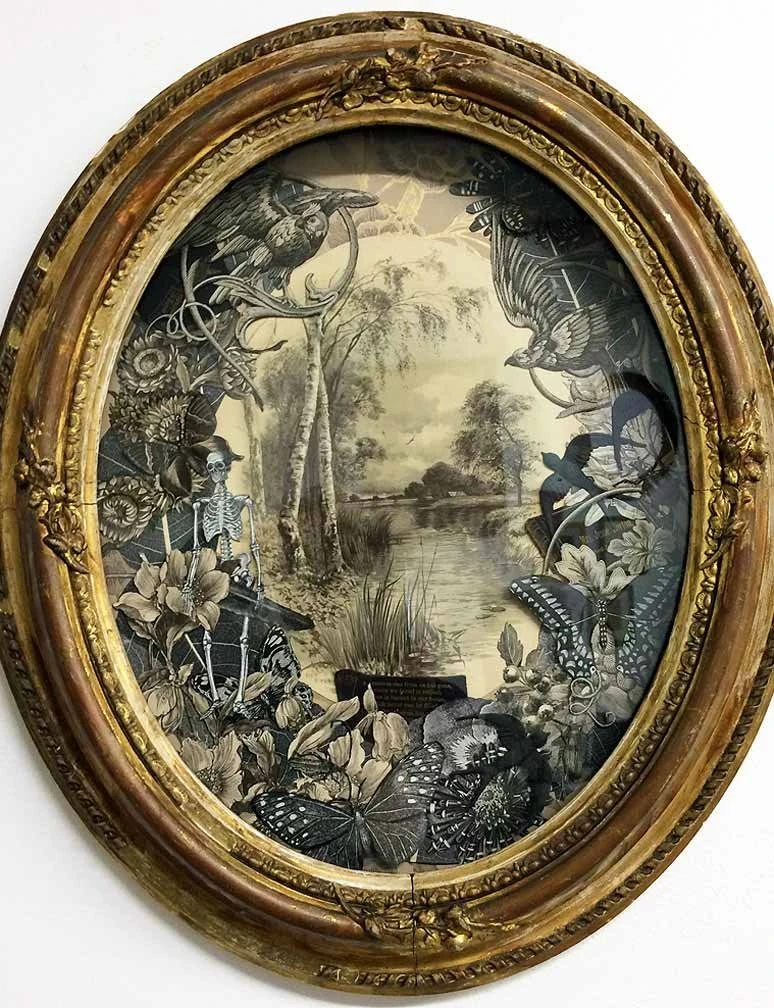
When the Cincinnati Public Library or the Art Academy or Cincinnati Art Museum dispose of old periodicals, as they do now and then, Pearce is perhaps the first to respond. “I got some things last month,” she told me with considerable pleasure. Nineteenth century Harper’s Magazines are catnip to this artist, and she says “I’m obsessed with Godey’s Ladies Book. I love the ads.” She calls the magazine “a history of women” and has a bound edition complete for 1855 as well as many other individual issues. Single pages and portions of pages become a basis for her art.
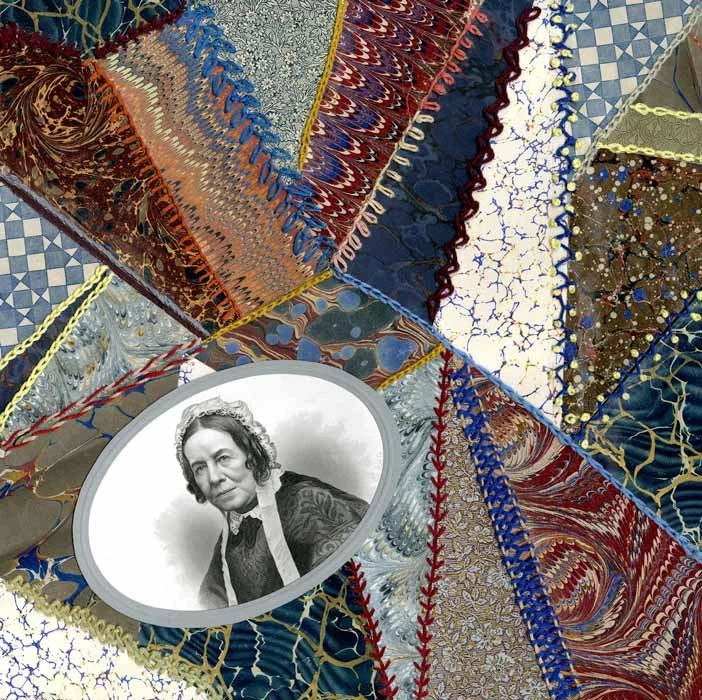
Sara Pearce, quilt square: Sarah Josepha Hale.
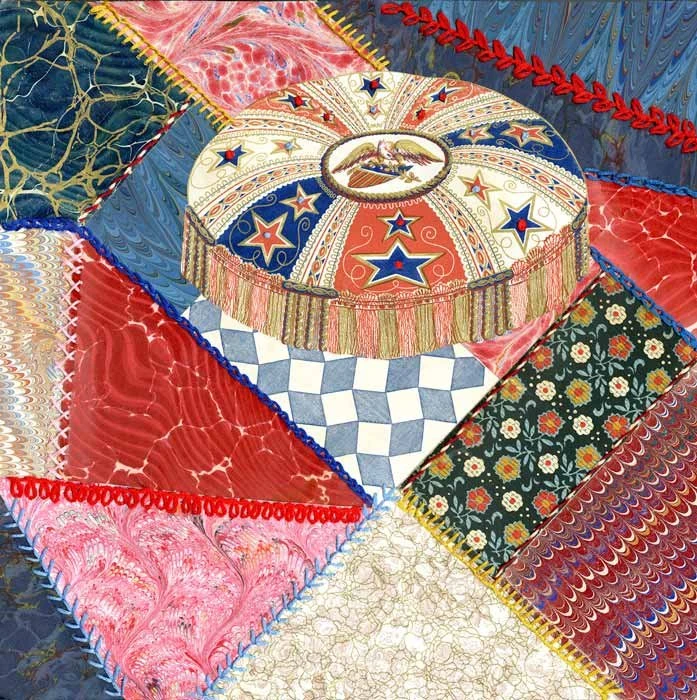
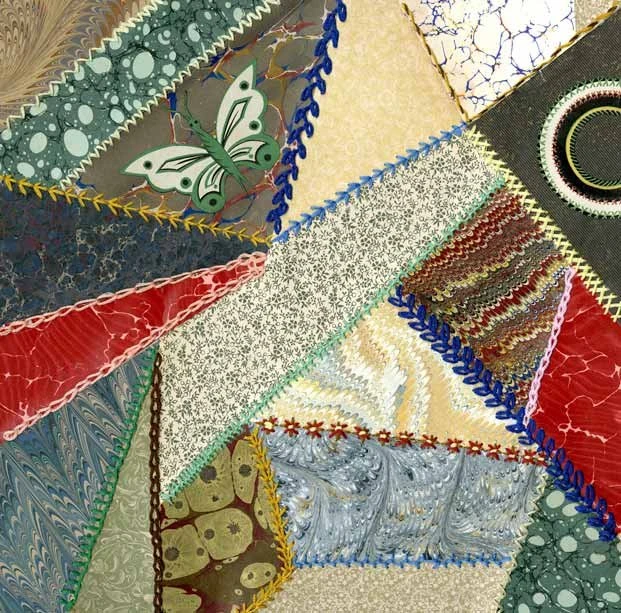
Godey’s Ladies Book was written by both men and women and Sarah Josepha Hale was the socially conscious editor, Pearce told me. Its readers would no doubt relate to a recent project of Pearce’s, once they got over their surprise. She has made a series of 12” x 12” embroidered panels, using crazy quilt stitches to connect cuttings of antique end papers, which are in fact pasted down with glue. The end papers, patterned, marbled, illustrated, “were hand embroidered by me, using vintage embroidery thread that had been my mother’s. I learned a lot doing it,” she told me. Like most artists, she seems to find life a continuing learning experience.
Pearce works standing up, like an old-fashioned printer hand setting type, and indeed both her father and grandfather were in the print business. She always gravitated to printing, she says, and standing up – given her line of art – “makes cutting easier.” Her studio has rows of broad, slim drawers topped by working space, narrow aisles between. “Never enough surfaces,” she notes.
Shortly after leaving journalism to establish her next career, as collage artist, a new and unwelcome learning experience intruded into Pearce’s life in the form of Stage IV cancer. It took a year and a half to work through that, but her cancer is not curable. She relapsed in 2015. Her cancer is inactive now, but she remains in treatment with daily medications and chemotherapy once every three weeks.
Some of the old magazines and other sources “are too beautiful to cut up,” the artist says regretfully. She speaks of amazing, large books from the late 1800s, sometimes found in flea markets, and considers dumpsters a useful source for materials. People also give her old frames, publications, ephemera. “I’ll use it selectively,” she says. “I have so much weird stuff.” She showed me a family bible, from England, 1881. “I could talk about paper forever.”
“Paper with a Past” is the phrase she has adopted to explain what she works with and her web site is paperwithapast.com.
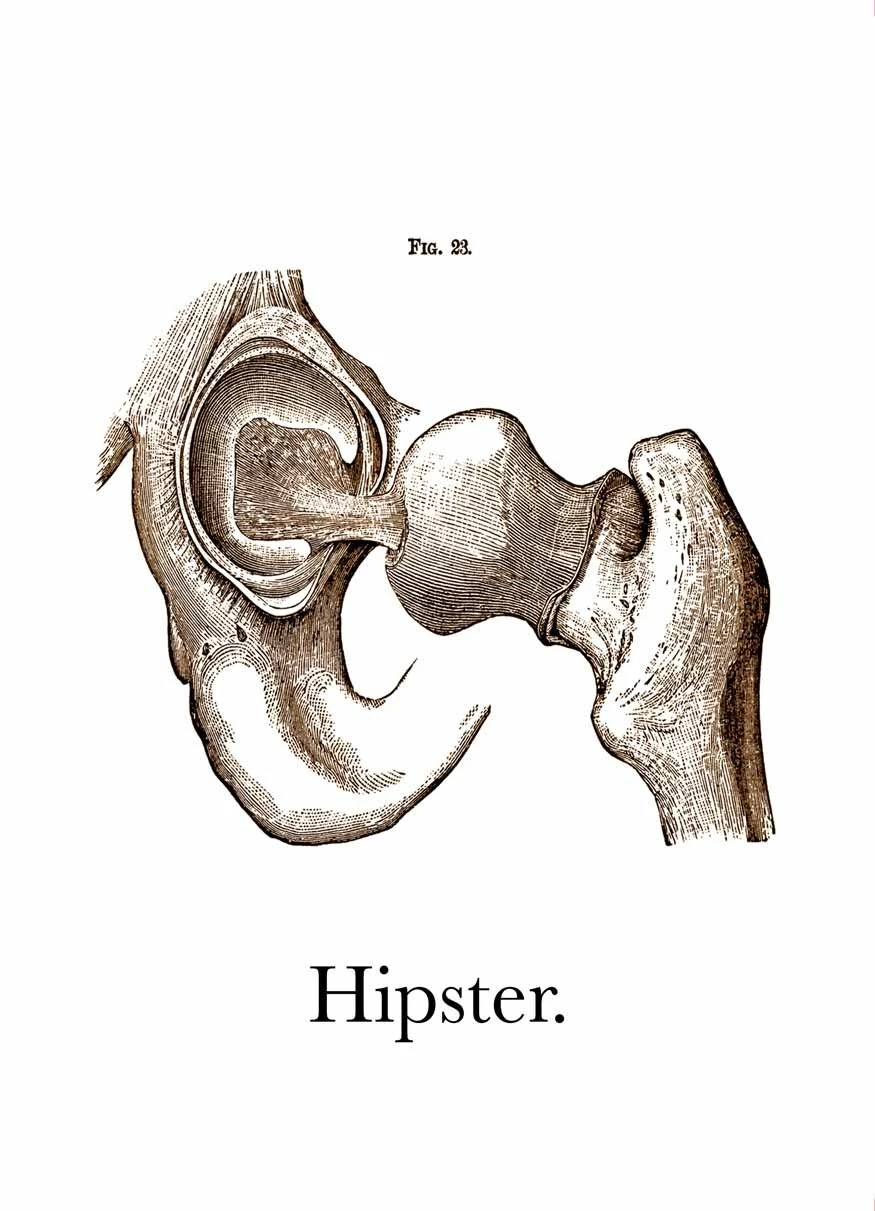
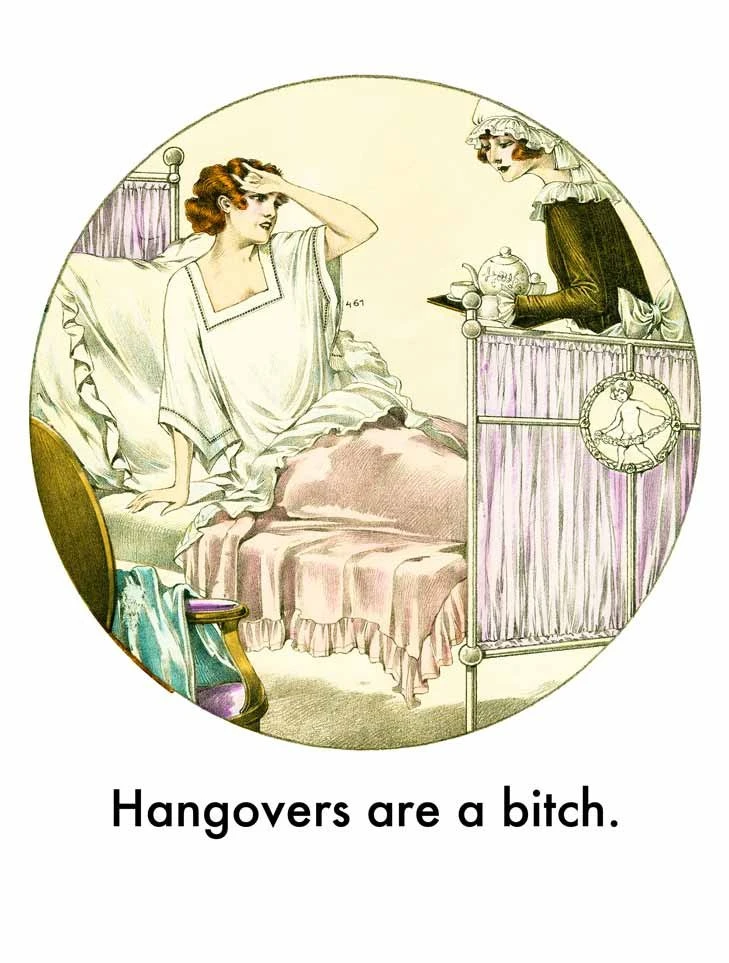
The old Harper’s magazines had few images of women in their illustrations, but Pearce corrects that in a number of works, replacing the men by pasting them over with pictures of appropriately garbed women. It’s interesting to think about how the women who dressed that way would respond to Pearce’s art. Like many, this artist doesn’t consider the fight over and took part in the women’s march in Washington D.C. in January. She wants her art to make substantial statements. Such as: “You are whoever you think you are.” And the follow-up: “Who do you think you are?”
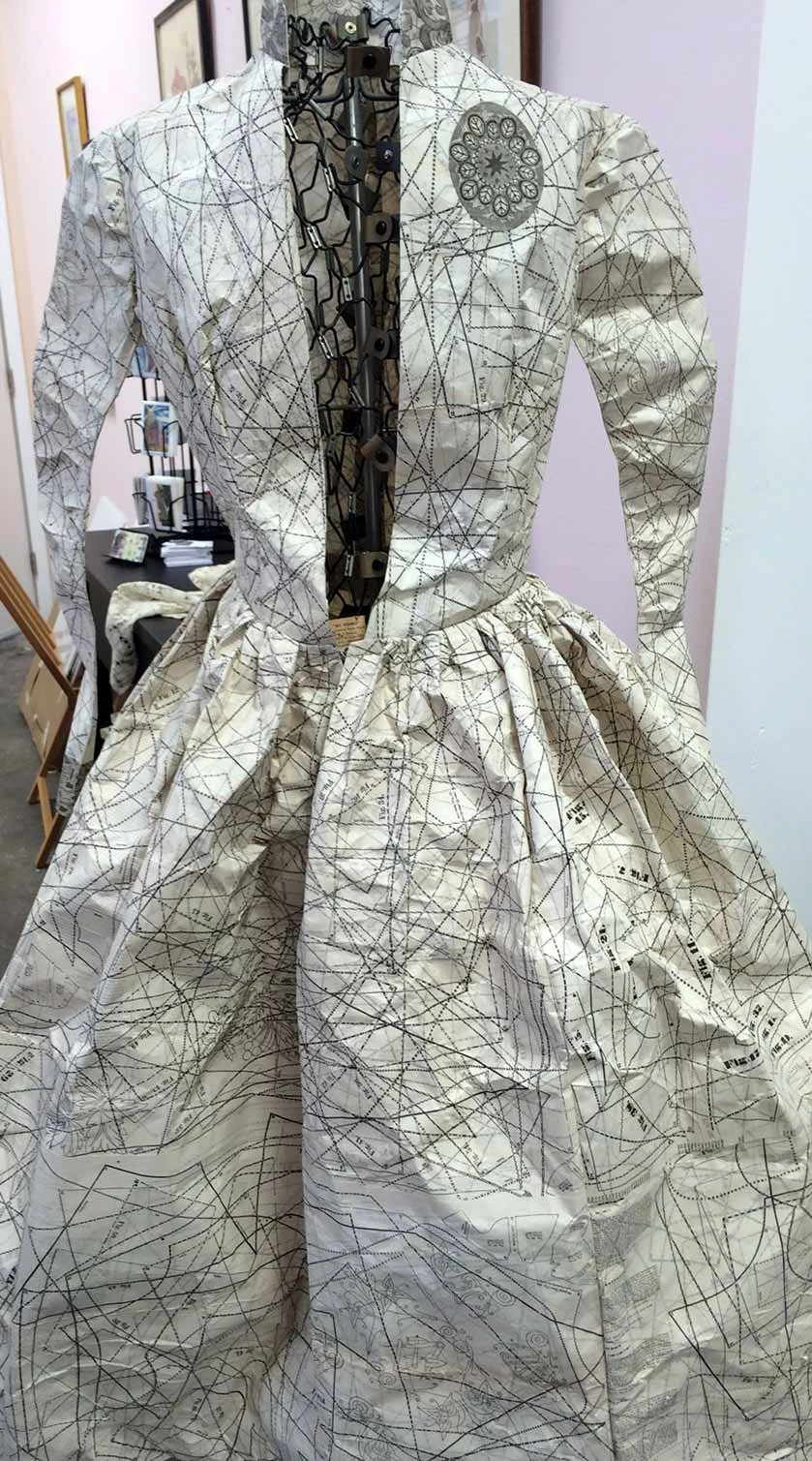
In a solo exhibition last summer at the Loveland (Colorado) Museum of Art Pearce presented collages and 3D paper pieces exploring the role of women in the west in the late 19th century. One of the works in that exhibition was a really astonishing paper dress that could almost be worn by a grown woman – one with a tiny, tiny waist. It is made from actual paper patterns included in 1874 issues of Harper’s Bazaar magazine.
In downtown Cincinnati her work can be seen right now at the gallery she helped to found a few months ago. Gallery 708, at 708 Walnut Street, opened late last year with hours from 11 a.m. to 7 p.m. Tuesday through Saturday and features both fine art and fine craft. Artist owned and operated, this exhibition space came about when new owners of Carew Tower closed the Fifth Street Gallery there and the artists involved looked for a likely place to relocate. The immediate area to 708 is – surprisingly – a neighborhood of art venues: Weston Art Gallery, Main Library, YWCA Women’s Art Gallery, the Contemporary Arts Center, the 21st Century Museum Hotel.
I stopped by Gallery 708 and was pleased to see some of Pearce’s work outside the crowded precincts of her studio. I think I haven’t mentioned that humor is a pretty consistent feature of what she does, and my notes from what I saw at the gallery reflect that engaging element. “The Grand Tour: Airborne,” a 17 x 21 inch archival print on 100% rag paper, is all in gentle color except for a black and white image of a woman with a view camera, apparently recording the antics of four airborne women above the city’s canals and classic buildings. For another work, in a very subtle move, she has pasted two figures on the inside of the protective glass. They actually cast shadows on the image itself, a first in my experience of looking at art. Among the things she spoke of is her strong preference for non-reflective glass in framing but she didn’t say anything about using it as a base.
Still another Pearce work in the 708 exhibition shows a fish among trees, somewhere she presents a couple of butterflies larger than life, and elsewhere are three women, one with a large saw, another with an axe and the third with binoculars. All this is meticulously executed, incongruity given dignity.
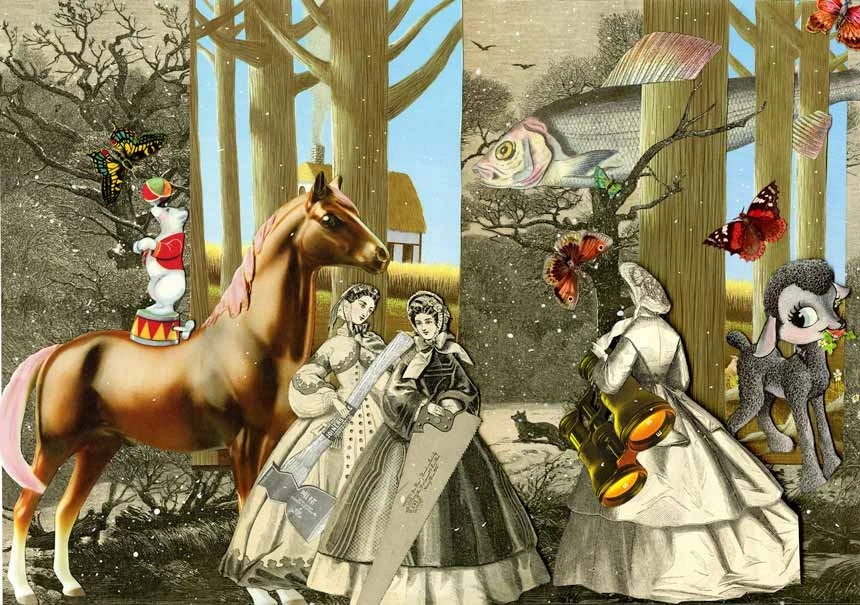
Sara Pearce, Rocky Mountain High: Cecie, Inez and Lillian Begin to Wonder About the Brownies They Ate For Dessert.
Titles are another source of pleasure. I particularly enjoyed the far west landscape, populated by 19th c. ladies looking faintly disturbed, called “Rocky Mountain High: Cecie, Inez and Lillian Begin to Wonder About the Brownies They Ate For Dessert.” Am not at all sure brownies had yet been thought of, when such women were visiting the Rocky Mountains, but playing fast and loose with time frame is an artistic privilege. A sampling of other titles includes “Stilled Life,” “Midnight Gambol: Or Why The Bees Slept In Every Morning” and “Miracles: Behold, Beets.”