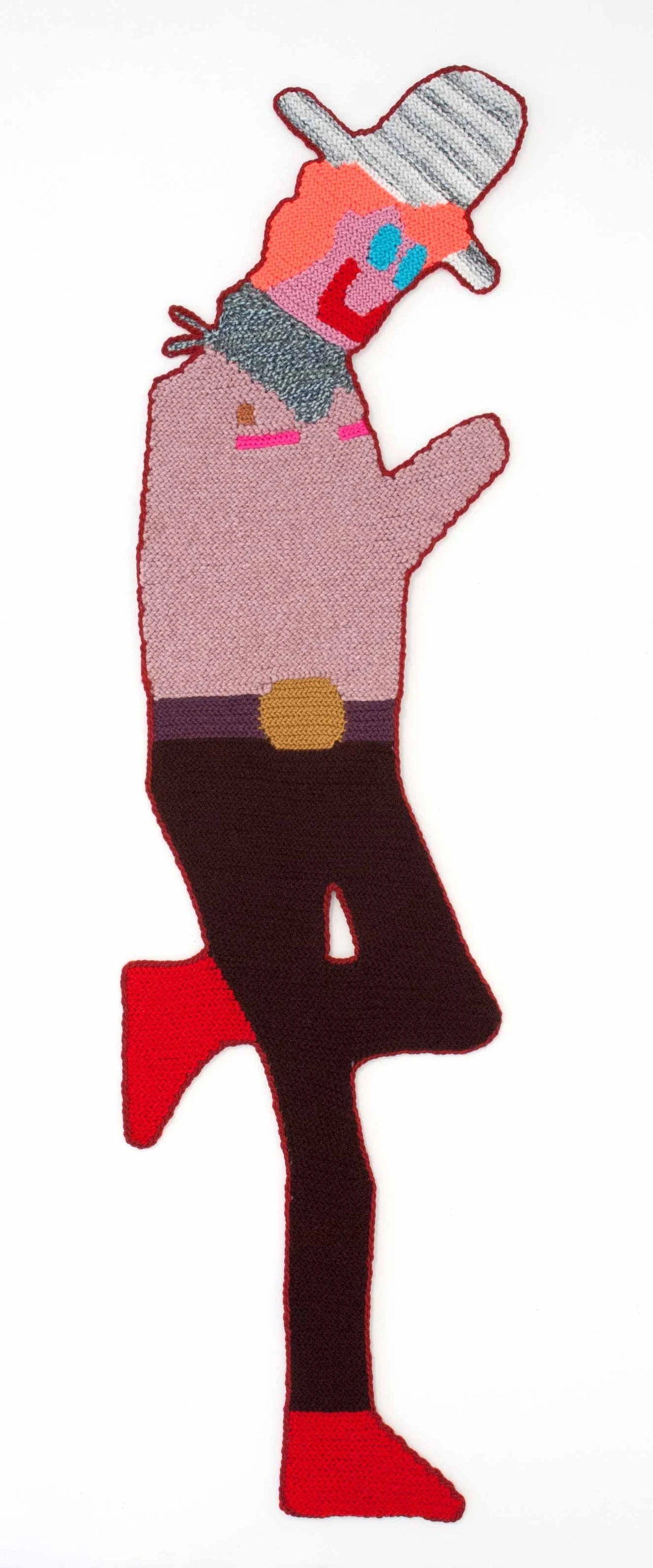
This can be seen in Chandler’s Mr. Fisty (FIG. 4) which collides Americana archetypes, queer sex practice, geography, camp, race and also hair color, frequently red, as that of greatest difference, or the most recessive gene.34 Further Haraway speaks of the cyborg as “…an effort to….in the utopian tradition of imagining a world without gender, which is perhaps a world without genesis, but maybe also a world without end.”35 Eliding the specifically socialist-feminist aspect of Haraway’s method, Chandler’s characters seem to negotiate space in a very similar manner; how they negotiate labor wouldn’t seem readily available. However, on a relative note to that end, in an interview with Iva Kinnaird Chandler discusses Mike Kelley’s (1954-2012) crocheted work as only ever possible because of the work already done by feminism, and that this seems to have been smudged out of his work. While it is not held herein that Chandler’s work is as concretely or radically imaginative as Haraway’s cyborgs contend, there are many similarities. The characters in Caroline’s queer communities are located in a world that is effectively post-gender and all-queer, interestingly, Chandler’s work would also seem unalienated in its labor, and also transcendent.36
The bodies, altered by surgery, that he suggests echo the cyborg where people are “not afraid of permanently partial identities and contradictory orientations of self. The political struggle is to see from both denominations gleaning possible understanding from the opposite vantage.”37 This sentiment in turn reflects the interview conducted for this essay where Chandler ponders gender:
Maybe the culture needs to adopt the idea that women are men that were told they were women and men are women that were told they were men. Aside from sex and gender there is the permeable membrane of embodiment which I refer to as ‘the third layer’ and that is where things get really interesting.38
This suggests an intermediary. Finally, in describing the cyborg Haraway suggests that feminists must generate a parsed and put back together “postmodern collective” subjectivity, that is also personal.39 Does this not resonate Chandler’s third layer? Finally, and eerily, in the manifesto’s last passage Haraway writes of a “common language” which relates to Chandler’s earlier works serving as a sort of alphabet, and concludes the manifesto writing: “Though both are bound in the spiral dance I would rather be a cyborg than goddess.” This last passage would seem to indicate the process of crochet (twerkw) in “the spiral dance.”40,41
In summation of this section of bodies it seems pertinent to link Chandler’s bodies to Halberstam’s fluxing “gaga genders,” that exist outside the binary in the margins and spaces abandoned by normativity having “…multiplied like computer viruses in late capitalist cultures.”42 Also relevant is Foucault’s Utopian Body, discussed by Barabara Paul in P.L.O.G.S.:
“Utopia is a place outside all places, but it is a place where I will have a body without body…Untethered, invisible, protected—always transfigured….{Utopia is}The land of fairies, land of gnomes, of genies, magicians…It is the land where you’re visible when you want, invisible when you desire.”43
Strangely, cosmically perhaps, this language seems to suggest Caroline’s work, which often cites “…mythology, animism, alchemy, Lambic beer, symbolism, tarot card, metaphysics, psychedelia, and shamanism, specifically the traditions of the Shipibo Indians, Siberian genderqueer shamanism, and the Winnebago concept of the trickster for clarity.”44
Lastly, Jackson Davidow (b.1990) in his essay Beyond the Binary: The Gender Neutral in JJ Levine’s Queer Portraits, speaks about the formal operation of gender that’s held in Levine’s portraits. They speak gender identity, without speaking about it, through a neutral silence that speaks simply, effectively “…spurning the game of interpretation that perpetuates the policing of sexist binary notions of gender.”45 Chandler’s works operate in a similar fashion, perhaps though without silence as they queer the binary through what Chandler refers to as the “third layer.”46
Moving forward the body extends into community inhabited by embodiments of heroes and friends of the future and the past, Chandler seems to occupy a space of consciously playful perversity that enacts queer time, and this is where the conversation of temporality and horizonal imagination will depart.
Time and Horizons
Time, in capitalist society, moves in a line from a beginning toward an end. Halberstam explains a temporality that is oriented along lines of profit and accumulation, that time can be owned and valued as capital in and of itself, and that there is decorum associated with the time and geographies of business. Halberstam suggests we are conditioned in our responses to time, frustrated by traffic jams, happy to meet a deadline on time, and fashionably late to parties. In these self-associations of temporality, time seems normal, framed in capitalism.47 Halberstam’s In a Queer Time and Place has been a valuable resource in understanding queer time as it relates both to functions of community and worlding. Halberstam’s theorization of queer time importantly realizes the heteronormative structures of “family-time.”48 In opposition Halberstam refers to subcultural subjects who are found working when others sleep in abandoned spaces, or in spaces that might be domestic for many others; the living room becomes a studio, the kitchen becomes half woodshop.49 Additionally, people who live non-normatively face risks and financial realities “outside the organizations of time and space that have been established for the purposes of protecting the rich from everyone else.”50 Halberstam’s discussion of temporality defines oppositional cultures as being temporally incongruous, that the sexual flow of time and space speak to the quality of hegemony, and finally that queerness challenges the structures as currently exist.51
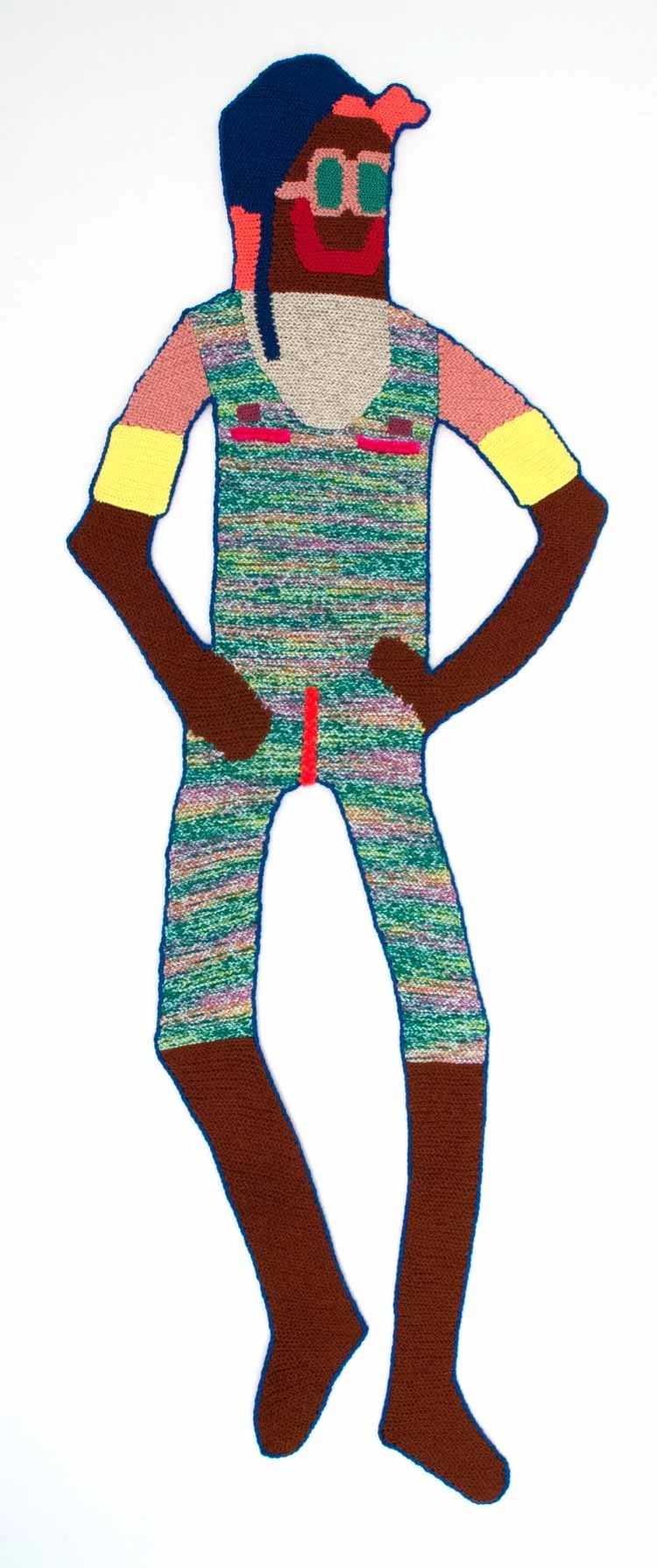
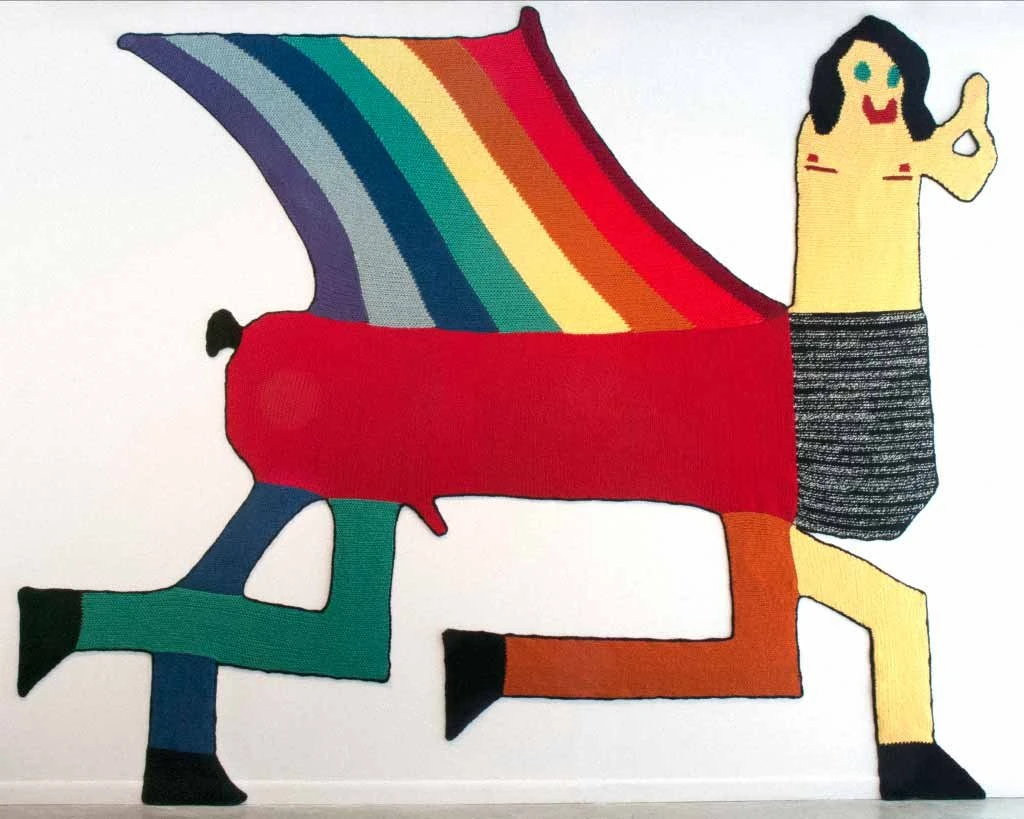
In summation it seems appropriate to discuss Icaro (Fig. 10). According to Chandler Icaro is misspelled to reflect Carl Jung’s (1875-1961) structure for the self in the process of individualization. The correct spelling of the name ends in “us” which implies a perilous integration of the self. An icaro is futher a song learned from plant spirits and sung by Shipibo Indians in ayahuasca ceremonies. Through tonality the shaman creates a synthetic visual landscape of color for the traveler. The etymology of icaro is the Quechua word ikaray which means to blow smoke to heal.71 In all of these ways we see the modus operandi of Chandler’s work becomes visible. The twelve foot tall Icaro is combinative as a centaur, and yet signified as singular in his identity by misspelling of his name. This duality implies the coterminous nature of relational queerness, that subjectivity is originated of many parts. By implying the ayahuasca ceremony Chandler suggests that life’s journey is uncannily strange and also must be visionary. The implication of the word ikaray speaks to the healing discovered in affirmative space of community. The fact that Icaro has something of a penis but then also top scars suggests freedom of play, and freedom of choice, and chimerical infinity. His happy disposition suggests the hopeful future, and his rainbow cape lends importance and a dose of campy confidence.
Bibliography
Batchelor, David. Chromophobia. London: Reaktion, 2000.
Berlant, Lauren, and Michael Warner. “Sex in Public.” Critical Inquiry 24, no. 2, Intimacy (January 01, 1998): 547-66. Accessed December 02, 2016.
Bradford, Katherine. “The Best Little Whore House in Texas.” The Best Little Whore House in Texas. December 24, 2015. Accessed September 18, 2016.
Britton, Lauren, and Caroline Wells Chandler. “Caroline Wells Chandler.” Caroline Wells Chandler By Lauren Britton Caroline Wells Chandler’s Latest Exhibition Homunculus Is on View at Field Projects Gallery in. Accessed November 27, 2016.
Burns, Emily. “Caroline Wells Chandler.” Maake Magazine. 2016. Accessed September 18, 2016.
Chandler, Caroline Wells, and Stacy Yeapanis. “OtherPeoplesPixels Interviews Caroline Wells Chandler.” OtherPeoplesPixels Blog. 2013. Accessed November 28, 2016.
Chandler, Caroline Wells. “Caroline Wells Chandler on Katherine Bradford.” Painters On Paintings. October 03, 2016. Accessed November 27, 2016.
Chandler, Caroline Wells. “A Conversation of Queer Aesthetics with Caroline Wells Chandler.” Online interview by author. November 26, 2016.
Chandler, Caroline Wells. “Notes on Trolls: Artist Statement.” Rema Hort Mann Foundation. Accessed November 28, 2016.
Davidow, Jackson. “Beyond the Binary: The Gender Neutral in JJ Levine’s Queer Portraits.” In Otherwise: Imagining Queer Feminist Art Histories, edited by Amelia Jones and Erin Silver, 304-19. Manchester, UK: Manchester University Press, 2016.
Davis, Vaginal, Kaucyila Brooke, and Daniel Hendrickson. “A Chart of Universal History Kaucyila Brooke and Vaginal Davis in Conversation with Daniel Hendrickson.” In Pink Labor on Golden Streets: Queer Art Practices, edited by Christiane Erharter, Dietmar Schwärzler, Ruby Sircar, and Hans Scheirl, 122-35. Berlin: Sternberg Press, 2015.
Davis, Whitney. Queer Beauty: Sexuality and Aesthetics from Winckelmann to Freud and beyond. New York: Columbia University Press, 2010.
“Editors and Fugitives Ulrike Müllwe in Conversation with Harmony Hammond.” In Pink Labor on Golden Streets: Queer Art Practices, edited by Christiane Erharter, Dietmar Schwärzler, Ruby Sircar, and Hans Scheirl, by Ulrike Müller and Harmony Hammond, 151-61. Berlin: Sternberg Press, 2015.
Erharter, Christiane, Dietmar Schwärzler, Ruby Sircar, and Hans Scheirl, eds. Pink Labor on Golden Streets: Queer Art Practices. Berlin: Sternberg Press, 2015.
Fusselman, Amy, and Caroline Chandler. “Ohio Interviews: Caroline Wells Chandler.” Ohio Edit. June 4, 2015. Accessed November 27, 2016.
Getsy, David J., and Williams J. Simmons. “Appearing Differently Abstraction’s Transgender and Queer Capacities.” In Pink Labor on Golden Streets: Queer Art Practices, edited by Christiane Erharter, Dietmar Schwärzler, Ruby Sircar, and Hans Scheirl, 39-55. Berlin: Sternberg Press, 2015.
Halberstam, Judith. Gaga Feminism: Sex, Gender, and the End of Normal. Boston: Beacon Press, 2012.
Halberstam, Judith. In a Queer Time and Place: Transgender Bodies, Subcultural Lives. New York: New York University Press, 2005.
Haraway, Donna Jeanne. A Cyborg Manifesto: Science, Technology, and Socialist-feminism in the Late Twentieth Century. 2009.
Heidenreich, Nanna. “Eyelips; On Tejal Shah’s Between the Waves.” Edited by Christiane Erharter, Dietmar Schwärzler, Ruby Sircar, and Hans Scheirl. In Pink Labor on Golden Streets: Queer Art Practices, 56-67. Berlin: Sternberg Press, 2015.
Jones, Amelia, and Erin Silver, eds. Otherwise: Imagining Queer Feminist Art Histories. Manchester, UK: Manchester University Press, 2016.
Jones, Amelia, Erin Silver, and Johnathan D. Katz. Otherwise: Imagining Queer Feminist Art Histories. Edited by Amelia Jones and Erin Silver. Manchester, UK: Manchester University Press, 2016.
Jones, Amelia. “Every Man Knows Where and How Beauty Gives Him Pleasure Beauty Discourse and the Logic of Aesthetics.” In The Art of Art History: A Critical Anthology, edited by Donald Preziosi. Oxford: Oxford University Press, 1998.
Kinnaird, Iva, and Caroline Wells Chandler. “‘Queering the Lines'” OutSmart Magazine. March 26, 2015. Accessed November 28, 2016.
Logue Deirdre, Allyson Mitchell, and Helena Reckitt. “Not at the Beginning and Not at the End.” In Otherwise: Imagining Queer Feminist Art Histories, edited by Amelia Jones and Erin Silver, 357-71. Manchester, UK: Manchester University Press, 2016.
Lorde, Audre. Sister Outsider: Essays and Speeches. Trumansburg, NY: Crossing Press, 1984.
Lorenz, Renate. Queer Art: A Freak Theory. Bielefeld: Transcript, 2012.
Munõz, José Esteban. Cruising Utopia: The Then and There of Queer Futurity. New York: New York University Press, 2009.
Mulvey, Laura. Visual and Other Pleasures. Bloomington: Indiana UP, 1989. Print.
“On the Site of Her Own Exclusion: Strategizing Queer Feminist Art History.” In Otherwise: Imagining Queer Feminist Art Histories, edited by Amelia Jones and Erin Silver, by Dore Bowen, 145-59. Manchester, UK: Manchester University Press, 2016.
Paul, Barbara. “Between ‘Bodies without Bodies’ and Body Landscapes, Queer Artistic Negotiations.” In Pink Labor on Golden Streets: Queer Art Practices, edited by Christiane Erharter, Dietmar Schwärzler, Ruby Sircar, and Hans Scheirl, 239-48. Berlin: Sternberg Press, 2015.
Scheirl, Hans, and Jakob Lena Knebl. Pink Labor on Golden Streets: Queer Art Practices. Edited by Christiane Erharter and Dietmar Schwärzler. By Ruby Sircar. Berlin: Sternberg Press, 2015. 29-37.
Steinhauer, Jillian. “Crocheting a Queer Vision of Art History.” Hyperallergic RSS. February 24, 2016. Accessed September 18, 2016.
1 Christiane Erharter et al., eds., Pink Labor on Golden Streets: Queer Art Practices (Berlin: Sternberg Press, 2015), pg.11.
2 Dates were undiscoverable, any dates of identified persons that would seem missing from here on out are only not included if they could not be found.
3 Pink labor on Golden Streets will be Referred to as P.L.O.G.S. from here on out.
4 Amelia Jones, “Every Man Knows Where and How Beauty Gives Him Pleasure Beauty Discourse and the Logic of Aesthetics,” in The Art of Art History: A Critical Anthology, ed. Donald Preziosi (Oxford: Oxford University Press, 1998), pg.388.
5 Vaginal Davis, Kaucyila Brooke, and Daniel Hendrickson, “A Chart of Universal History Kaucyila Brooke and Vaginal Davis in Conversation with Daniel Hendrickson,” in Pink Labor on Golden Streets: Queer Art Practices, ed. Christiane Erharter, Dietmar SchwäÌrzler, Ruby Sircar, and Hans Scheirl (Berlin: Sternberg Press, 2015), pg.134.
6 Katherine Bradford, “The Best Little Whore House in Texas,” The Best Little Whore House in Texas, December 24, 2015, accessed September 18, 2016.
7 Ibid.
8 “On the Site of Her Own Exclusion: Strategizing Queer Feminist Art History,” in Otherwise: Imagining Queer Feminist Art Histories, ed. Amelia Jones and Erin Silver, by Dore Bowen (Manchester, UK: Manchester University Press, 2016), pg. 147.
9 Laura Mulvey. Visual and Other Pleasures. Bloomington: Indiana UP, 1989. Print.
10 Katherine Bradford, “The Best Little Whore House in Texas,” The Best Little Whore House in Texas, December 24, 2015, accessed September 18, 2016.
11 Katherine Bradford, “The Best Little Whore House in Texas,” The Best Little Whore House in Texas, December 24, 2015, accessed September 18, 2016.
12 Renate Lorenz, Queer Art: A Freak Theory (Bielefeld: Transcript, 2012), pg. 134.
13 Amelia Jones, Erin Silver, and Johnathan D. Katz, Otherwise: Imagining Queer Feminist Art Histories, ed. Amelia Jones and Erin Silver (Manchester, UK: Manchester University Press, 2016), pg. 80.
14
15 David J. Getsy and Williams J. Simmons, “Appearing Differently Abstraction’s Transgender and Queer Capacities,” in Pink Labor on Golden Streets: Queer Art Practices, ed. Christiane Erharter, Dietmar SchwäÌrzler, Ruby Sircar, and Hans Scheirl (Berlin: Sternberg Press, 2015), pg.39.
16 Caroline Wells Chandler, “A Conversation of Queer Aesthetics with Caroline Wells Chandler,” online interview by author, November 26, 2016.
17 The question posed oddly enough was about Marxism.
18 Iva Kinnaird and Caroline Wells Chandler, “‘Queering the Lines'” OutSmart Magazine, March 26, 2015, accessed November 28, 2016.
19 Audre Lorde, Sister Outsider: Essays and Speeches (Trumansburg, NY: Crossing Press, 1984), pg.53.
20 Judith Jack Halberstam, In a Queer Time and Place: Transgender Bodies, Subcultural Lives (New York: New York University Press, 2005), pg.116.
21 Emily Burns, “Caroline Wells Chandler,” Maake Magazine, 2016, accessed September 18, 2016.
22 David J. Getsy and Williams J. Simmons, “Appearing Differently Abstraction’s Transgender and Queer Capacities,” in Pink Labor on Golden Streets: Queer Art Practices, ed. Christiane Erharter, Dietmar SchwäÌrzler, Ruby Sircar, and Hans Scheirl (Berlin: Sternberg Press, 2015), pg.51.
23 Getsy originally said “critique of relationality,” which I changed syntactically, but not so as to swap meanings.
24 Nanna Heidenreich, “Eyelips; On Tejal Shah’s Between the Waves,” ed. Christiane Erharter, Dietmar SchwäÌrzler, Ruby Sircar, and Hans Scheirl, in Pink Labor on Golden Streets: Queer Art Practices (Berlin: Sternberg Press, 2015), pg.63.
25 Caroline Wells Chandler, “A Conversation of Queer Aesthetics with Caroline Wells Chandler,” online interview by author, November 26, 2016.
26 Katherine Bradford, “The Best Little Whore House in Texas,” The Best Little Whore House in Texas, December 24, 2015, accessed September 18, 2016.
27 Audre Lorde, Sister Outsider: Essays and Speeches (Trumansburg, NY: Crossing Press, 1984), pg.53.
28 Judith Jack Halberstam, In a Queer Time and Place: Transgender Bodies, Subcultural Lives (New York: New York University Press, 2005), pg.120.
29 David Batchelor, Chromophobia (London: Reaktion, 2000), pg.22.
30 Katherine Bradford, “The Best Little Whore House in Texas,” The Best Little Whore House in Texas, December 24, 2015, accessed September 18, 2016.
31 Caroline Wells Chandler, “Notes on Trolls: Artist Statement,” Rema Hort Mann Foundation, accessed November 28, 2016.
32 Donna Jeanne. Haraway, A Cyborg Manifesto: Science, Technology, and Socialist-feminism in the Late Twentieth Century (2009), pg.149.
33 Donna Jeanne. Haraway, A Cyborg Manifesto: Science, Technology, and Socialist-feminism in the Late Twentieth Century (2009), pg.150.
34 Katherine Bradford, “The Best Little Whore House in Texas,” The Best Little Whore House in Texas, December 24, 2015, accessed September 18, 2016.
35 Donna Jeanne. Haraway, A Cyborg Manifesto: Science, Technology, and Socialist-feminism in the Late Twentieth Century (2009), pg.150.
36 Donna Jeanne. Haraway, A Cyborg Manifesto: Science, Technology, and Socialist-feminism in the Late Twentieth Century (2009), pg.150.
37 Donna Jeanne. Haraway, A Cyborg Manifesto: Science, Technology, and Socialist-feminism in the Late Twentieth Century (2009), pg.154.
38 Caroline Wells Chandler, “A Conversation of Queer Aesthetics with Caroline Wells Chandler,” online interview by author, November 26, 2016.
39 Donna Jeanne. Haraway, A Cyborg Manifesto: Science, Technology, and Socialist-feminism in the Late Twentieth Century (2009), pg.163.
40 Katherine Bradford, “The Best Little Whore House in Texas,” The Best Little Whore House in Texas, December 24, 2015, accessed September 18, 2016.
41 Lauren Britton and Caroline Wells Chandler, “Caroline Wells Chandler,” Caroline Wells Chandler By Lauren Britton Caroline Wells Chandler’s Latest Exhibition Homunculus Is on View at Field Projects Gallery in: pg. #, accessed November 27, 2016.
42 Judith JackHalberstam, Gaga Feminism: Sex, Gender, and the End of Normal(Boston: Beacon Press, 2012), pg.71.
43 Michel Foucault. “Utopian Body.” In Sensorium: Embodied Experience, Technology, and Contemporary Art. Edited by Caroline A. Jones. Cited in, Barbara Paul, “Between ‘Bodies without Bodies’ and Body Landscapes, Queer Artistic Negotiations,” in Pink Labor on Golden Streets: Queer Art Practices, ed. Christiane Erharter, Dietmar SchwäÌrzler, Ruby Sircar, and Hans Scheirl (Berlin: Sternberg Press, 2015), pg.242.
44 Caroline Wells Chandler, “A Conversation of Queer Aesthetics with Caroline Wells Chandler,” online interview by author, November 26, 2016.
45 Jackson Davidow, “Beyond the Binary: The Gender Neautral in JJ Levine’s Queer Portraits,” in Otherwise: Imagining Queer Feminist Art Histories, ed. Amelia Jones and Erin Silver (Manchester, UK: Manchester University Press, 2016), pg. 313.
46 Caroline Wells Chandler, “A Conversation of Queer Aesthetics with Caroline Wells Chandler,” online interview by author, November 26, 2016.
47 Judith Jack Halberstam, In a Queer Time and Place: Transgender Bodies, Subcultural Lives (New York: New York University Press, 2005), pg.7.
48 Ibid.pg.10.
49 Ibid.
50 Ibid.
51 Ibid. pg.13.
52 Jillian Steinhauer, “Crocheting a Queer Vision of Art History,” Hyperallergic RSS, February 24, 2016, accessed September 18, 2016.
53 Emily Burns, “Caroline Wells Chandler,” Maake Magazine, 2016, accessed September 18, 2016.
54 Ibid.
55 Ibid.
56 Donna Jeanne. Haraway, A Cyborg Manifesto: Science, Technology, and Socialist-feminism in the Late Twentieth Century (2009), pg.151
57 Judith Jack Halberstam, In a Queer Time and Place: Transgender Bodies, Subcultural Lives (New York: New York University Press, 2005), pg.120.
58 Lauren Berlant and Michael Warner, “Sex in Public,” Critical Inquiry 24, no. 2, Intimacy (January 01, 1998): pg. 553, accessed December 02, 2016.
59 Judith Jack Halberstam, In a Queer Time and Place: Transgender Bodies, Subcultural Lives (New York: New York University Press, 2005), pg.174.
60 Renate Lorenz, Queer Art: A Freak Theory (Bielefeld: Transcript, 2012), pg. 74.
61 Judith Jack Halberstam, In a Queer Time and Place: Transgender Bodies, Subcultural Lives (New York: New York University Press, 2005), pg.120.
62 Whitney Davis, Queer Beauty: Sexuality and Aesthetics from Winckelmann to Freud and beyond (New York: Columbia University Press, 2010), pg.27-29.
63 José Esteban. Munõz, Cruising Utopia: The Then and There of Queer Futurity(New York: New York University Press, 2009), pg.11.
64 José Esteban. Munõz, Cruising Utopia: The Then and There of Queer Futurity(New York: New York University Press, 2009), pg.11.
65 Ibid. pg.21.
66 Ibid. pg.25.
67 Ibid. pg.25.
68 José Esteban. Munõz, Cruising Utopia: The Then and There of Queer Futurity(New York: New York University Press, 2009), pg.56.
69 Ibid. pg.91.
70 Ibid. pg.97.
71 Iva Kinnaird and Caroline Wells Chandler, “‘Queering the Lines'” OutSmart Magazine, March 26, 2015, accessed November 28, 2016.