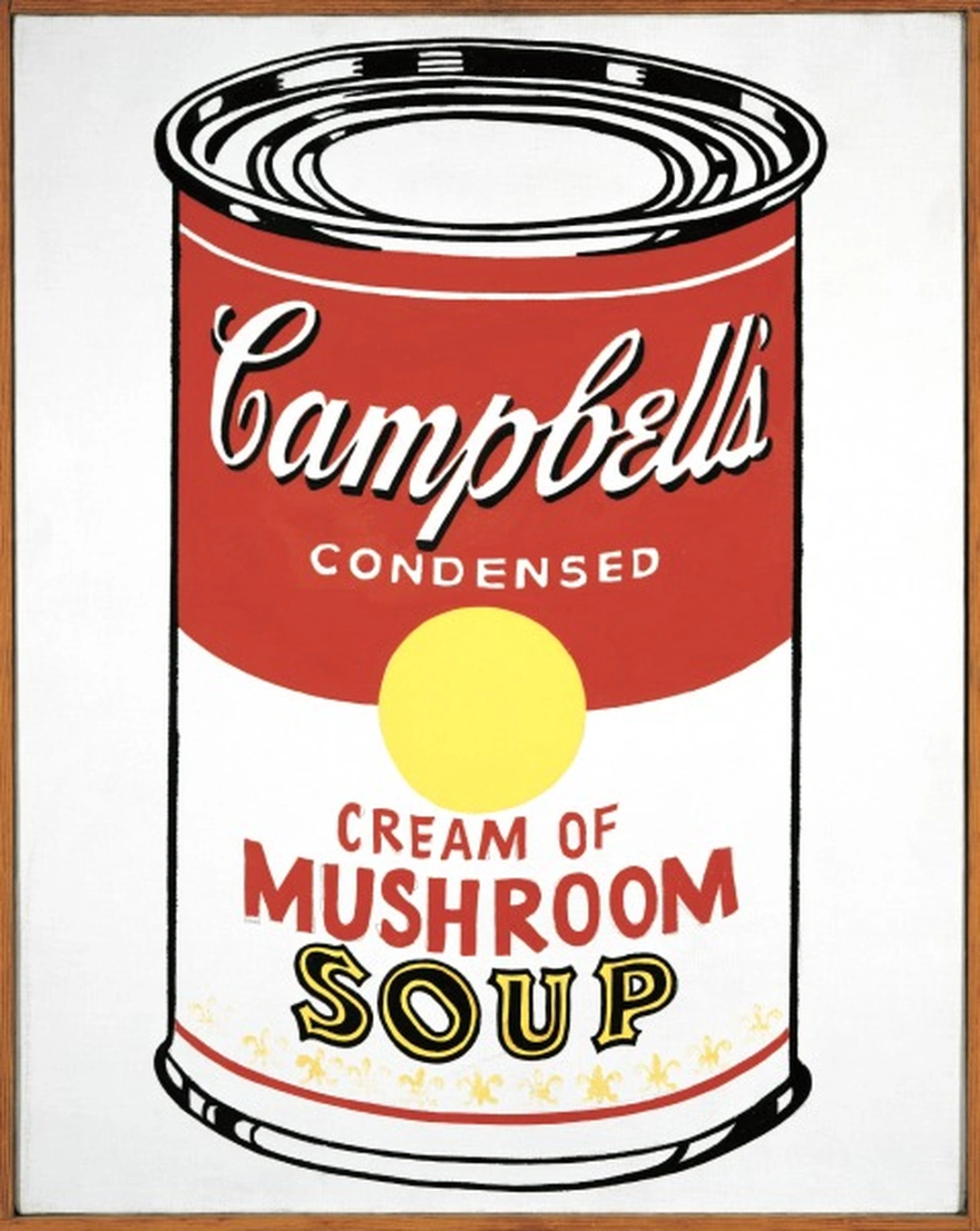
Andy Warhol, Soup Can (Cream of Mushroom), 1962, casein and pencil on linen, 20" x 16". Promised Bequest of Alice F. and Harris K. Weston. L53.2004. Photograph courtesy of the Cincinnati Art Museum.
At the Cincinnati Art Museum, I always breezed through the Schmidlapp Gallery with its antiquities on my way somewhere else. Well, that will never happen again since the gallery has been renovated to present “18 of the Art Museum’s most iconic works of art,” according to the wall text.* That declaration is unnecessary since the dramatic new installation screams “Masterpiece!”
The works—paintings, sculptures, decorative arts, and one photograph–were chosen to represent the Museum’s “core strengths as a collecting institution.” (Just a note: there are no female artists represented.) They’ve been designated “iconic” because “they have such immense power and beauty . . . an icon stays with you, remaining lodged in your memory and echoing through other forms, images, and spaces you encounter.” Okay.
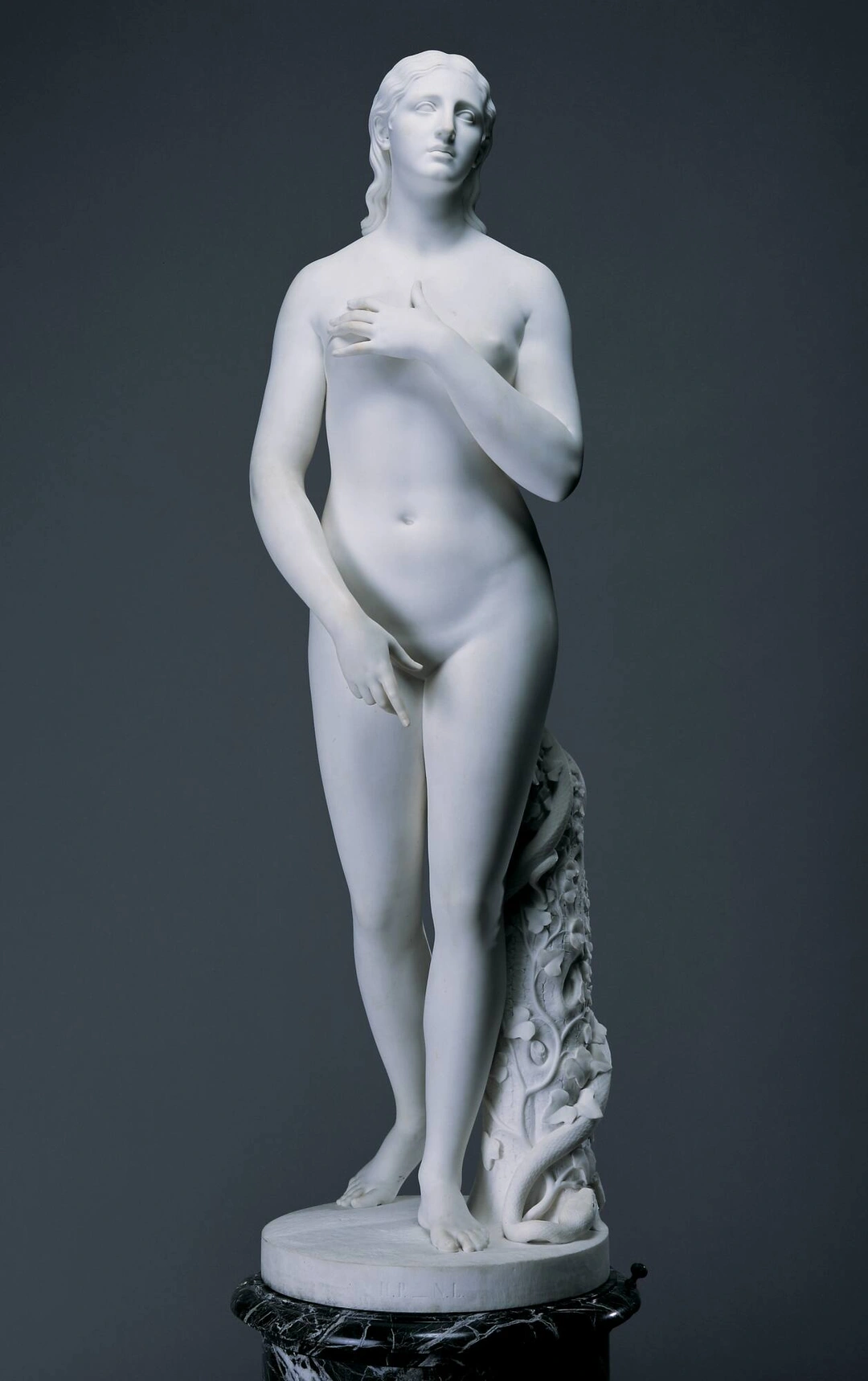
The installation actually starts in the Museum’s stately lobby with the classical Roman nude “Statue of a Greek God or Hero,” mid-1st century AD. Directly behind him, but at a respectful distance, is the neo-classical “Eve Disconsolate,” designed 1858-1873, carved 1872-1877, by Hiram Powers (American, 1805-1873), almost hometown boy as he began his artistic career in Cincinnati.
The statues make an interesting comparison: the real deal and the wanna be. Although realistically carved in marble, both figures are idealized. Because of 19th-century mores, Powers used a Biblical character as cover for depicting a nude. Standing demurely, Eve in faux-modesty covers one breast and hides/accentuates her sex as she points to the snake that did her in. The Greek lets it all hang out.
With his defined musculature and well toned tush, he looks like a guy who, when he isn’t being heroic, spends his time at the gym. Eve stands but without any evidence of skeleton or muscle. Her gently modeled butt isn’t the result of time on a Stairmaster.
Eve represents the taste of her time. She was a gift from Cincinnati arts patron Nicholas Longworth in 1888, just a few years after it was carved and just seven years after the Museum was incorporated and two years after the construction of the Eden Park building. (The Schmidlapp Wing was added in 1907.)
In the not-so-distant past, this academic sculpture might have been relegated to the storeroom. But here Eve is, in all her glory. One museum visitor called her “a naked lady.” (OMG! He didn’t know the difference between “naked” and “nude.”) But he had stopped to “look, pause, and concentrate,” at least for as long as it took to snap a picture of his companions in front of her.
After appreciating Eve’s derrière, you’re plunged into the darkened Schmidlapp Gallery. Each icon is lit theatrically and installed in an “alcove,” created by ceiling-length black fringe curtains curving around each piece. (If I were high-minded, I’d make some comment about fiber art, but truthfully my first reaction was “tango dress!” I need a bumper sticker that says, “I’d rather be tangoing.”)
Hiram Powers, Eve Disconsolate, 1872–1877, marble, 77 1/4" x 27 1/2" x 23 5/8". Gift of Nicholas Longworth. Photograph courtesy of the Cincinnati Art Museum.
On a somewhat higher intellectual plane, the ambience reminded me of the now defunct Steuben Glass store on Manhattan’s Fifth Avenue, a stone’s throw away from the gilded Trump Tower. There, after walking through the functional and decorative objects for sale, you entered a dramatically lit gallery showcasing Steuben’s greatest hits. The Steuben and Museum presentations are precious, in both senses of the word.
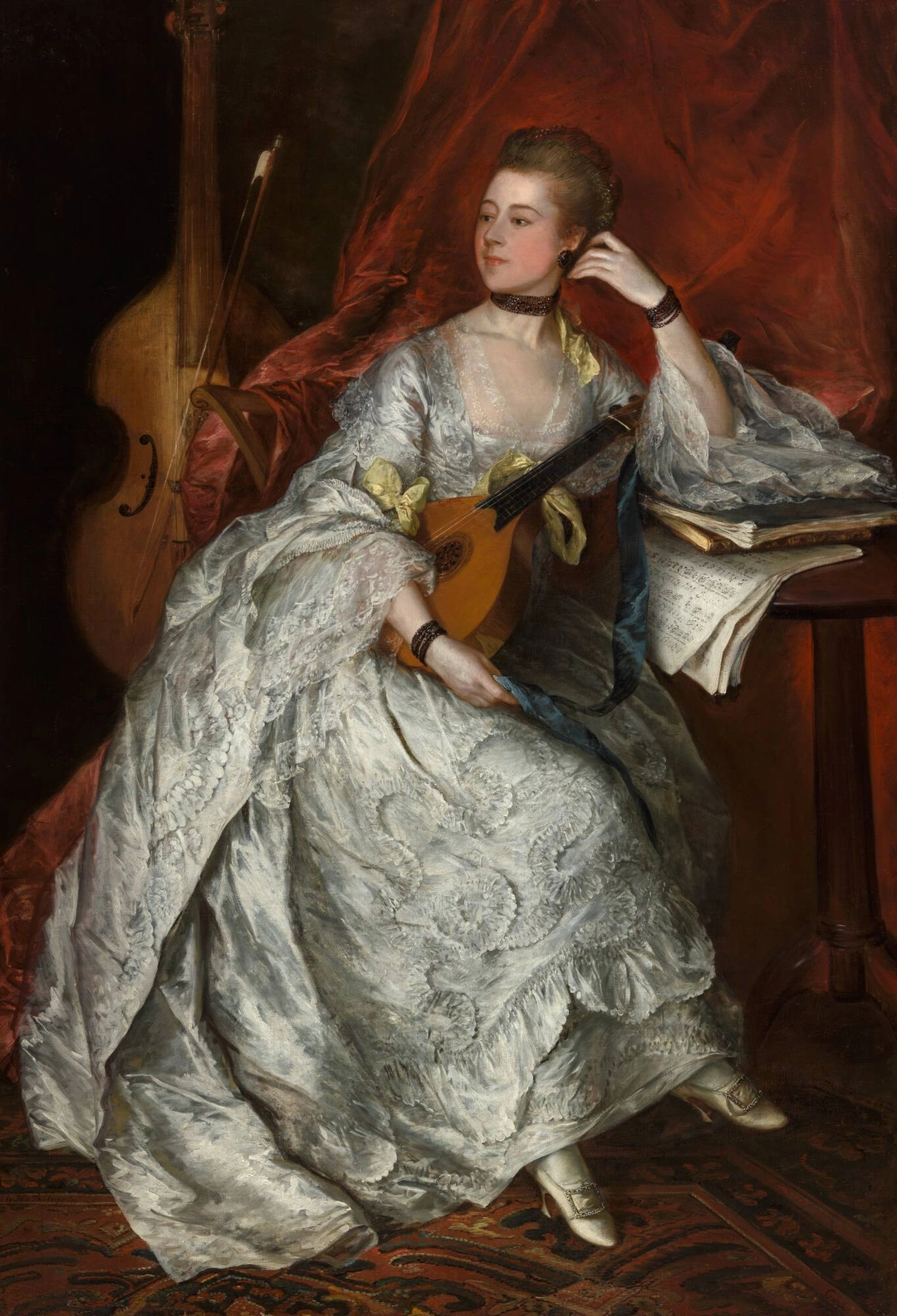
In the gallery proper, the first painting on the left is Thomas Gainsborough’s (English, 1727-1788) “Ann Ford, Later Mrs. Philip Thicknesse,” 1760. The contrite Eve looks heavenward, but Ann, posed rather scandalously with her legs casually crossed, looks with a superior air off to the left.
In the alcove opposite is Anthony van Dyck’s (Flemish, 1599-1641) “Portrait of a Man in Armor (Member of the Spinola Family?),” c. 1621-1627. Like a soldier alert to his surroundings, he also looks beyond the picture plane. Grasping a staff in his right hand, he’s ready for combat. Ann, with her cello behind her (remember the position of how it’s played) could be ready for a romp in her delicious confection of a dress.
The curators who selected the icons appear partial to homegrown talent. Four of the 18 works have strong Cincinnati connections. In addition to Powers, there’s the much lauded Frank Duveneck (American, 1848-1919) represented by the dashing “Whistling Boy,” 1892. The label calls him a “hometown hero painter,” whatever that means, and says that he “stands as a symbol of Cincinnati’s German heritage.”
Also representative of Cincinnati’s artistic richness is the large ceramic “Vase,” 1893. It’s a product from the Rookwood Pottery, founded in 1880 by the hobbyist china painter Maria Longworth Nichols (1849-1932), the granddaughter of Nicholas.
The vase’s size is impressive—nearly 20” high–but so is the decoration by Albert Robert Valentien (1862-1925). He was the first professionally trained artist to be employed by the Pottery and chief decorator from 1881 to 1905. His Japonesque-style drawing of cranes and clouds wraps around the form in a completely organic way.
The vase’s rich high-gloss mahogany glaze, a deep gold, red, and orange over dark brown, was the Pottery’s “standard glaze,” developed to set its production apart. Since the Museum has the largest public collection of Rookwood, I would have loved to have been a fly on the at the deliberations about exactly which piece should be anointed as an icon.
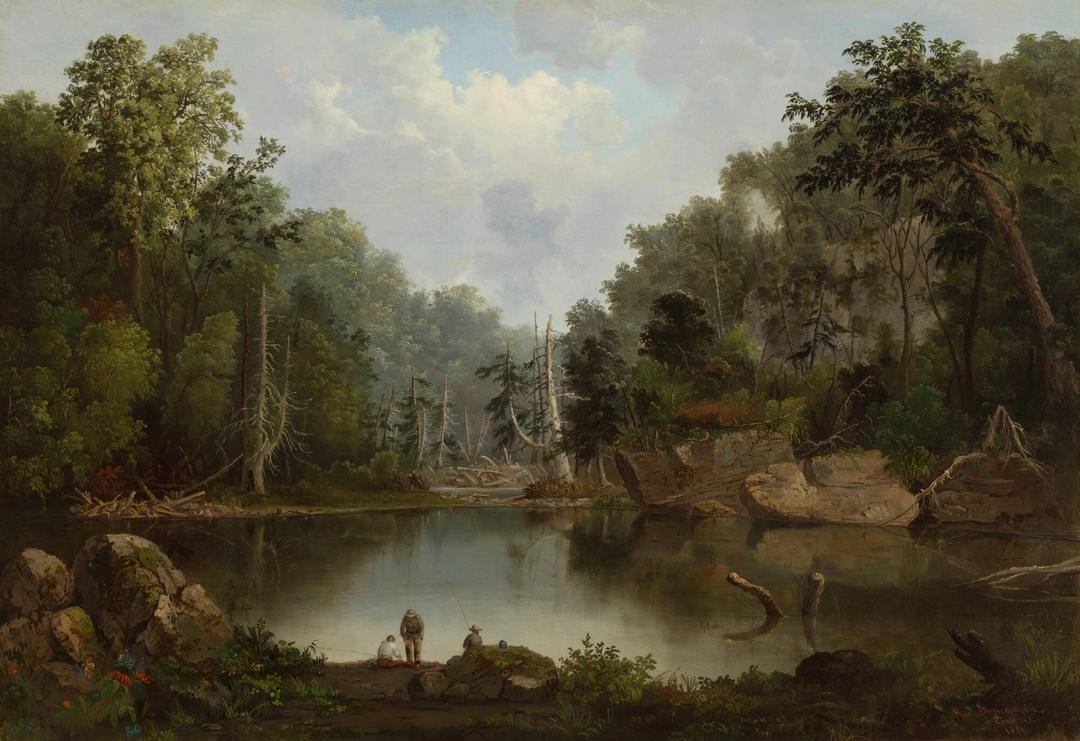
There’s one more hometown artistic hero: Robert S. Duncanson (1821-1872, American). The career of the son of a Canadian father of Scottish descent and an African-American mother was promoted by Nicholas Longworth. (Has there ever been an exhibition exploring the Longworth influence on the city’s artistic life?)
In 1851, considering Duncanson “one of our most promising artists,” the arts patron commissioned him to paint eight 9’ x 6 ½’ murals for the entry hall of his home, the Belmont, now the Taft Museum of Art. The murals are still in place.
Influenced by the Hudson River School, Duncanson depicts a scene that celebrates the grandeur of nature in “Blue Hole, Flood Waters, Little Miami River,” 1851. Man is insignificant, just three small fishermen in the foreground.
Thomas Gainsborough, Ann Ford (later Mrs. Philip Thicknesse), 1760, oil on canvas, 77 5/8" x 51 7/8". Bequest of Mary M. Emery. Photograph courtesy of the Cincinnati Art Museum.
Since the first two works—the Greek God and Eve–set up an interesting conversation across centuries, I would have liked to have seen more of that. For example, opposite the Duncanson, instead of the exquisite c. 1745 “Commode” by the ébéniste privelégié du roi, cabinetmaker to the king, Jean-Pierre Latz (French, 1691-1754), I would have preferred the two small oil-on-wood panels by Hans Memling (Netherlandish, active 1465-d. 1494): “St. Stephen” and “St. Christopher,” both c. 1479-1480. These figures dominate the scene and stand against a stylized landscape, a reversal of Duncanson’s painting.
Then the Rookwood vase could be installed opposite the French bombé chest with its rich wood intarsia and gilt hardware. I don’t want to ghetto-ize the dec arts, but the pieces do relate aesthetically with their swelling forms and “palette” of rich browns and golds.
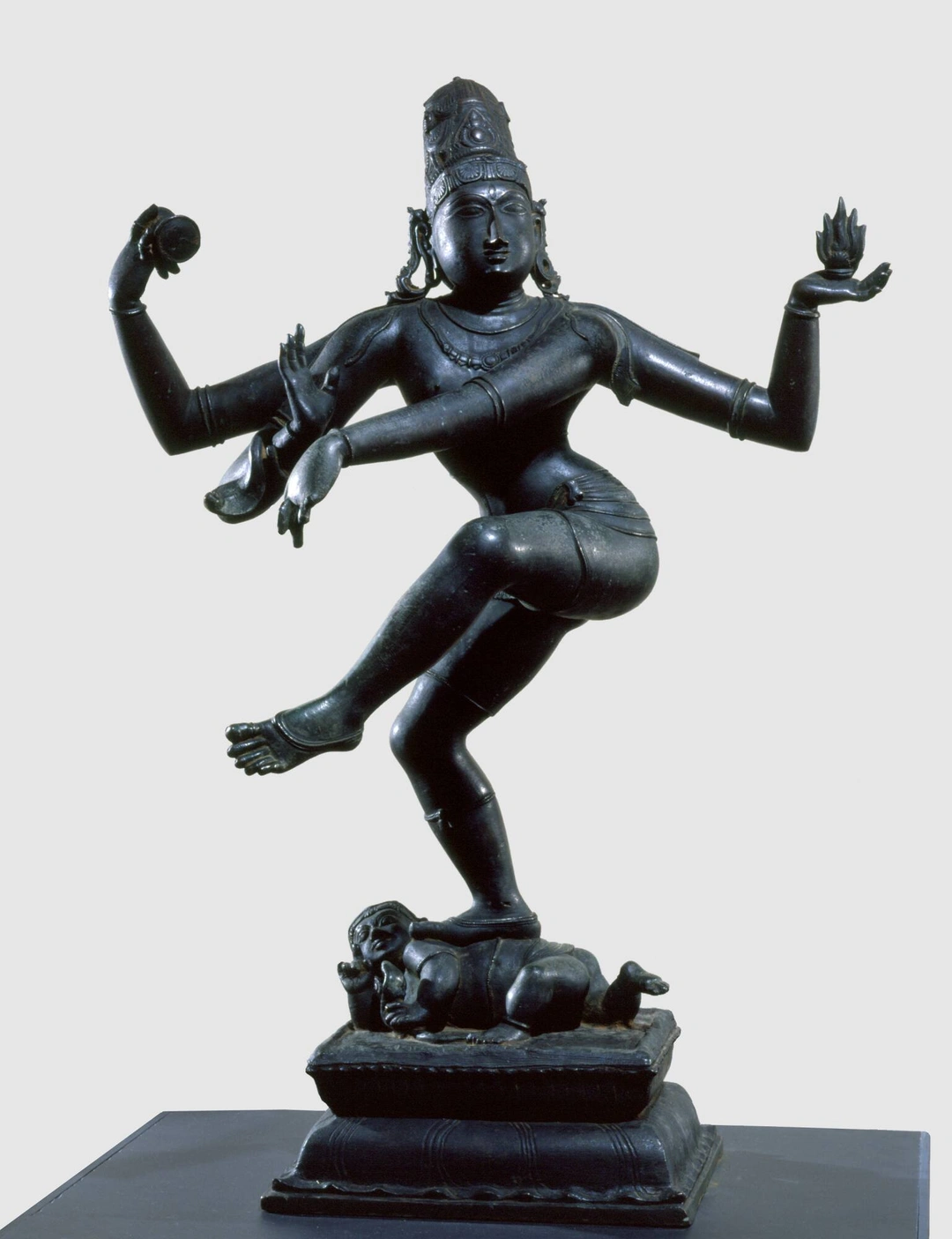
The magnificent South Indian bronze “Shiva Nataraja,” 16th-17th century, is currently positioned opposite the stolid Early Cycladic II, 1500 BC – 2400 BC, stone “Reclining Female Figure,” who has wrapped her arms tightly across her torso. Her face is Brancusi-esque with her sloping forehead and aquiline nose, its only facial feature. Of course, she predates the 20th-century Romanian sculptor by a few millennia.
The multi-armed Hindu god is all action, standing on a soft leg with his other extended and bent at the knee. He’s ready to take the next step.
Why not put Edgar Dégas’s (French, 1834-1917) two bronze ballerinas, c. 1883-1888, across from the dancing Shiva? One of the ballet dancers stands with her right leg fully extended horizontally, a pose not that different from Shiva’s.
And then that Cycladic figure could have faced off with the wood Benue River Valley, Nigeria, mid-20th century “Human Figure.” The African figure stands firmly on two legs and is as attenuated as a Giacometti.
The African and the Cycladic lady illustrate the connection between the modern and the primitive explored in the 1984 “Primitivism in 20th Century Art: Affinity of the Tribal and the Modern” exhibition, organized by William Rubin for the Museum of Modern Art.
Representing the 20th century are two no-brainer choices: Henri Matisse’s (French, 1869-1954) “Romanian Blouse,” 1937, and Andy Warhol’s (American, 1928-1987) “Soup Can,” 1962, although it’s Campbell’s Cream of Mushroom not the iconic Tomato Soup.
You know how in museums and galleries there are “Exhibition Continues” signs. Two are needed here. On either side of Eve and behind mirrored glass are two small galleries with two more pieces: Richard Avedon’s “Bill Curry, Drifter, Interstate 40, Yukon, Oklahoma, June 16, 1980,” 1980, and an Egyptian “Mummy of Adult Male,” Ptolemaic period, 332 BC-30 BC.
Everyone loves a mummy, and this one is magnificently preserved. An x-ray of the roughly 35-year-old guy, deformed by his bindings, makes a ghostly image on the non-mirrored side of the one-way glass and appears superimposed over the boneless Eve. With the colors still vibrant, his linen wrapping was painted with symbols intended to protect him, but I wasn’t sure what to make of the soles of his feet. The little black circles, arranged in rows, looked like the non-slip rubber nubs found on the bottoms of slipper socks.
On the other side of Eve is Avedon’s compelling portrait of a grizzled drifter, Bill Curry, from his “American West” series. Curry is roughly life-sized and every line, every smudge of grime, every stringy strand of hair is reproduced in excruciating detail in the rich black and white tones of the gelatin silver print. Perhaps no longer best known for his fashion photographs, Avedon was working in the tradition of Walker Evans and Dorothea Lange, two of the best known photographers of the Historical Unit of the Farm Security Administration, which documented the plight of the rural poor from 1935 to1944.
Curry confronts the camera, Avedon, and ultimately the viewer head on. Being short, I would have liked the 47” x 37 ¾” photograph to have been hung a little lower so we could have been eye-to-eye. Still as he stared out, I was totally captivated and found it hard to break my gaze.
Now comes the question: do the casual visitor and the more informed viewer “get” why these pieces are icons?
The dramatic installation is a successful strategy to slow visitors down enough so that the works of art can “remain lodged” in their memory. Hopefully these icons provide a baseline to judge the other 64,982 pieces in the collection that didn’t make the cut.
–Karen S. Chambers
*All quotes are from didactic material in the installation.
Some of the antiquities will be re-located to a new permanent collection gallery, “The Collections: Six Thousand Years of Art,” which opens on December 2, 2011.
Renovation of the Schmidlapp Gallery through October 29, 1213, at the Cincinnati Art Museum, 953 Eden Park Drive, Cincinnati, OH 45202, 513-721-2787, .













Comments powered by Talkyard.