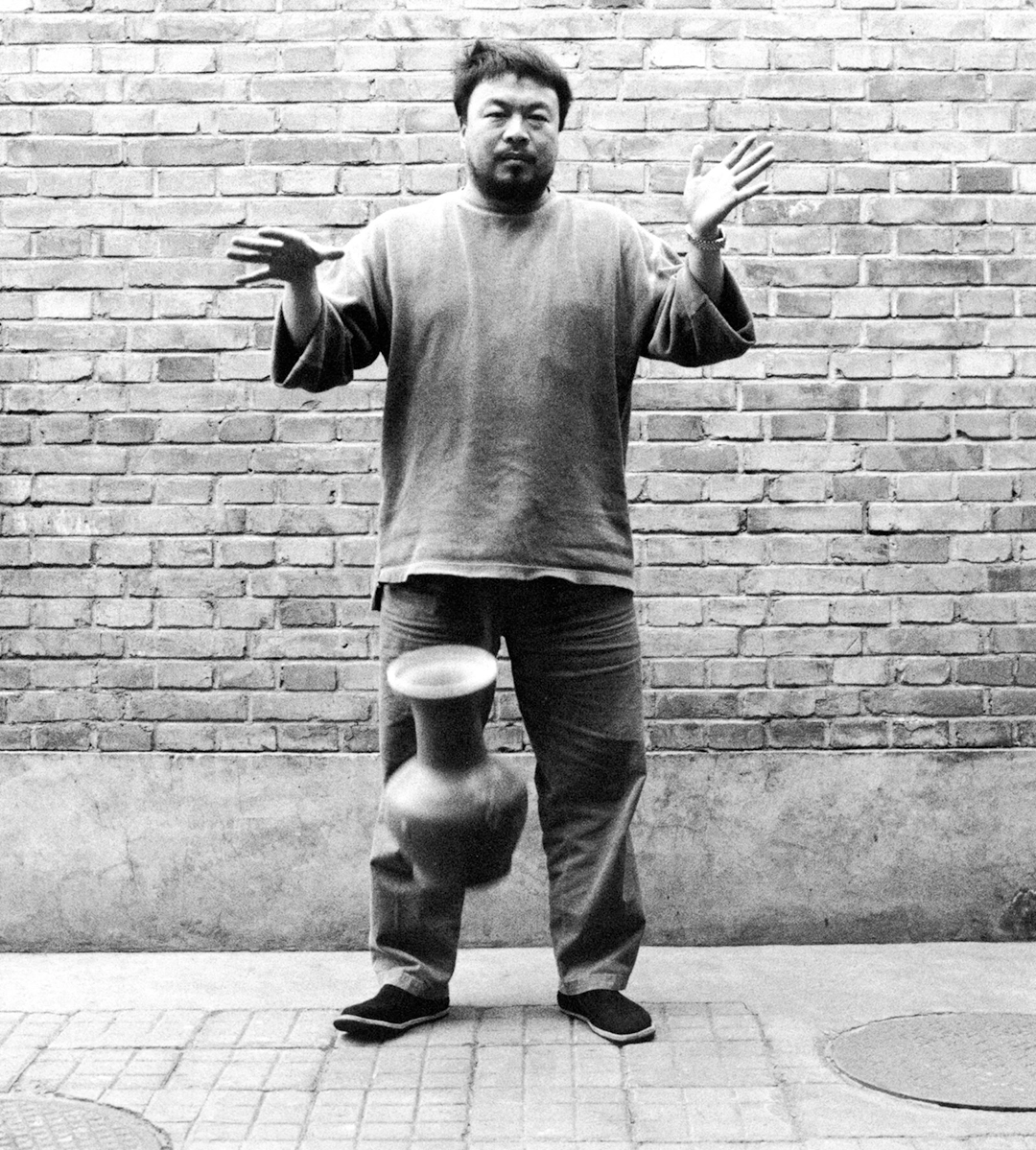
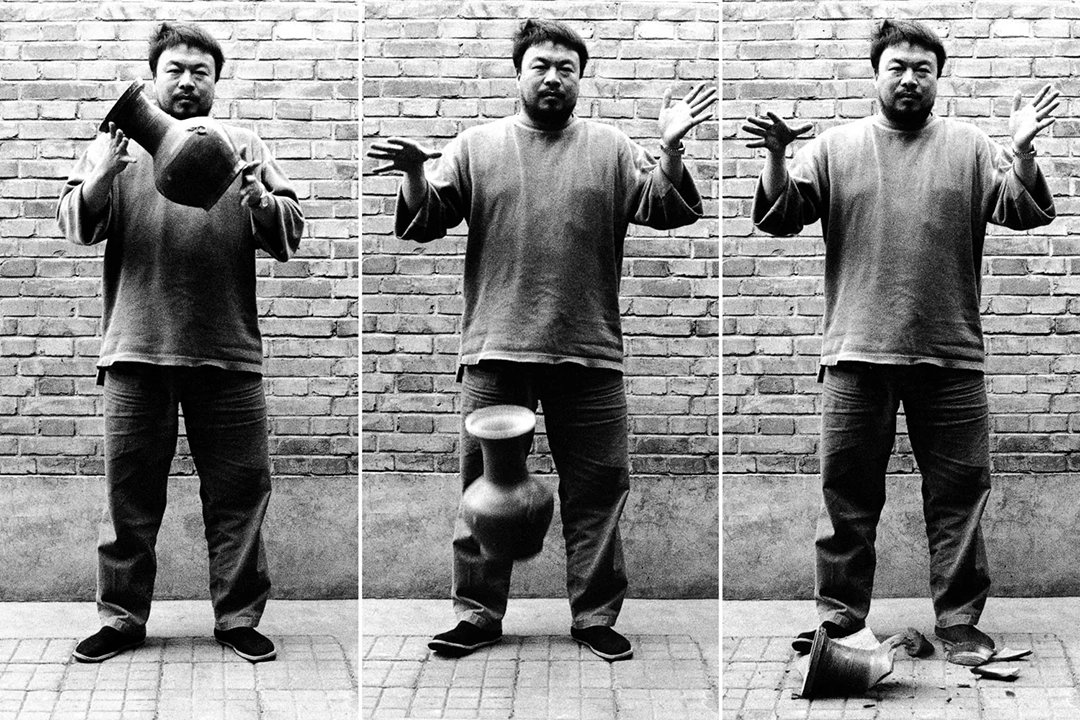
Dropping a Han Dynasty Urn, 1995 (Second panel of the triptych)
Triptych of black-and-white gelatin silver prints
Each print: 50¼ × 39½ in. (127.7 × 100.3 cm)
Edition of 8
Ai Weiwei's art leaves me with certain reservations. The public figure strikes me as overly polished, burnished almost to excess.
Some years ago he dropped an authentic Han dynasty urn onto the floor. Made sometime between 206 BC and AD 220, its first and only purpose was to shatter. He had bought it in Beijing in the early 1990s, during China's rapid urban expansion, when such objects could still be found in considerable numbers. Weiwei himself has said that he began collecting them after returning from the United States in 1993.
It is said that he had to smash a second urn because the photographer failed to capture the exact instant of the fall. Critics have readily embraced interpretations that make the performance appear less overtly iconoclastic. One is that it recalibrates the value we assign to historical objects. Conceived as an act of confrontation, it has also been read as an indictment of the systematic destruction of cultural heritage—both Chinese and universal—during the delirious years of the Cultural Revolution. One cannot help recalling François Girard's magnificent The Red Violin, released, incidentally, after Weiwei's performance. Others have seen in it a quieter reproach directed at China's compulsive drive toward modernization.
If I wished to make peace with the gesture, I could argue that Dropping a Han Dynasty Urn destroyed the physical object while granting it symbolic permanence, bringing into existence a new work of art, arguably more valuable than the unfortunate vessel itself.
Personally, I cannot accept that bargain. I do not applaud the destruction of heritage—any heritage, admirable or reprehensible alike. I can understand relocating it, and there are circumstances in which relocation may even be justified. My sympathy ends there.
If I question these gestures—so common in recent years—it is not because I value the material traces of history above all else. What troubles me is the ease with which they erase the labour and vigilance of hundreds, perhaps thousands, of anonymous people who, across generations, devoted themselves to preserving those objects.
Time confers value. When an object survives for centuries, time settles upon it with irreversible weight until it becomes a treasure. The flourishing trade in antiquities rests on precisely that principle. Yet permanence is not reserved for material things. Words endure. So do myths, stories, legends, covenants and promises. Even silence can be preserved. There are silences more precious than the urn Ai Weiwei allowed to fall. Brian W. Aldiss understood this perfectly in Intangibles, Inc., his 1959 story in which the course of an entire life depends upon leaving an utterly insignificant object untouched.
Now I arrive at what truly concerns me. For years I have lived with the suspicion that gratuitous gigantism has become one of contemporary art's most celebrated alibis for aesthetic impoverishment.
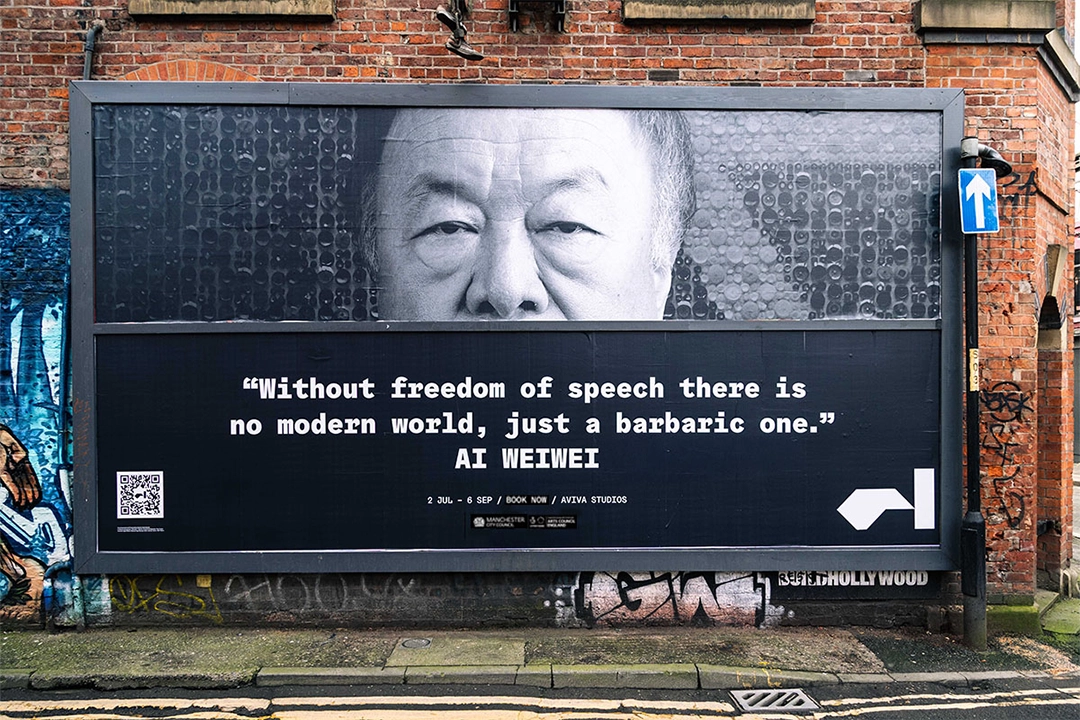
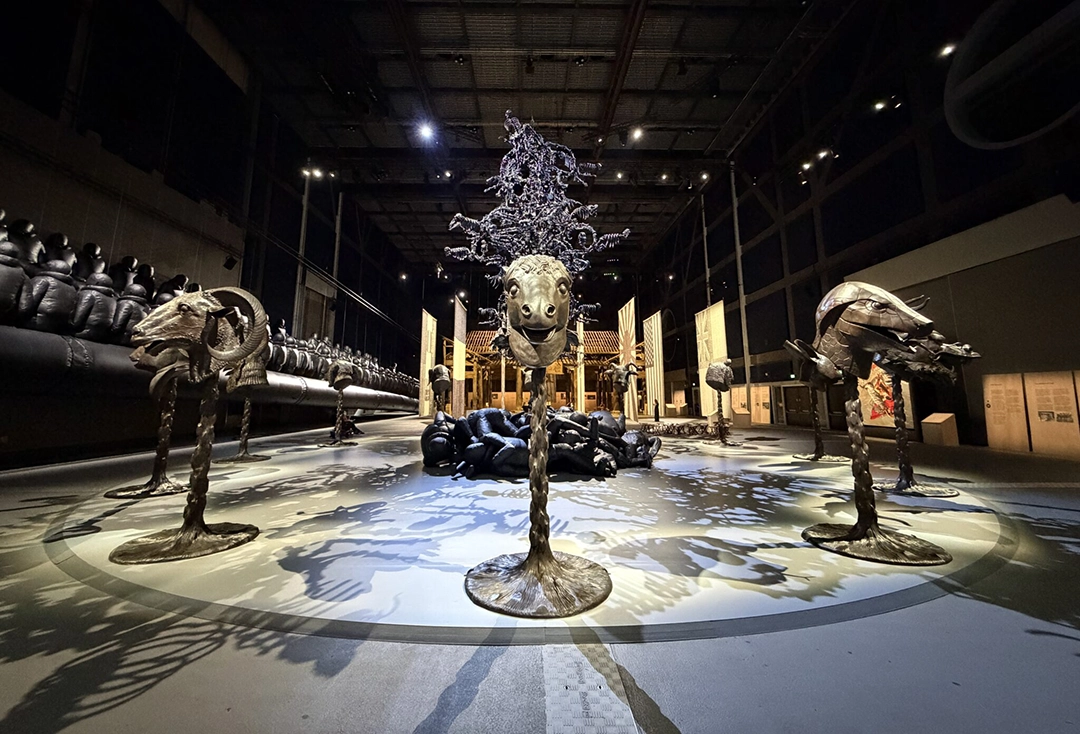
Ai Weiwei does not merely drop ancient urns. At this very moment, Ai Weiwei: Button Up! is on view at Aviva Studios in Manchester, where it will remain until 6 September. We know the artist—an activist as well, and, as Tim Smith-Laing wrote in the Financial Times, someone who has spent decades documenting the failures and excesses of the Chinese Communist Party—was imprisoned, placed under house arrest and ultimately driven into exile. Today, Luis Manuel Otero Alcántara arrives in the United States, likewise forced to abandon his homeland, along with his books, his clothes and everything else that had helped shape him as an individual.
As part of a performance, Ai reconstructed an entire twenty-four hours of the eighty-one days he spent in detention, recreating his prison cell at full scale. Many people—myself included—recognize that risk has a tangible meaning in his life. His courage and his achievements are beyond dispute. Most of us will probably find ourselves moved, perhaps even brought to tears. Yet I belong to a vast community of exiles, and I have become too accustomed to these acts of catharsis.
From the photographs I have seen, everything has been conceived on a monumental scale.
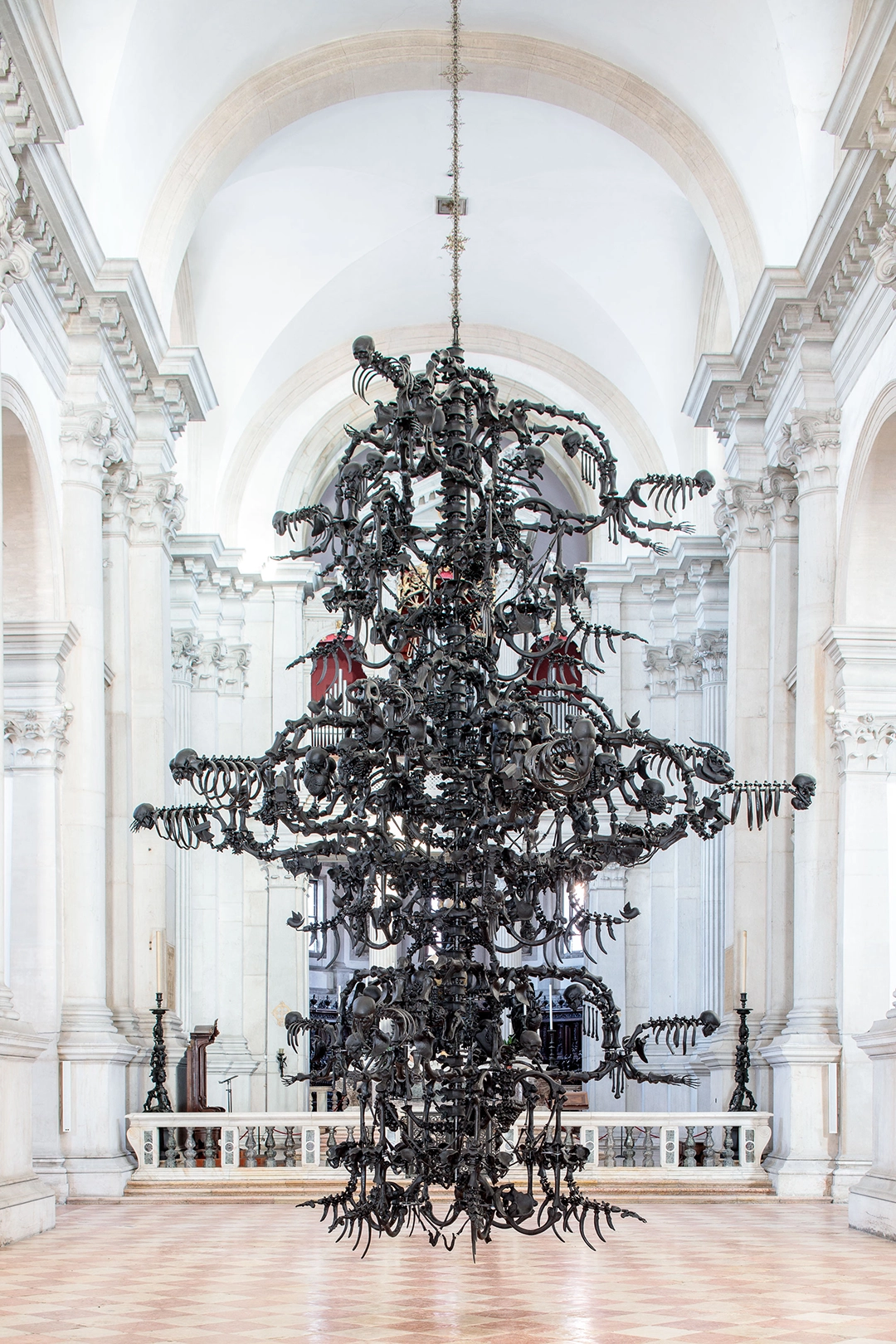
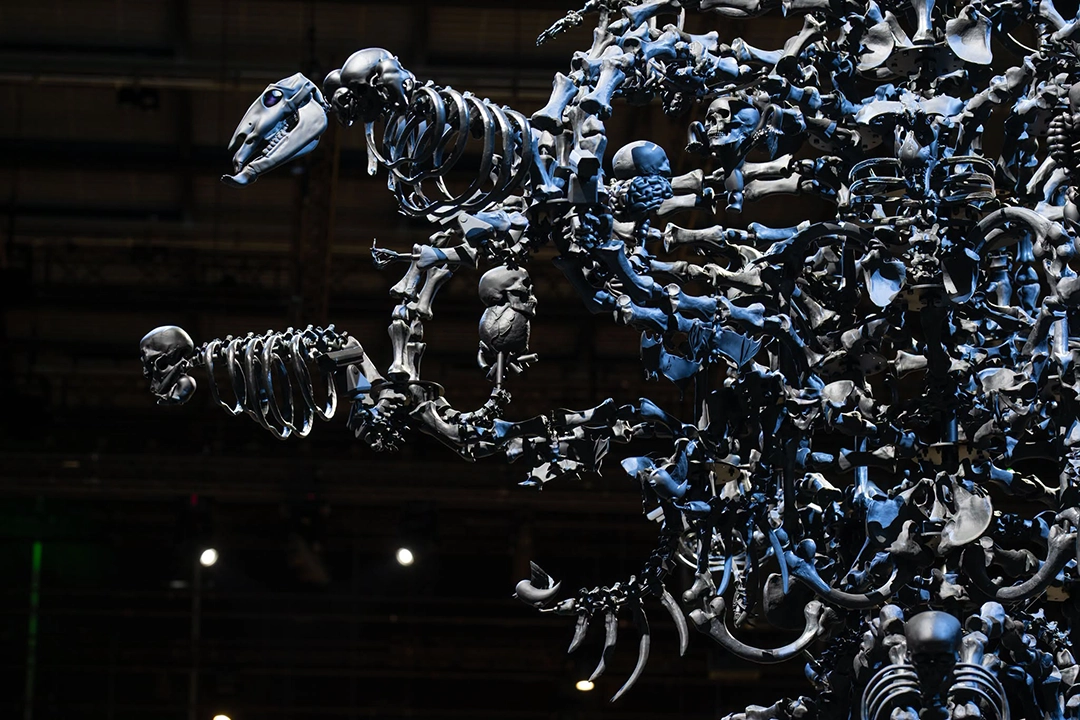
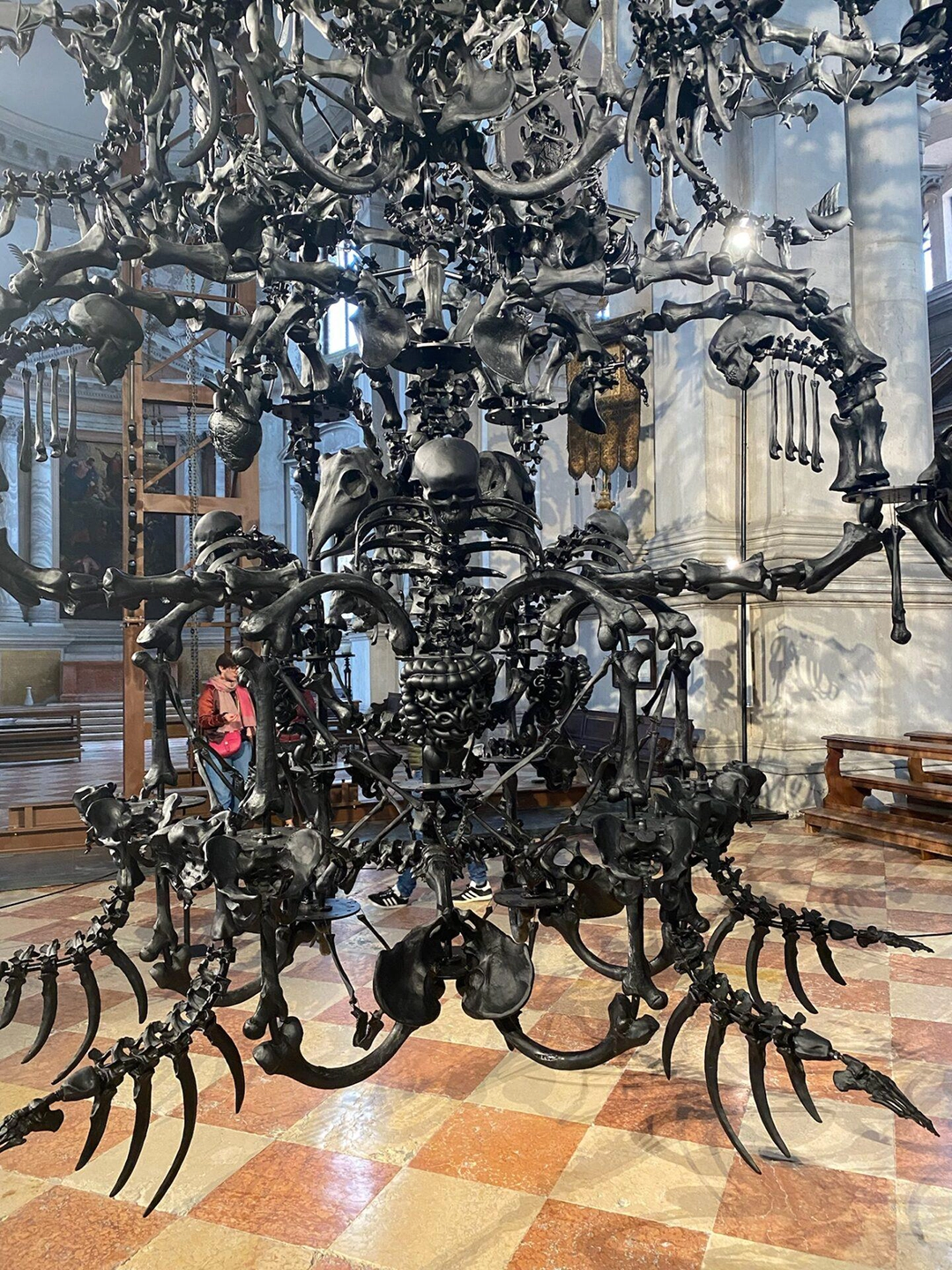
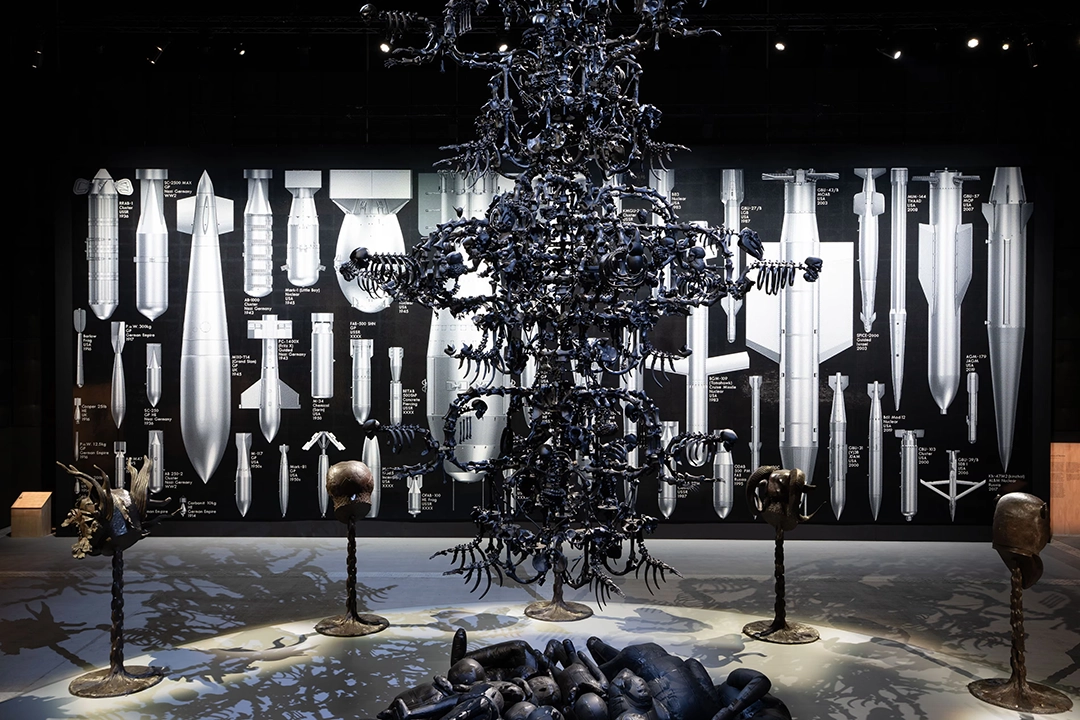
La Commedia Umana, 2021
Sculpture / installation. Approximately 2,000 hand-molded elements of black glass.
Blown and molded Murano glass | Dimensions variable according to installation.
Button Up!, Aviva Studios (through September 6, 2026).
Monumental suspended chandelier composed of thousands of black glass pieces shaped like bones, organs, skulls, and other human and animal anatomical fragments, assembled into a vast crystal chandelier.
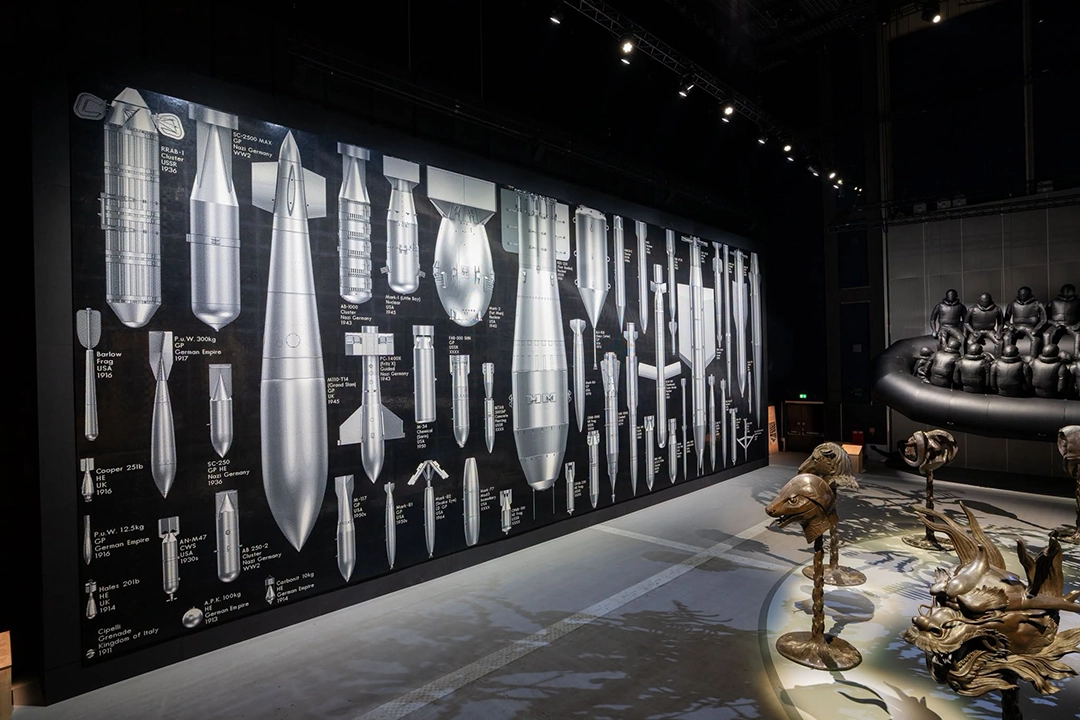
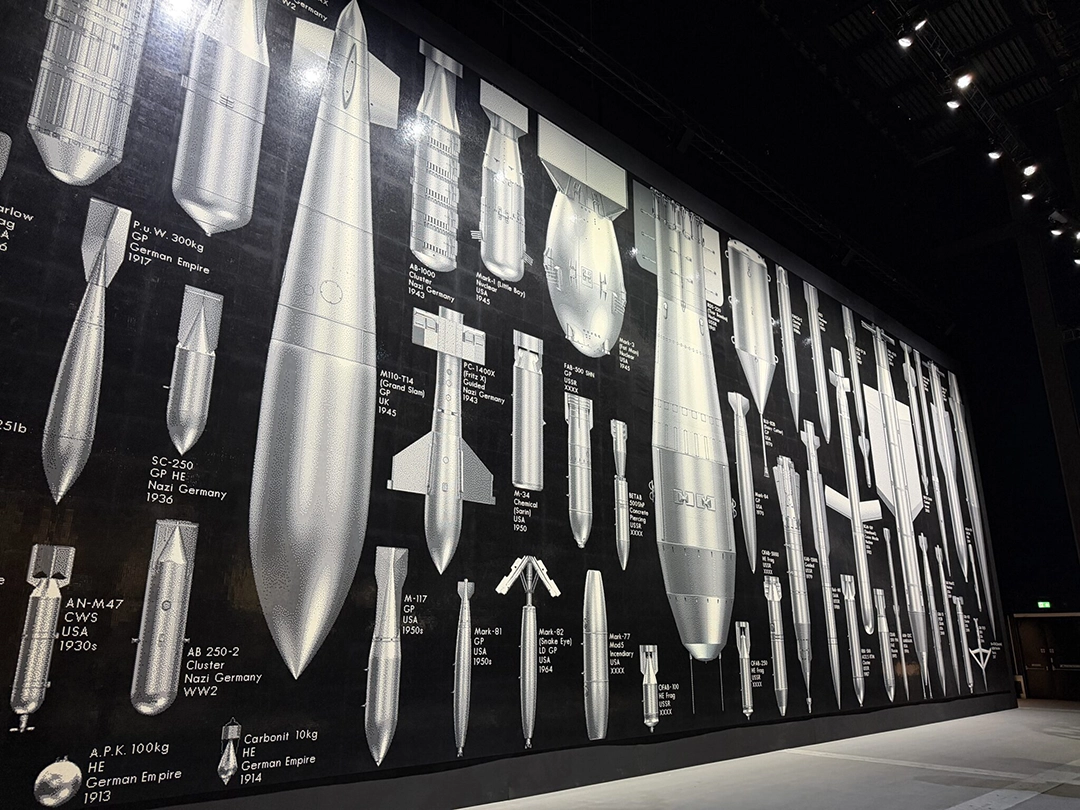
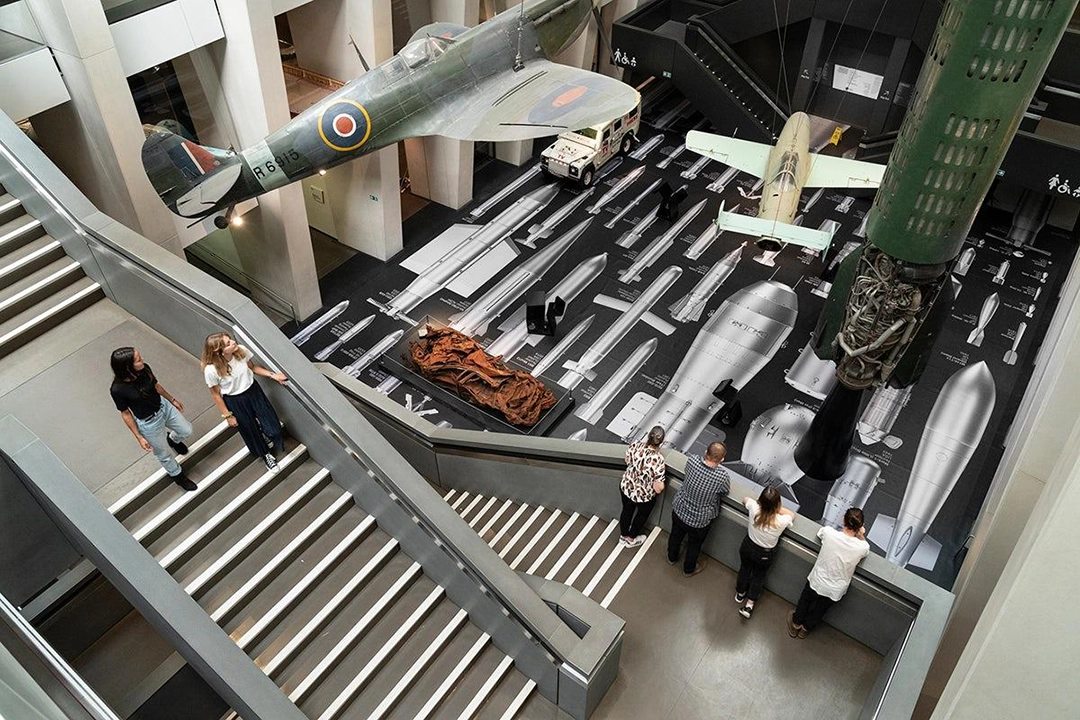
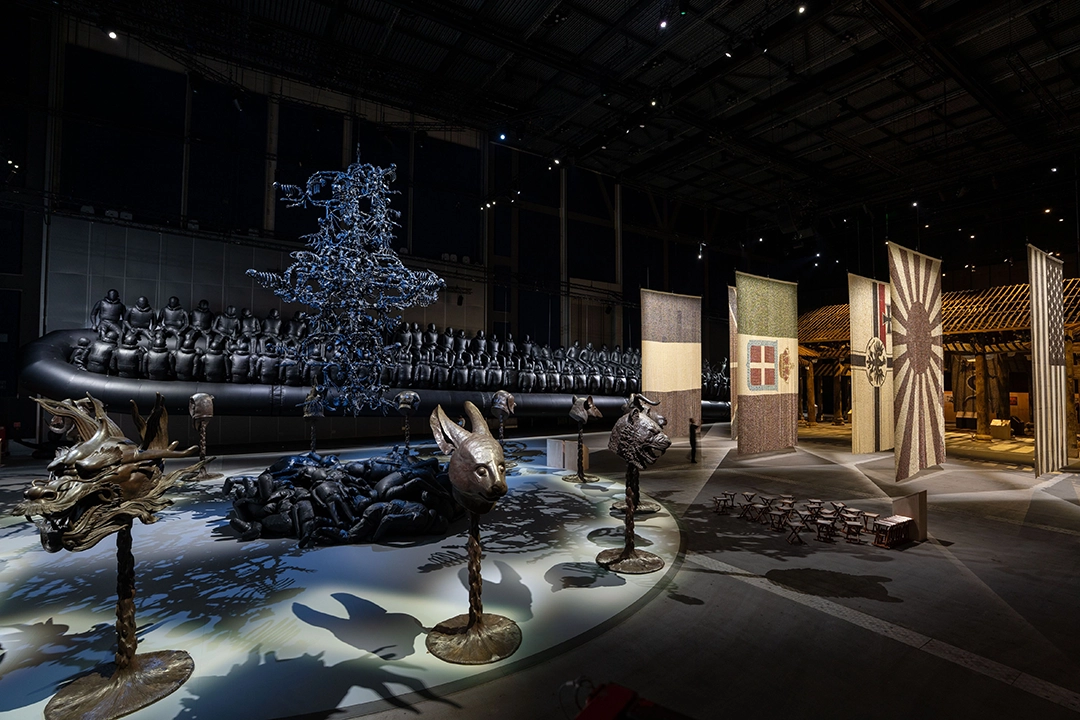
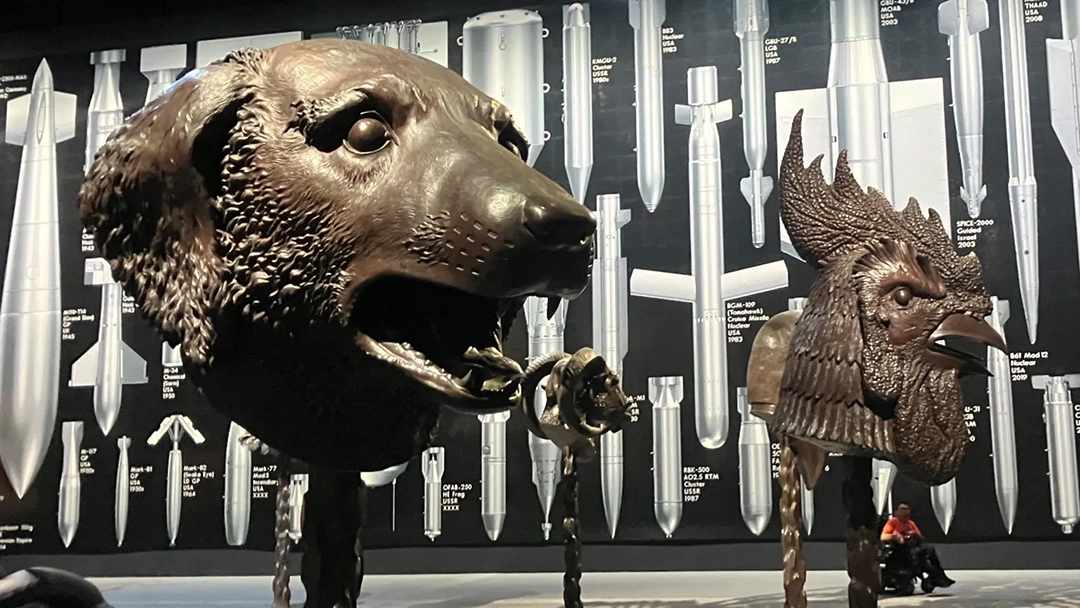
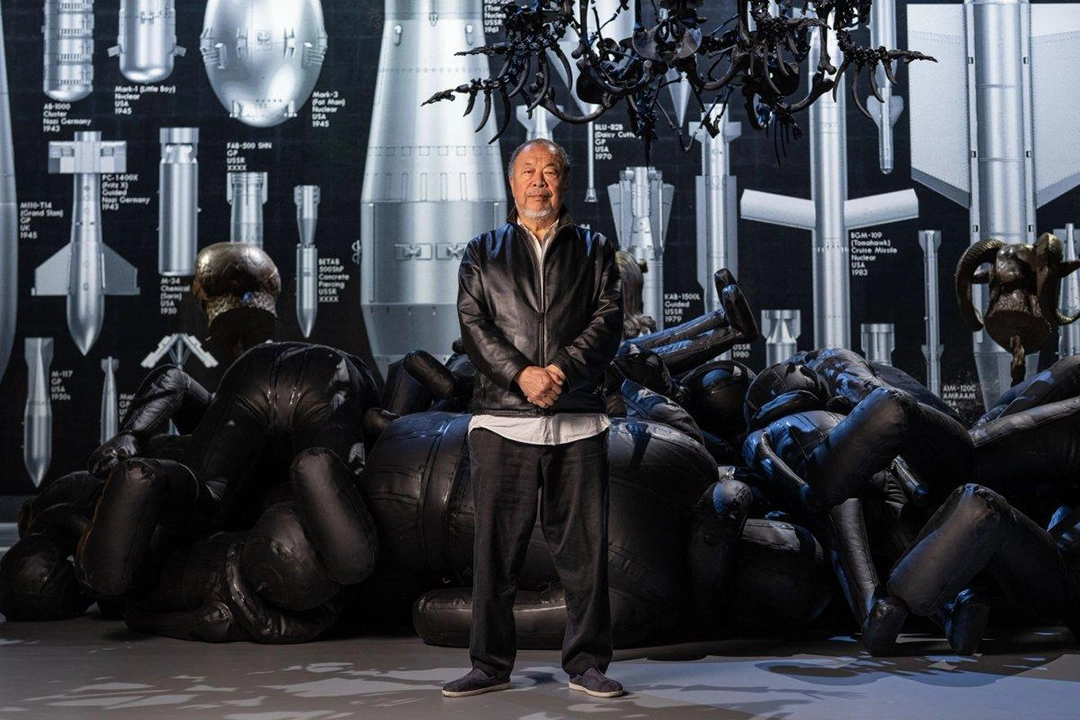
Suspended in semi-darkness, La Commedia Umana unfurls two thousand black glass fragments cast in the shape of human and animal bones. Beyond it stretches History of Bombs, a mural assembled from three and a half million LEGO bricks. The innocent nature of the toy seems to soften the overwhelming scale of the violence it depicts. The reconstructed prison cell recalls Giovanni Battista Piranesi's Carceri d'Invenzione, his eighteenth-century series of imaginary prisons whose dimensions lie far beyond any human measure. Everything is immense. Everything strains toward excess.
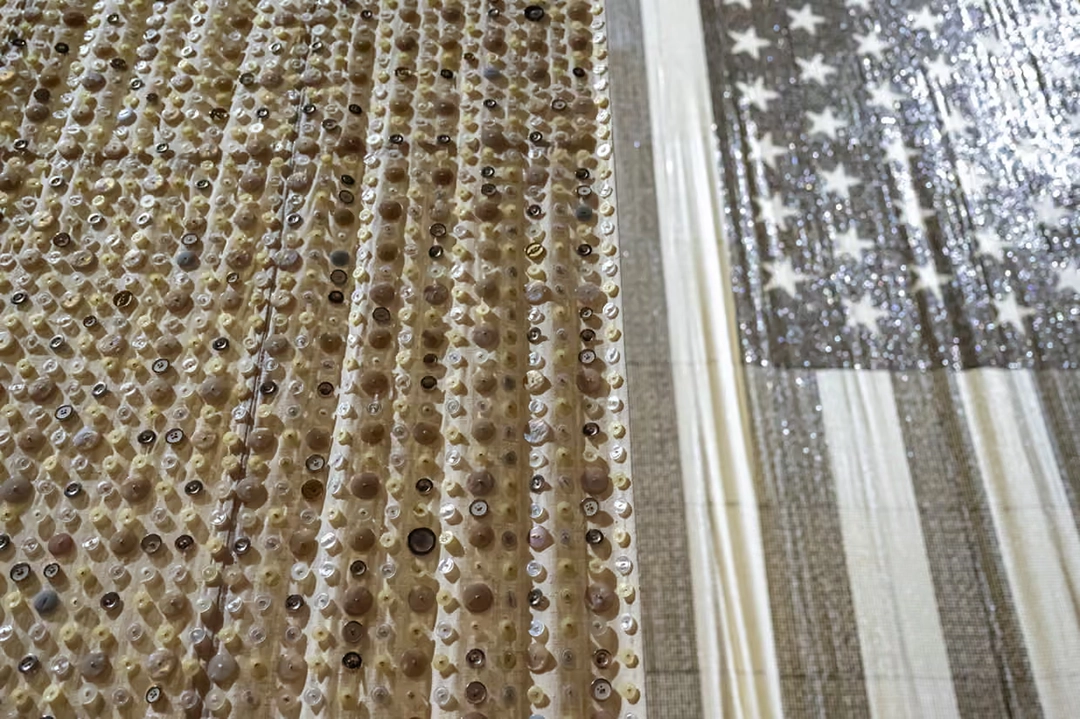
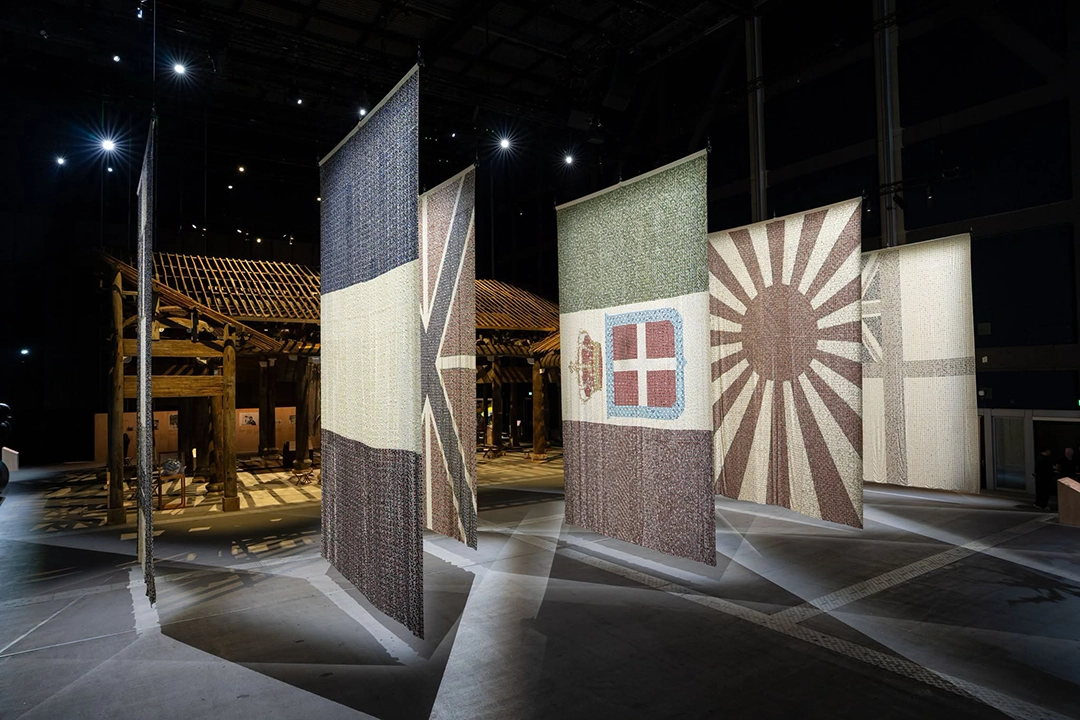
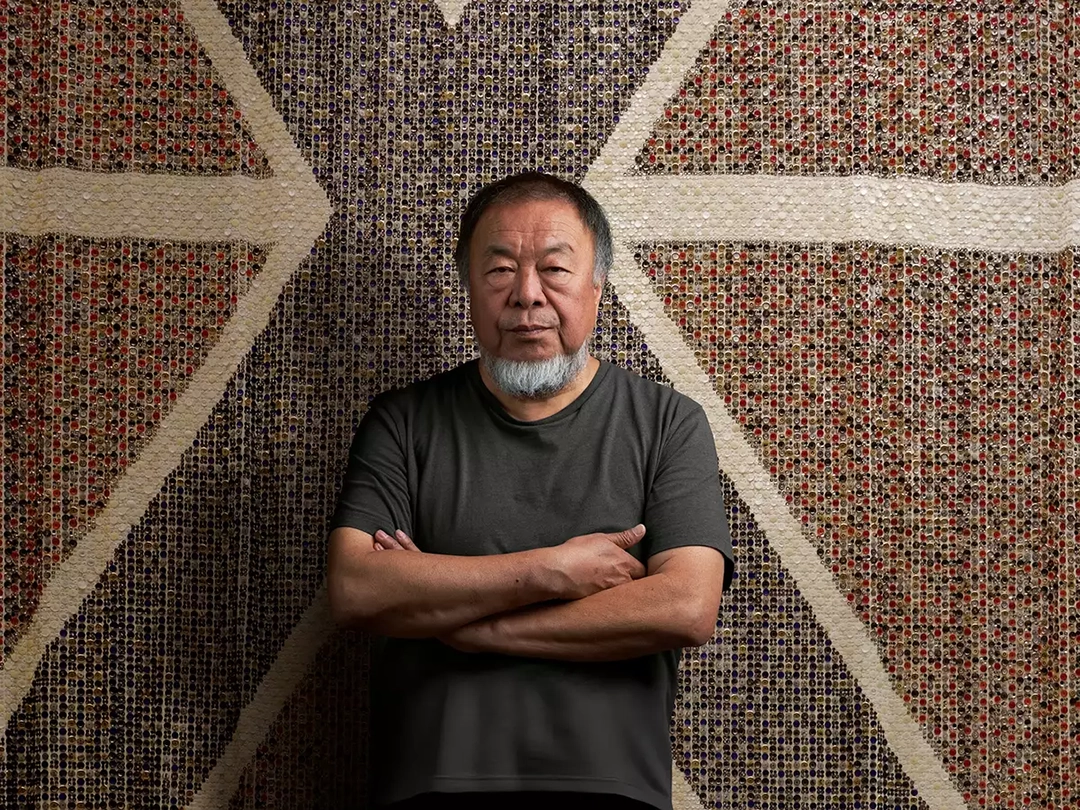
Eight-Nation Alliance Flags, 2026 (detail: United States flag)
Buttons sewn onto textile support. Approximately 500,000 buttons per flag. Variable dimensions.
Created for the exhibition Ai Weiwei: Button Up!, Aviva Studios, Manchester, United Kingdom.
It resembles art and, from one point of view, it is. That alone, however, does not make it good. It impresses me, but I am not persuaded. If sheer scale were enough, Gulliver's travels would unfold in museums devoted to the gigantic and the miniature.
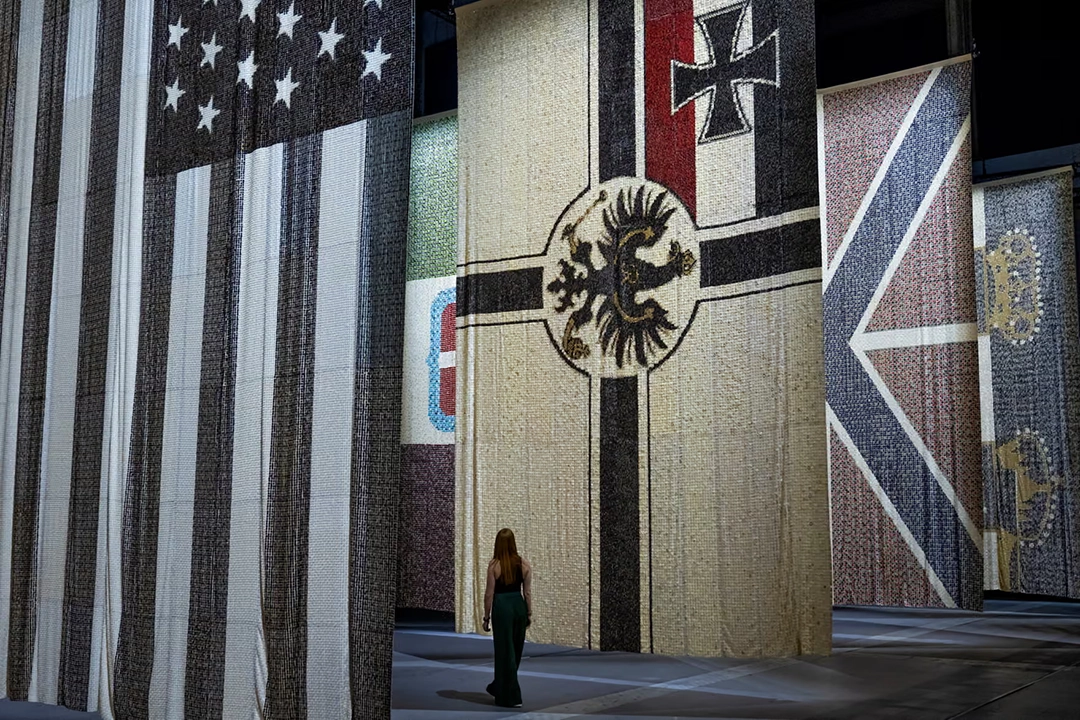
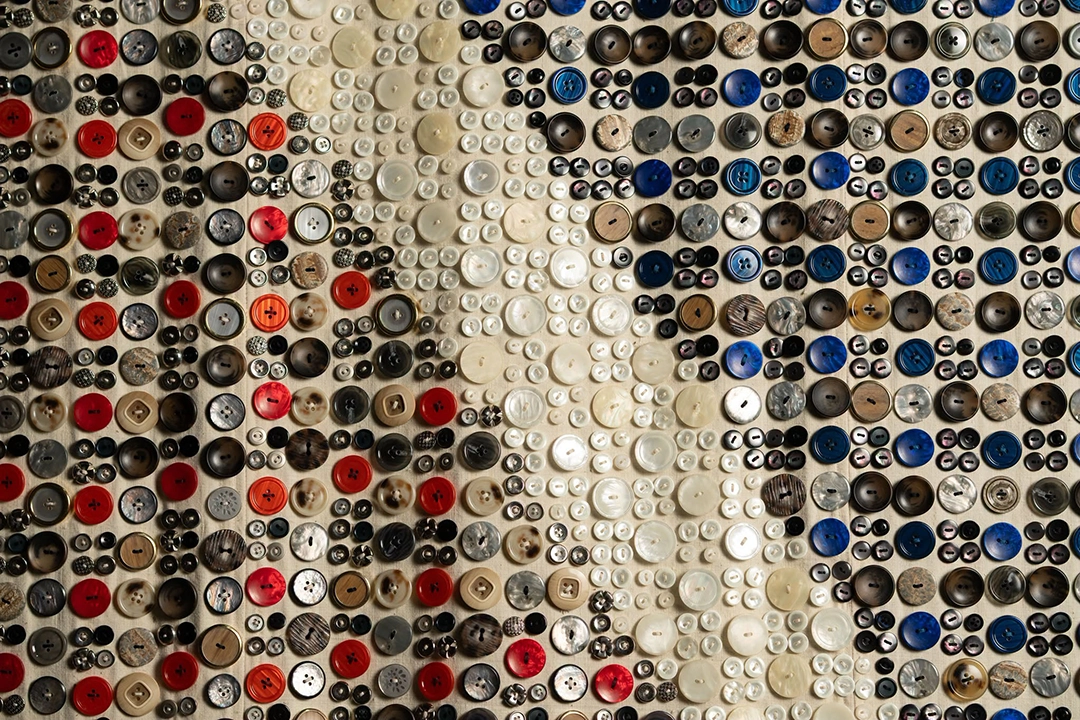
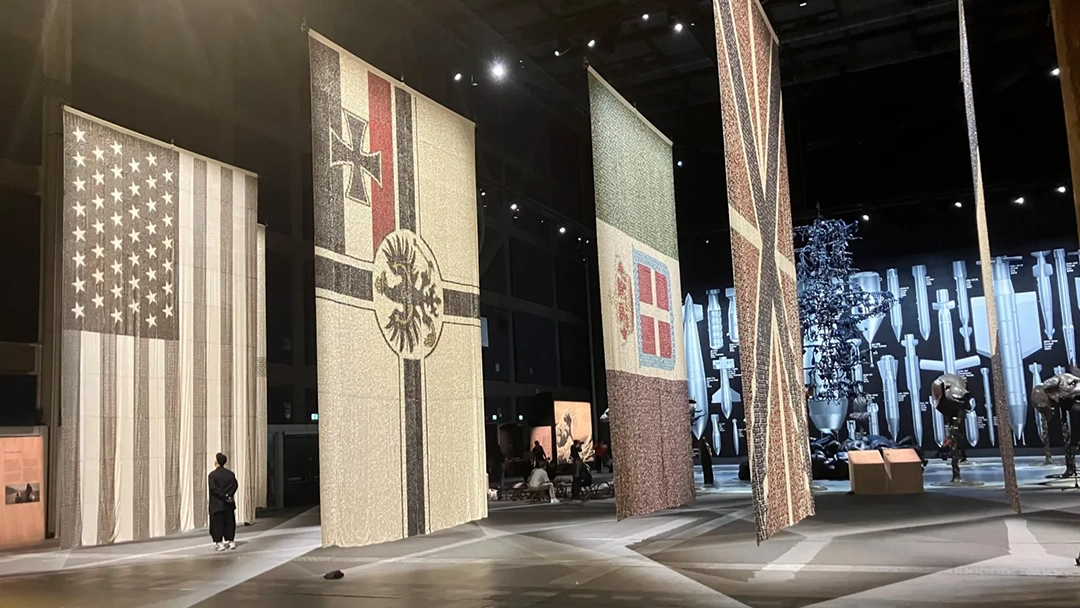
Eight-Nation Alliance Flags, 2026 (detail: United States flag) Buttons sewn onto textile support. Approximately 500,000 buttons per flag. Variable dimensions.
Created for the exhibition Ai Weiwei: Button Up!, Aviva Studios, Manchester, United Kingdom.
Eddy Frankel writes in The Guardian that Ai's work functions far better at a colossal scale, becoming most effective when it expands until it bears down on the viewer. Giraffes have looked down on me. So have elephants. Neither has ever induced an aesthetic blush.
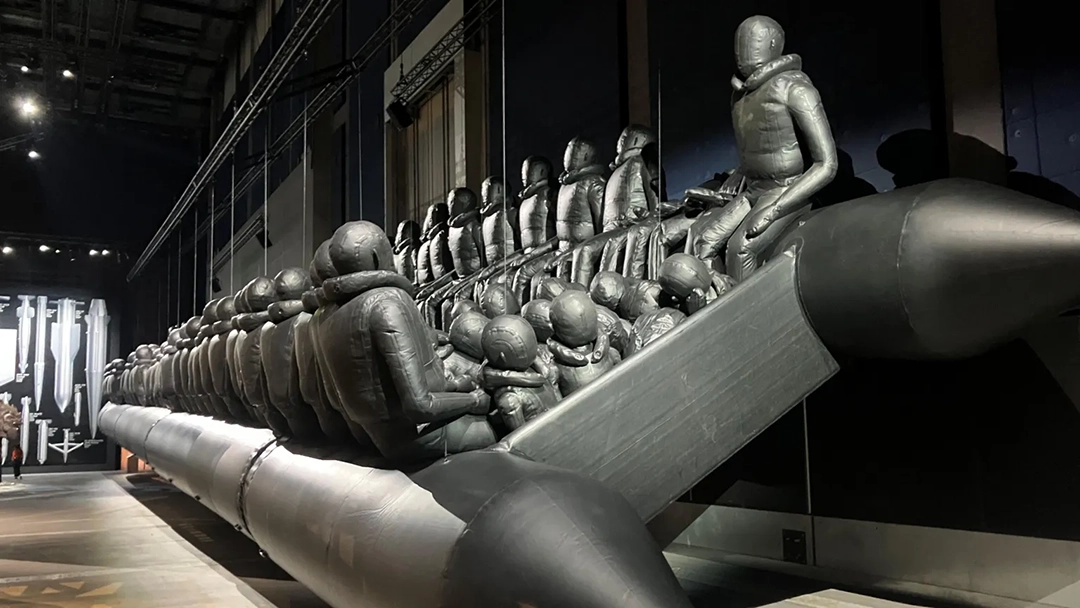
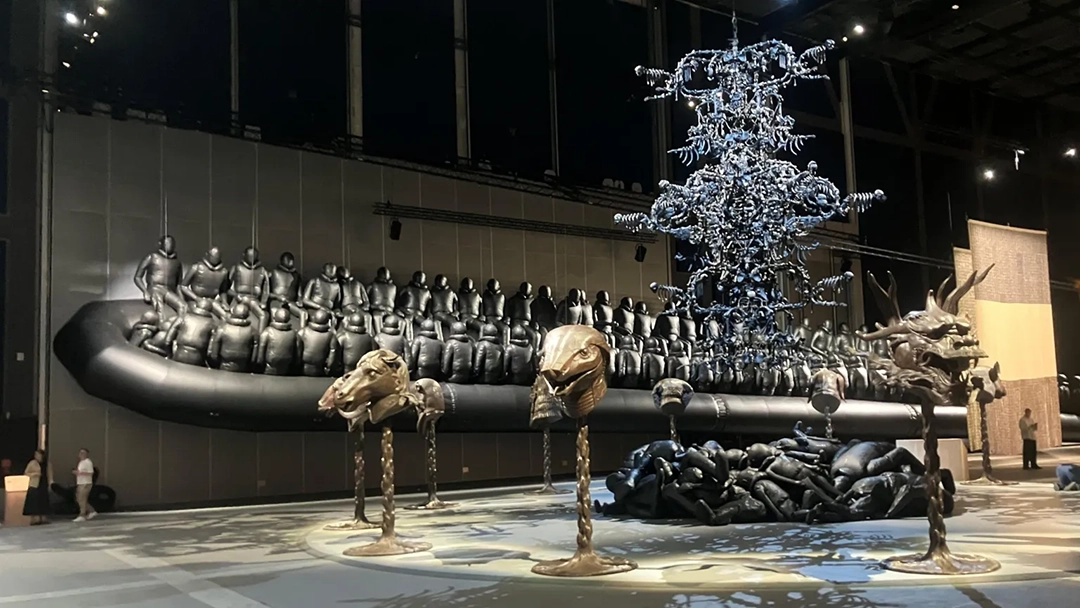
Law of the Journey, 2017 Sculpture / installation. Monumental inflatable boat with 258 life-sized figures.
Black PVC inflatable structure | Variable dimensions (approximately 60 × 6 × 3 m).
Button Up!, Aviva Studios (through September 6, 2026).
Monumental inflatable boat crowded with 258 anonymous, life-sized human figures wearing life jackets. Inspired by the refugee crossings of the Mediterranean, the work transforms an emergency rescue craft into an overwhelming symbol of forced displacement, mass migration, and the humanitarian consequences of war and political conflict.
A gigantic inflatable boat occupies an entire wall. It is crammed with people wearing life jackets. Frankel himself concedes that it is "not a particularly beautiful work, but it gets its message across, loudly."
Flags the size of building façades, stitched from hundreds of thousands of buttons, reproduce the emblems of the multinational alliance—Great Britain, the United States, Japan, France, Germany, Italy, Russia and the Austro-Hungarian Empire—that invaded China in 1900. They hang heavily, burdened by history and everything history left behind.
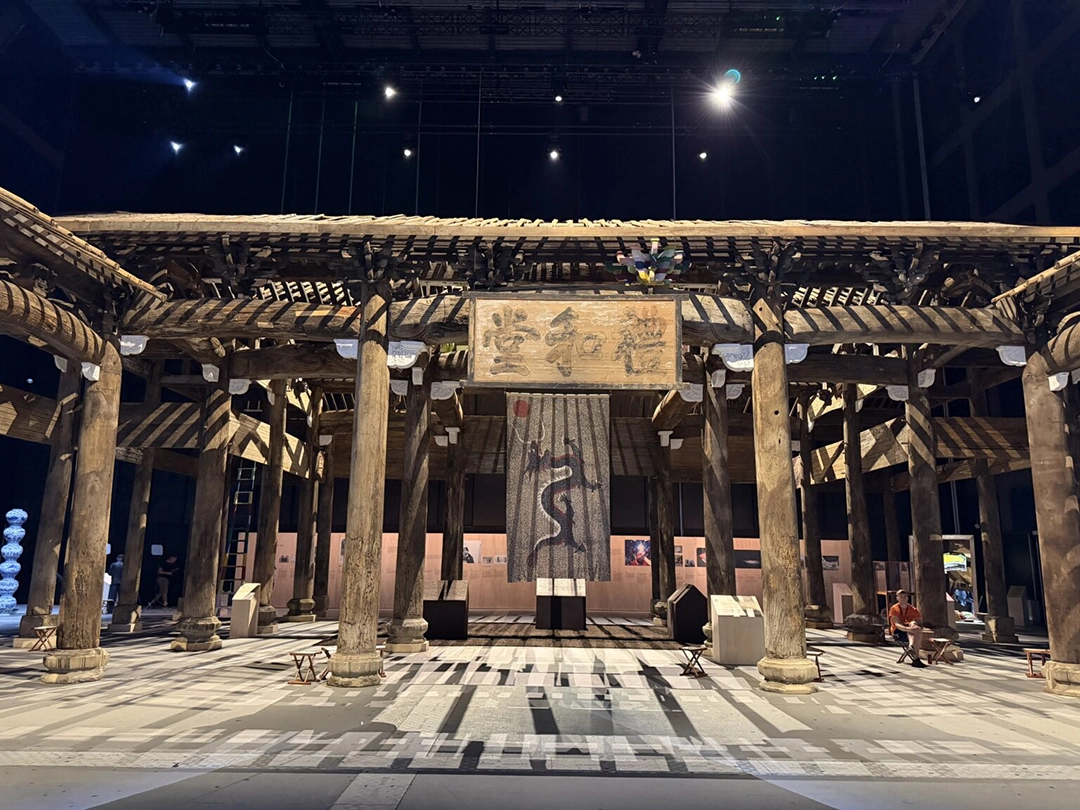
Cal Revely-Calder, writing in The Daily Telegraph, remarks that Ai Weiwei has never been celebrated for subtlety, and that little in this exhibition suggests otherwise. At times the work succeeds. Its most affecting piece, he argues, is the serene reconstruction of a Ming dynasty ancestral temple. Yet too often those effects prove fleeting, their emotional force dissolving almost as quickly as it appears.
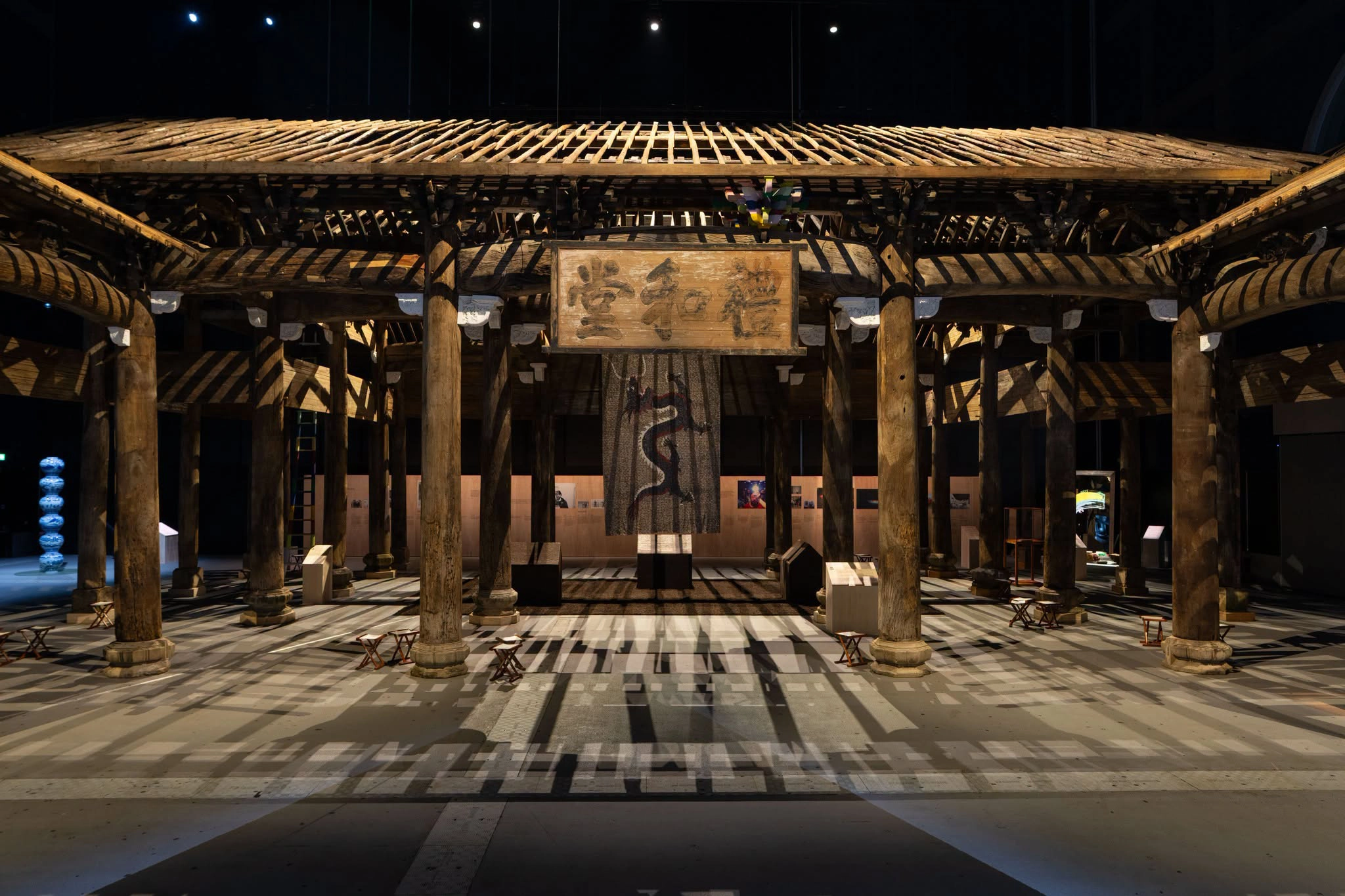
Ancestral Hall, 2015 Sculpture / architectural installation.
Wood from a Qing dynasty ancestral hall, dismantled and reassembled using traditional Chinese joinery techniques (without nails or screws) | Variable dimensions.
Button Up!, Aviva Studios (through September 6, 2026).
Monumental reconstruction of a traditional Chinese ancestral hall originally built during the Qing dynasty. Dismantled and meticulously reassembled using historic carpentry methods, the installation transforms a vernacular architectural structure into a meditation on memory, cultural heritage, displacement, and the tensions between preservation and modernization.
Throughout the exhibition, Ai rails against what he calls "the murky legacies of the West" and its allies through subjects as vast as colonialism, refugees and war, with the predictable intention of making visitors feel guilty.
His work, however, rarely unfolds into deeper layers of meaning. For all the legitimacy of its concerns, its messages too often collapse into excessive simplicity. Realpolitik, with all its contradictions and innumerable dimensions, seems invisible to Ai Weiwei's gaze. Equally absent is that genuinely transcendent art capable of wounding through gestures that are small, precise and devastating.
Everything I have read over the past few days, across a wide range of publications, has only confirmed suspicions I have carried for years. I do not believe Ai Weiwei is a fraud. Far from it. Yet among the many things he has enlarged beyond measure are his own legend, the actual reach of his work, his legacy and the shadow he casts.
I will never forgive him for smashing not one but two urns that had survived for nearly two thousand years.
For the sake of the photograph.











Comments powered by Talkyard.