
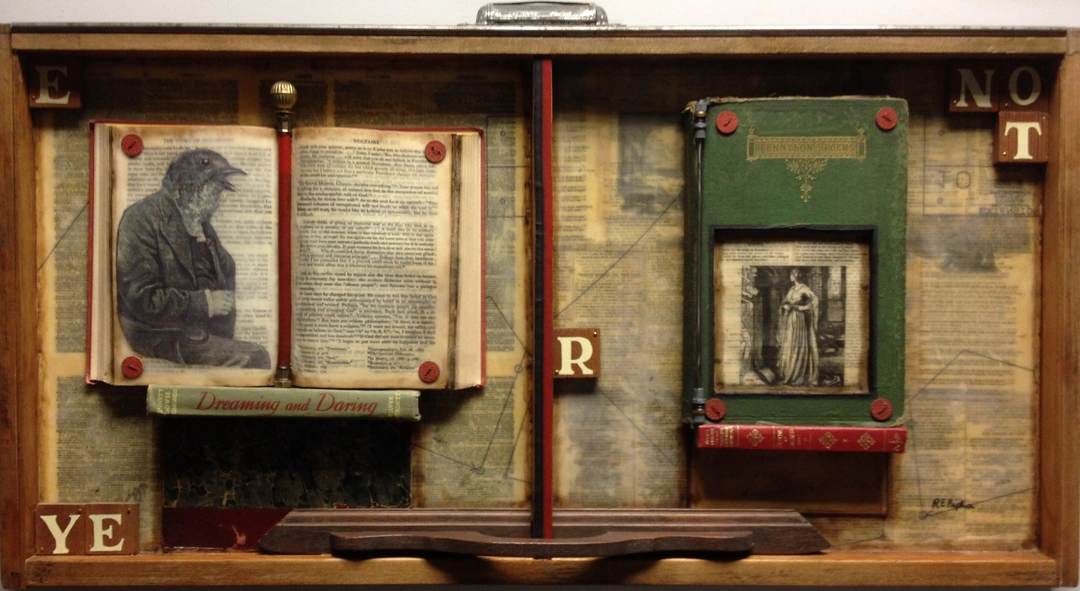
Though hardly indicative of the full breadth of contemporary craft art, the diversity of work presented in the “The Artist’s Craft” exhibit at The Carnegie Visual and Performing Arts Center is a window into the ability of artists to use traditional materials to create surprising compositions that challenge, and resonate with, the viewers sensibilities.
Arturo Alonzo Sanduval’s Landing Portal #3 is an illustration of just such a paradigm shift. Utilizing fiber arts to compose an ethereal pattern of orbs floating on whisps of iridescent plastic that drew me into the wall hanging with near-vertigo sensations, Sanduval has manipulated a monochromatic space that mimics the depth and dimension of the universe. Framed in a contrasting blue ring, the two basic elements are tied together with a vibration of gold stitching, animating the work as I slowly pass by. The scale of the work makes it relevant to my personal space, increasing its magnetic appeal.
An ensemble of free-form woven baskets by Judy Dominic is a study in contrasts and conundrum. All three baskets illustrate non-patterned weaving that can distract the eye as easily the materials or shape. Each form has edges collapsing in on the enclosed space, creating a cave-like space both protective and vulnerable. Random weaving of suede, plastic tubing, or wide strips of birch bark loosely reveal the bones of the baskets, implying flexibility of the artist’s creative process, and intention itself.
Dominic’s “Fred, Ginger, and Her Younger Sister” slides off the basket genre into a visceral demonstration of transparency and structure. The “bones” of wood sticks once again provides the framework for stretched pig gut, thin enough for light to reveal its translucent nature, the innards of the structure dancing behind the curtain of swirling texture inherent in the animal material. The stretched material strains at the edges of wood, creating in my mind a response of tension in my gut.
At the risk of pigeonholing, I would label Raymond Papka’s works “Atlas” and Eyebook II” as steam-punk treatments of book media, with blurred nautical images antiqued beneath layers of waxy film like logos softened by the ice at a hockey rink. These illusive images draw the viewer in closer to examine map images and assemblages, barely resisting the temptation to caress the artifacts/artworks. Resigned to visual scrutiny, my eyes run across the surface, exploring contrasts of bolts and cue balls, the relief of cutouts and layered appliqués, topped off with a contemporary touch of computer circuitry that spans time with leap-frogged references, creating a connection from an elusive past to the present day. The time warp occurs with anthropomorphic references to eyeballs, recessed and protruding, bringing into focus the relevant time line of life and knowledge. Can the book/knowledge see into the future?
David R. Farmer’s series of landscapes which includes the canvas “Line of Trees” is a group of paintings that use a forest scene of white birch tree trunks as the framework for colorful stippled leaf canopies that shift in hue across the surface. The emphasis seems to be on the bold pointillist effect utilizing a palette of fluorescent-bright colors; green, yellow, blue, and pink. Though some canvases are more successful than others, they rarely escape the viewer’s mental process of analysis and curiosity about why and how, and less on “what does it do for me?”
The elongated form of “Turbulence” smoothly reaches for the ceiling, the only sense of chaos coming from delicate swirls of metal that could easily represent wisps of smoke or fog, or the path of sprites among tall tree trunks. One of the hallmarks of great artists is that they make it look easy. Roberta Elliot has created an elegant example of technical mastery that allows the imagination of the artist to have full voice. Those who are oblivious to the techniques will be mesmerized by the subtle, pulsating energy of this piece.







Comments powered by Talkyard.