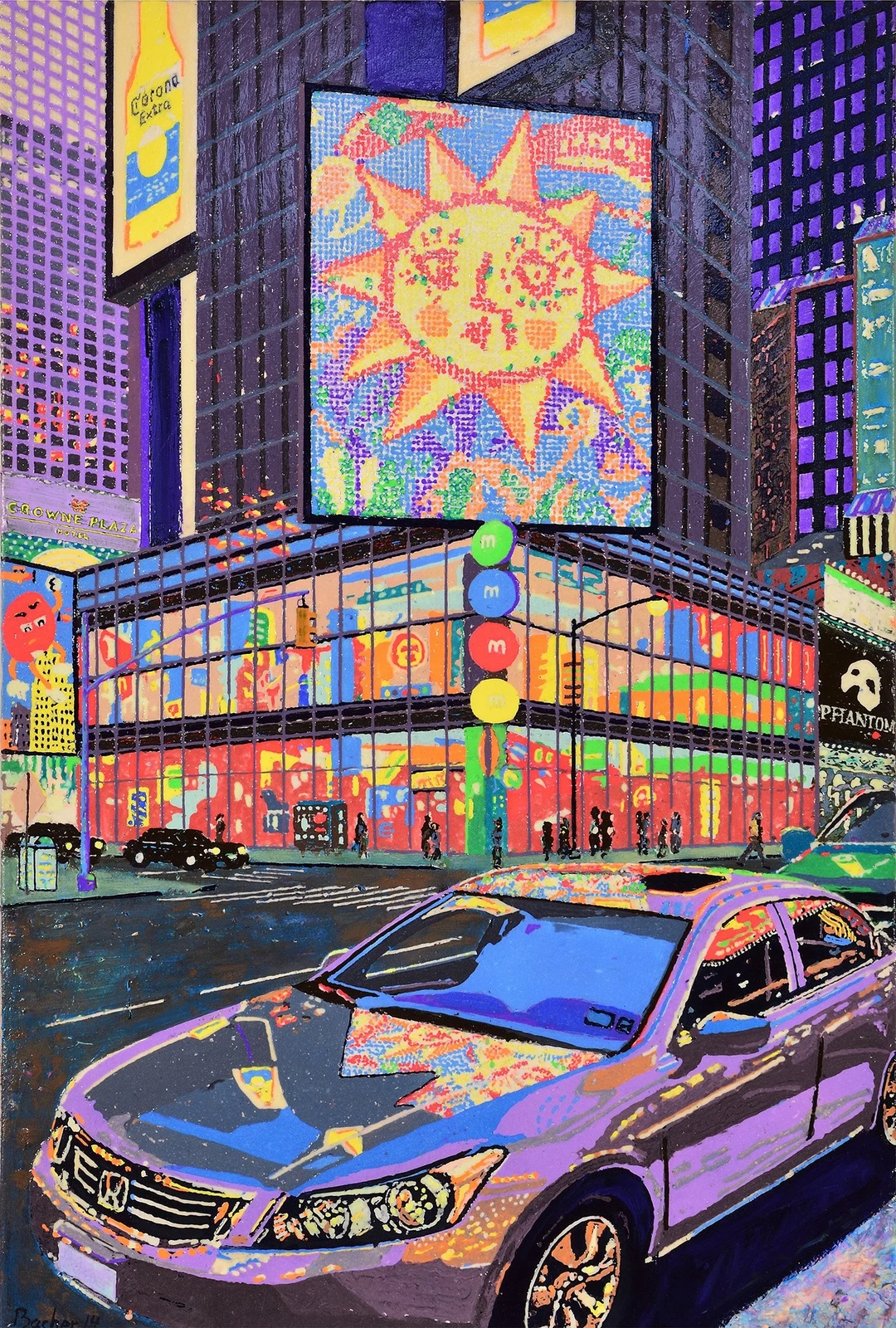
Tom Bacher, Times Square Sunrise, phosphorescent acrylic on canvas. Courtesy of Cincinnati Art Galleries, LLC.
Under the cover of darkness the city twinkles with the light from countless windows, streetlamps and signs, wrapping us in a blanket of familiarity. The city nightscape is as assuring and magical as a Christmas tree glowing in a dark living room, and as primal as fire. It is the light of our hometown, reflected in Tom Bacher’s luminous paintings.
Anyone familiar with Bacher’s renowned career will go into Cincinnati Art Galleries, LLC with certain expectations for the exhibit Fos-4-s-cent Met-A-more-fik Paintings. There are the kind of grand cityscapes that made Bacher’s career at the O.K. Harris Gallery in New York and won him the 1984 Cincinnati Post Corbett award. Among the 44 works on display there are also surprises.
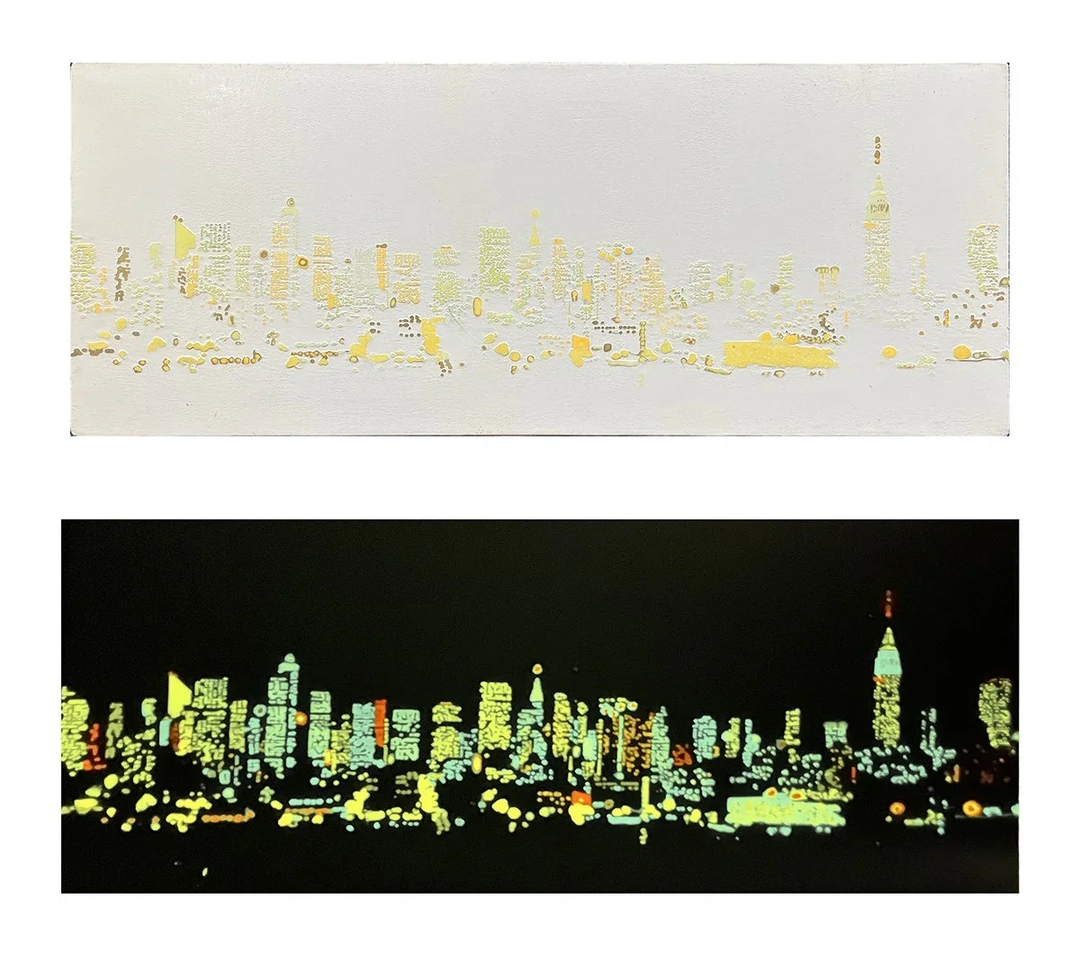
Tom Bacher, Viewing Manhattan (in the light, above; in the dark, below), phosphorescent acrylic on canvas, 24 x 60 inches. Courtesy of Cincinnati Art Galleries, LLC.
In the light, Bacher’s phosphorescent acrylic paintings are sprawling landscapes with thick, glossy, marbled layers. Many of the subjects are what they have been for more than 30 years, the Brooklyn Bridge, the Las Vegas Strip, the Ohio River, but his strokes appear to be getting looser and more Impressionistic. I’m astounded by some of his smaller paintings including Rookwood Indian Vase with the color and composition of a Matisse and Night Buildings a muddy, Fauvist landscape. Tucked in the corner, it is easily overlooked but daring.
Then the lights go out in the gallery and a whole other exhibit emerges. The sun appears to set, turning the sky from light pinks and blues, to deep oranges and purples. The stars come out. Lights flick on in the windows and reflect off of the now black river. I am back under the gentle cover of darkness again, looking out over the city on a hot summer night. I am walking along Eden Park Drive after dark and the Cut in the Hill creeps up the coal black Kentucky hillside like a golden Y. In the dark, his works are no longer paintings, they are light projections.
The transformation is not done. Time is as much an element in Bacher’s paintings as phosphorescents and light. He has discovered some colors including yellow do not glow as long as others. The stars begin to fade away and in the painting Eclipse the moon wanes from full to crescent after a few minutes in the dark. Black lights added still another character to his phosphorescents in Luminous at the Weston Art Gallery in 2009. At Cincinnati Art Galleries I find the close proximity to the office space in the gallery means some of the light from computer monitors spills over onto the canvases. The phosphorescents loose a bit of their punch. In another corner of the gallery, however, I am able to surround myself in the twinkle of of a dozen small paintings, and sit, consumed by the almost life-sized street scene in Morgan Stanley.
The luminosity Bacher is known for comes from his own mixture of acrylic paints with phosphorescent pigments. It is a process he invented in 1975 and he has not made a single work of art that does not glow since. 36 years of painting with in a single medium does not mean his work is void of discovery and innovation. Bacher has no manual on phosphorescents and no master painters to guide him. His entire body of work is the manual.
“I never wanted to recreate what someone has already done. I wanted to do something new, that I had to figure out,” Bacher says. His successes in luminosity have come through years of trial and error. To make a black sky glow as in the painting Terry’s Turf Club Bacher has learned it requires an immense amount of luminous colors. The rules of basic color mixing still apply but when it comes to the orange light reflecting on the wet road outside Terry’s the artist is mixing an acrylic red with a luminous yellow. If he wants to make a blue sky glow he may mix a Phthalo blue with a luminous orange. The result is a glowing blue sky.
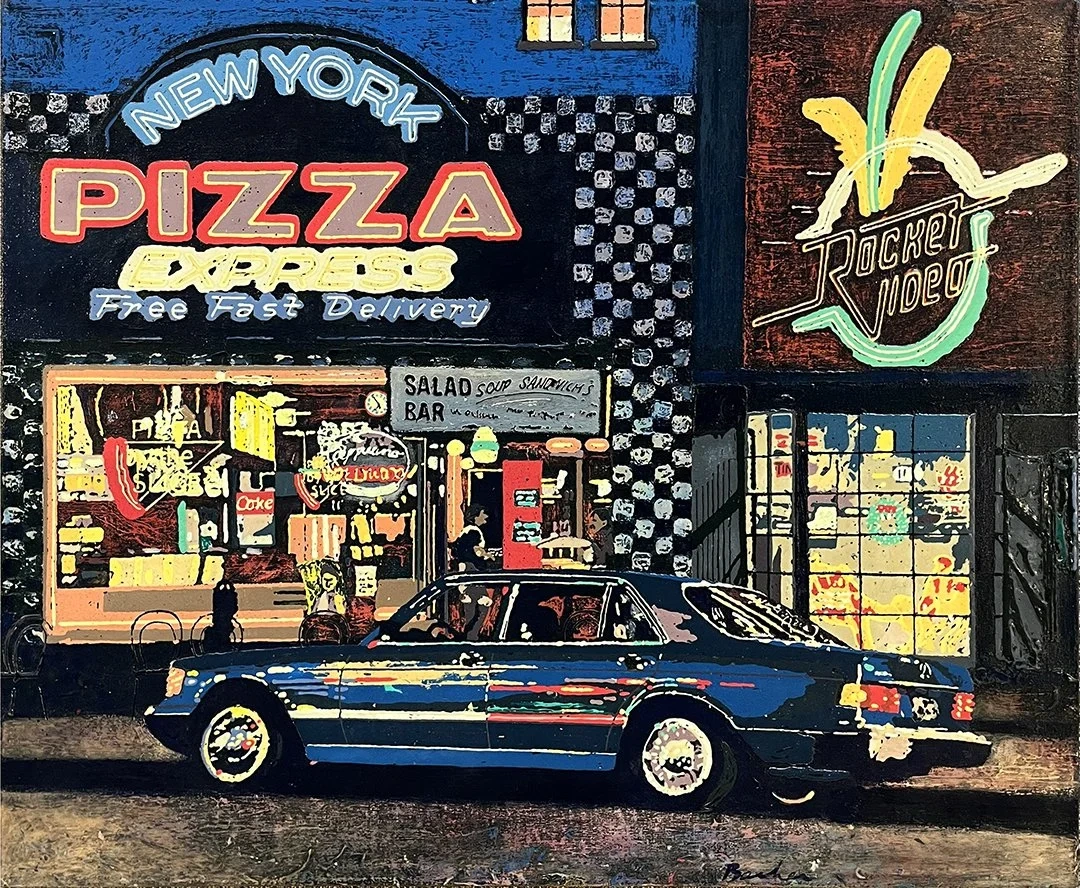
Tom Bacher, Melrose Pizza, phosphorescent acrylic on canvas. Courtesy of Cincinnati Art Galleries, LLC.
His paintings are as quintessentially American as the urban landscapes of the Ashcan school, Edward Hopper’s lonely city streets, and the open spaces of David Hockney and Richard Diebenkorn. His vernacular is American architecture, advertising, automobiles and the American West. In times of economic uncertainty we may come to Bacher the same way people came to Hopper during the Great Depression, to revive in us some idealistic myth about what it is to be American. We might not always find the nostalgia we seek.
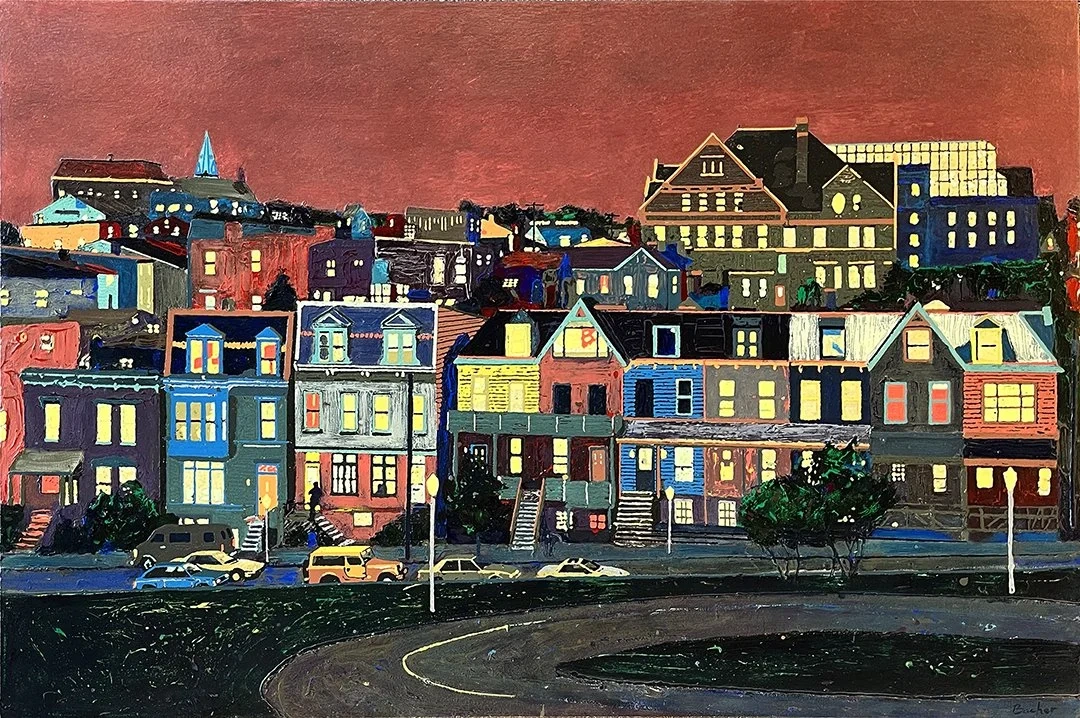
Hopper expresses intense loneliness on banal and vacuous streets with few human inhabitants. Figures are huddled off to one side of the picture plane, together but distant, as in the iconic Nighthawks. Bacher takes this convention further, removing the human figure entirely from the scene. Meanwhile the footprint of man is everywhere in his paintings, in loud neon signs, freshly waxed motorcycles, and the bicycle abandoned on the bridge. Often nature wades in a sea of brick and mortar. In Eden Park Drive trees bob between rows of townhouses in Mt. Adams. This entire chaotic cluster is crowned by the Queen City Tiara.
A series of small paintings of bicycles in Amsterdam is arguably another extension of Bacher’s Americana, celebrating a favorite past-time. In six paintings the bicycle rests against what appears to be the black iron railing of a walking bridge. It is reminiscent of a stroll along the canals, stopping to snap a photo of the jaunty cycle, like an American tourist in the Netherlands.
What is so eye catching about each painting is the cobblestone walkway, built up with layers of gel medium. Bacher uses Golden or Permanent Pigments to build his acrylic layers. This too has been a process of trial and error. Not all gel mediums react the same way to phosphorescent pigments.
“If I use a luminous blue with a Permanent Pigments gel, it will dry real quick and harden, whereas Golden will remain fluid.” he explains.
In the Amsterdam Bicycle series Bacher actually mixed gel medium with watercolors. The pigment bleeds up into the gel giving it this glassy iridescence. Now here is where Bacher’s surfaces get interesting. He is a luminous artist but he also self-identifies as an abrasion artist. He sands down his surfaces. He grinds through layers of acrylic and gel medium. The effect in his Amsterdam Bicycles is a texture like grout between the tiles. This series is even more brilliant in the light.
When Fos-4-s-cent Met-A-more-fik Paintings closes at Cincinnati Art Galleries Bacher will get ready for a new show in Paris and a major publishing endeavor. He says he’s trying to get some 36 years of luminous paintings into one book. He has thousands of photographs to sift through. There is even a kind of homage to Bacher now open at the Cincinnati Museum Center. Artists from Visionaries & Voices have put together After Dark an exhibit of glow-in-the-dark paintings inspired by a recent field trip to Bacher’s studio.
Fos-4-s-cent Met-A-more-fik Paintings continues through November 25 at Cincinnati Art Galleries, 225 East Sixth Street Cincinnati
–Selena Reder













Comments powered by Talkyard.