
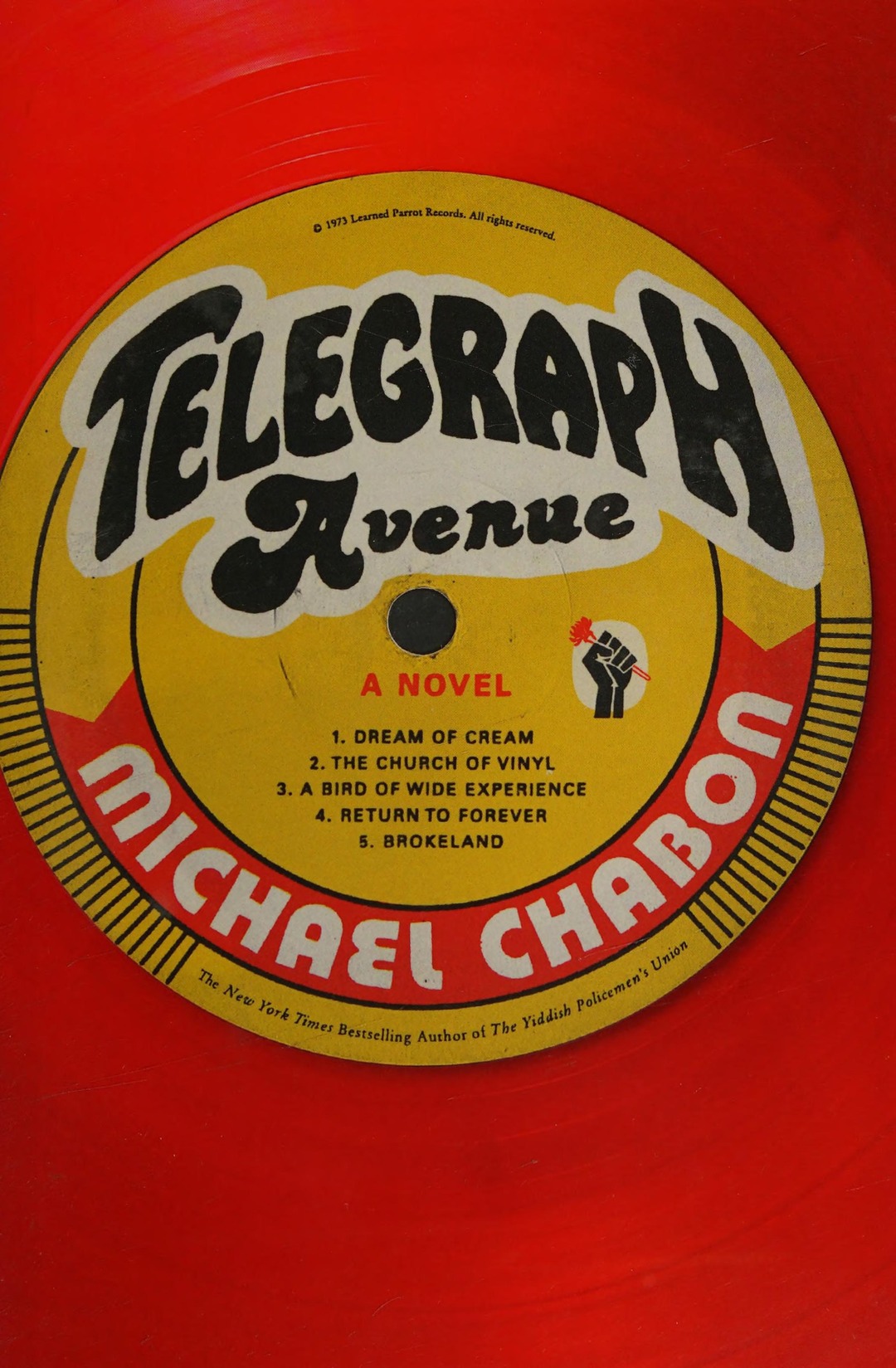
Telegraph Avenue, by Michael Chabon
When a great writer like Michael Chabon disappoints, the disappointment is that much greater, because our expectations are high about virtually anything he writes, and because contemporary American fiction has been so strikingly poor in 2012.
The real Telegraph Avenue became infamous in the l960s as a street in Berkely, California, known for its head shops and other such paraphernalia, and for its location as part of the protest movements. Oakland has long been considered the “bad” side of Berkeley, crime-ridden, drug-addled, and the home of Huey Newton and the original Black Panthers, who were an early radical political group attempting, among other goals, to clean up Oakland and empower the poor and the mainly black.
Chabon present this area as the setting for his novel Telegraph Avenue; ’60s leftovers Archy and Nat have been partners for decades in a used-record business, formerly a barber shop, and their store, though financially failing, is a hub where locals drop by to listen to jazz music, hang out, chat. gossip, remember. Archy, who is black, is married to Gwen a smart-as-hell back woman whose midwife practice she shares with Nat’s wife Avivia. Nat and Avivia are white.
The friendship and business partnership between Archy and Nat is the structuring device of the novel, much of which revolves around the hope of saving this business and the neighborhood/community from the development plans of a former black-athlete-cum business entrepreneur, who proposes to save said neighborhood; the little guys see these plans as a scam and much of the subplot of the novel involves various City Council members and their overlapping agendas. All these characters are leftover from the Newton era, and crimes past and present underscore all the relationships, and those of several peripheral characters as well. The basically fatherless Archy will, in the course of the novel, meet a son he doesn’t know existed while wife Gwen is getting ready to have their child. The broken black family is countered by the wise and successful black Woman, Gwen; Chabon positions Gwen as the best educated, most socially mobile and from a background of judges and lawyers and doctors. Sociological cliches abound.
As do subplots: pasts circle around presents and futures, and the reader often wonders how much of the detail is necessary for the narrative and how much of it is Chabon showing off his research abilities. The author’s understanding and knowledge of early jazz and rhythm and blues is impressive, if monotonous. One senses a competition with Jennifer Egan’s Goon Squad throughout, both in narrative, character development, and even in the syncopation of Chabon’s language.
Unfortunately, the thinnish plot feels more like a television or movie script than a novel, skimming the surface of many racial cliches, stereotypes, and post mortems on the nature of communities, past and present (Archy, in the end, will become a realtor). Since Archy and Nat are the primary characters, Chabon fails to delineate much about either of them: he tends to create some strongly defined and nuanced characters (Gwen; Archy’s father and his girlfriend; Nat’s son) and some cardboard ones, and his primary protagonists fall flat, and usually seem one-dimensional.
Chabon’s other maddening problem in Telegraph Avenue is his often overblown language. Writing is always about how language is used: Chabon’s prose is frequently overlyrical and overripe, overwritten; he insists on using three descriptive adjectives or adverbs on virtually any noun all through the novel, and the three are often unnecessary, sometimes redundant , and often don’t make sense together. One is led to conclude that Chabon has some sort of OCD problem with adjectives, making much of the writing in Telegraph Avenue cloying and occasionally downright embarrassing. Chabon needs a much tougher editor.
Telegraph Avenue is occasionally moving and occasionally funny, but as the big novel I suspect that it is meant to be, it fails.
—–Daniel Brown












Comments powered by Talkyard.