Installation view, “Perfectly Concocted Context” by Jonathan Monk. © the Artist; Courtesy Cherry and Martin, Los Angeles
Paradoxically, Jonathan Monk’s show at Cherry and Martin exists simultaneously as a well-curated group show and Monk’s single-authored conceptual installation. Surprisingly, instead of leeching all significance from its constituents, the show embodies its title, “Perfectly Concocted Context.” Individual artworks are shown to advantage while uniting to form a more meaningful whole that resounds their spirit like an echo chamber.
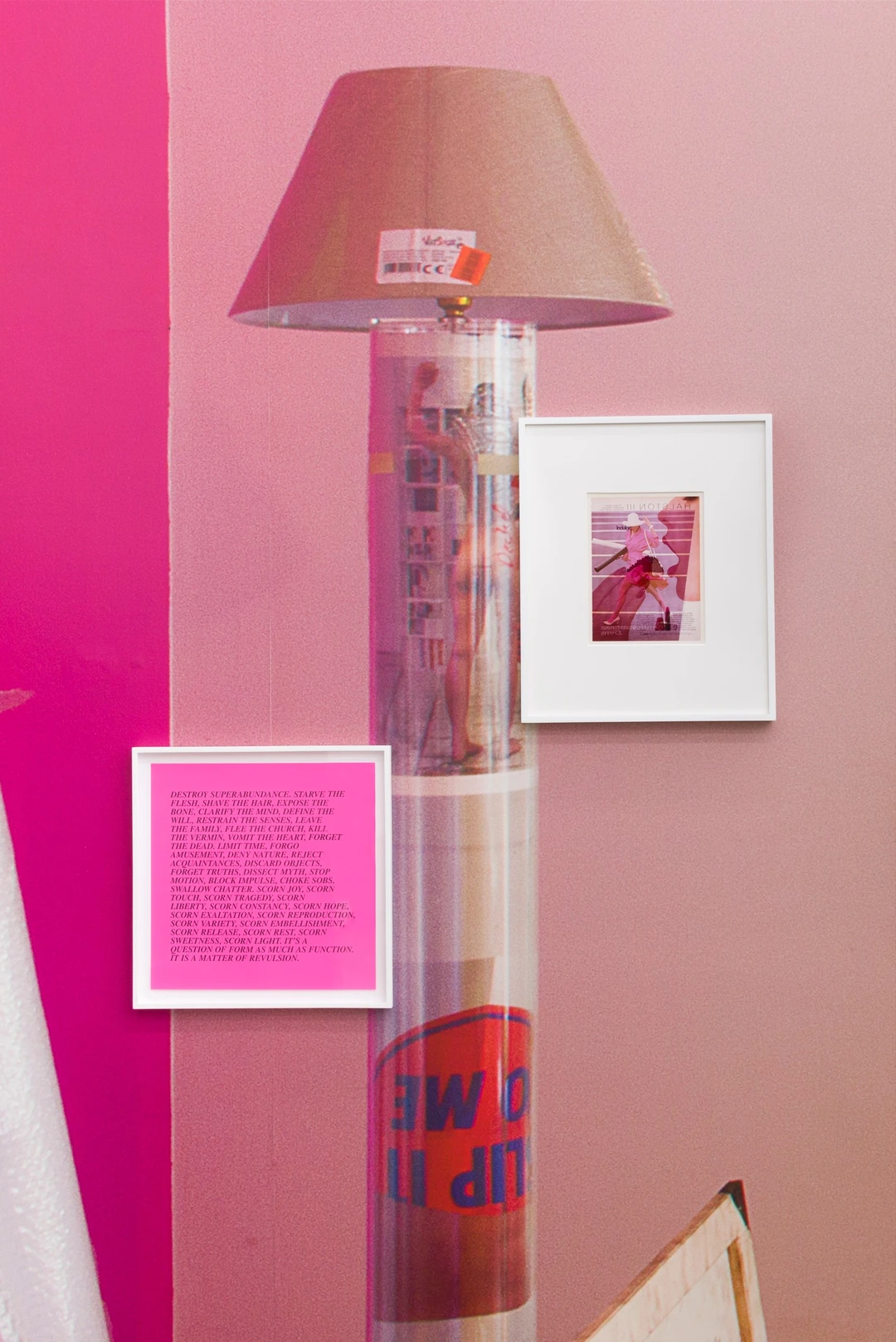
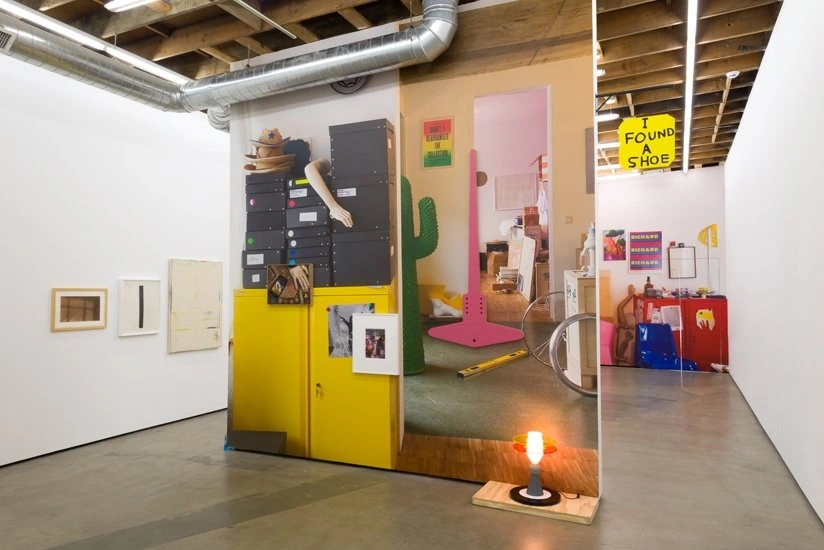
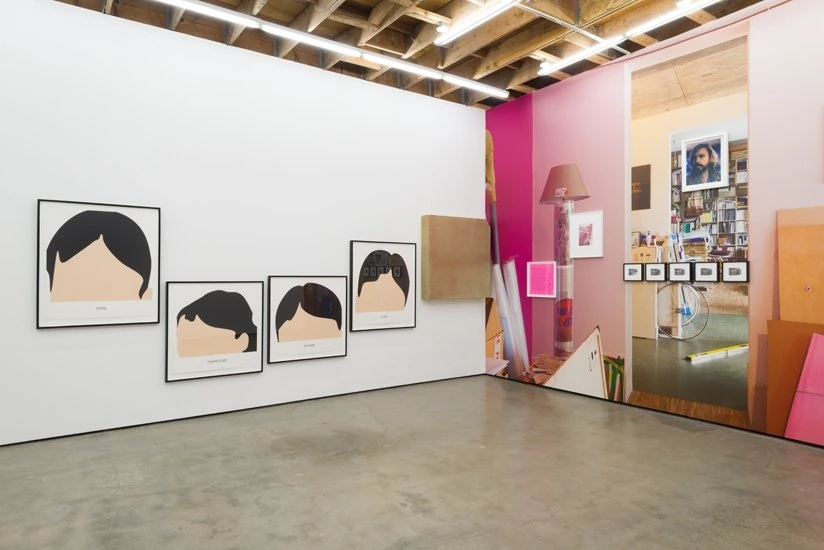
The installation appears as a partial re-creation of Monk’s studio. Besides the curation, he contributed Studio Model One(2017) and Studio Model Two(2017): two walls papered in large-scale photos supposedly portraying his work areas. These look more like scenes from a storeroom or library of artworks that one would expect from a collector or gallery. This fits Monk’s modus operandi of using other artists’ work to create his own, and here he plays the role of artist-as-collector quite literally. Instead of traditional materials like paint or sculptural compounds, this suggests that his studio contains other artists’ work.
As its title implies, Monk’s installation, and its concomitant works by other artists, address context, re-contextualization, and appropriation either of images, ideas, or actual items. Nina Beier’s bottled liquids, one of a particular brand of perfume, and the other of a particular brand of liquor, while ostensibly the same color and purchased at the same shop, invite purely visual inspection of commercial packages’ content. Other pieces employ recycled images, icons, and text.
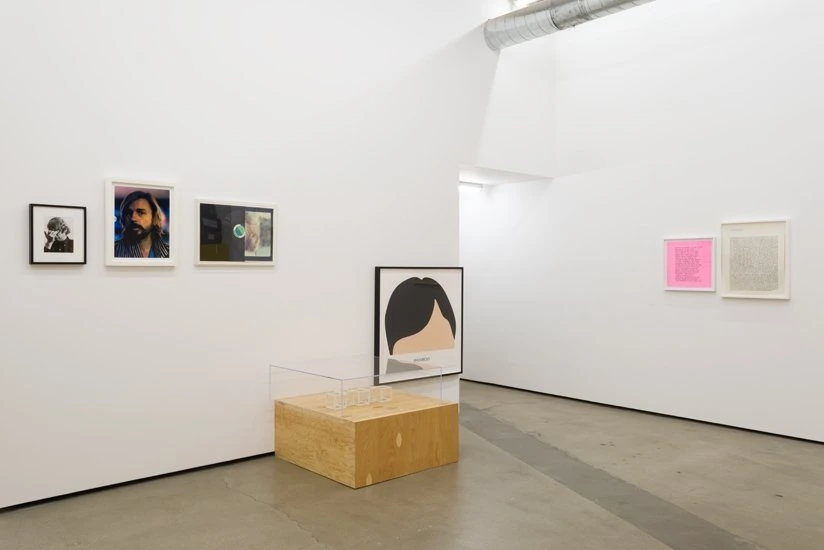
Installation view, “Perfectly Concocted Context” by Jonathan Monk. © the Artist; Courtesy Cherry and Martin, Los Angeles
Visually and conceptually, disparate artworks and depicted scenes harmoniously align. Mirroring the shape of its own glass enclosure, Sol LeWitt’s sculpture of joined cubes also echoes the rectangularity of framed 2D pieces on nearby walls. Perhaps the format of Louise Lawler’s vinyl wall piece across from Studio Model 2 provided Monk’s inspiration for his own wall pieces.

Installation view, “Perfectly Concocted Context” by Jonathan Monk. © the Artist; Courtesy Cherry and Martin, Los Angeles
Works by other artists are hung on each of Monk’s wall pieces, which have a trompe l’oeil effect. From afar, it’s difficult to tell which pictures are part of the photo and which are hung over the photo-papered wall. It feels as though the gallery space has been transformed into a 3D collage.
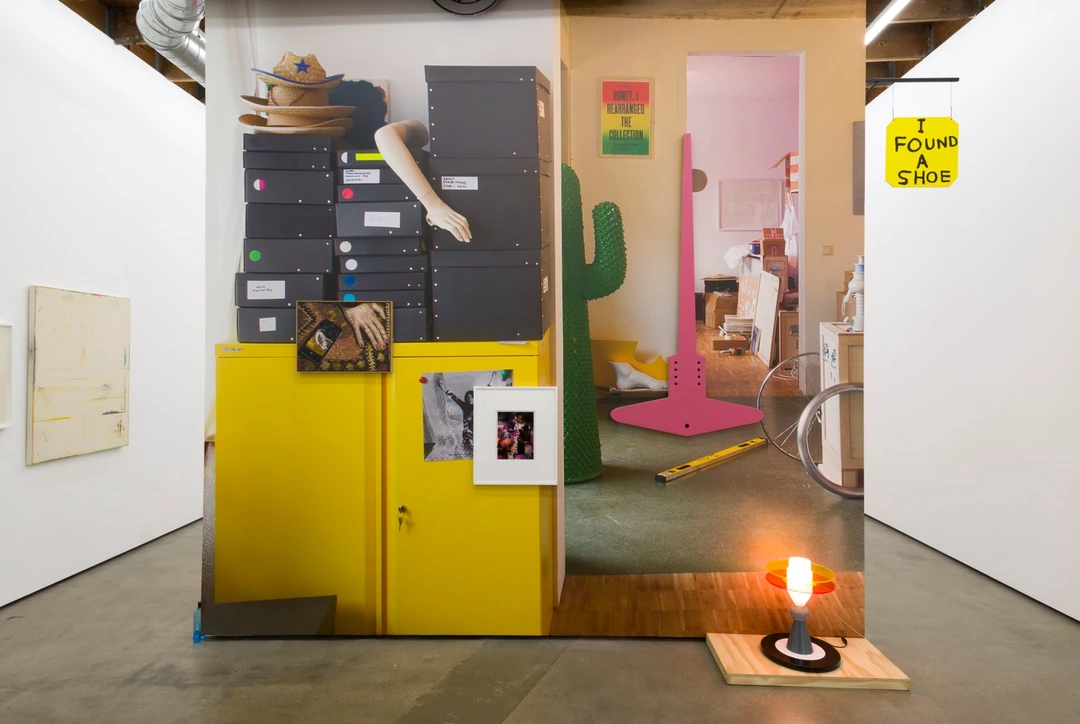
Installation view, “Perfectly Concocted Context” by Jonathan Monk. © the Artist; Courtesy Cherry and Martin, Los Angeles
In contrast to the cool opaque gloss often typifying Conceptual or Minimal art, this installation’s inviting environment evokes a semi-domestic setting like that of a house. By virtue of their stature extending from floor to ceiling, Monk’s wall pieces visually activate the space around them. Mundane architectural features that would normally be inert, like pipes and air conditioning tubes, seem integral. Ettore Sottsass’ lamp on the floor in front of Studio Model One, Ceal Floyer’s welcome mat turned to welcome visitors as they leave the gallery, and David Shrigley’s sign appended to Studio Model One, reading “I found a shoe” on one side and “I lost a shoe” on the other, all play on spatiality and connote domesticity.
Installation view, “Perfectly Concocted Context” by Jonathan Monk. © the Artist; Courtesy Cherry and Martin, Los Angeles
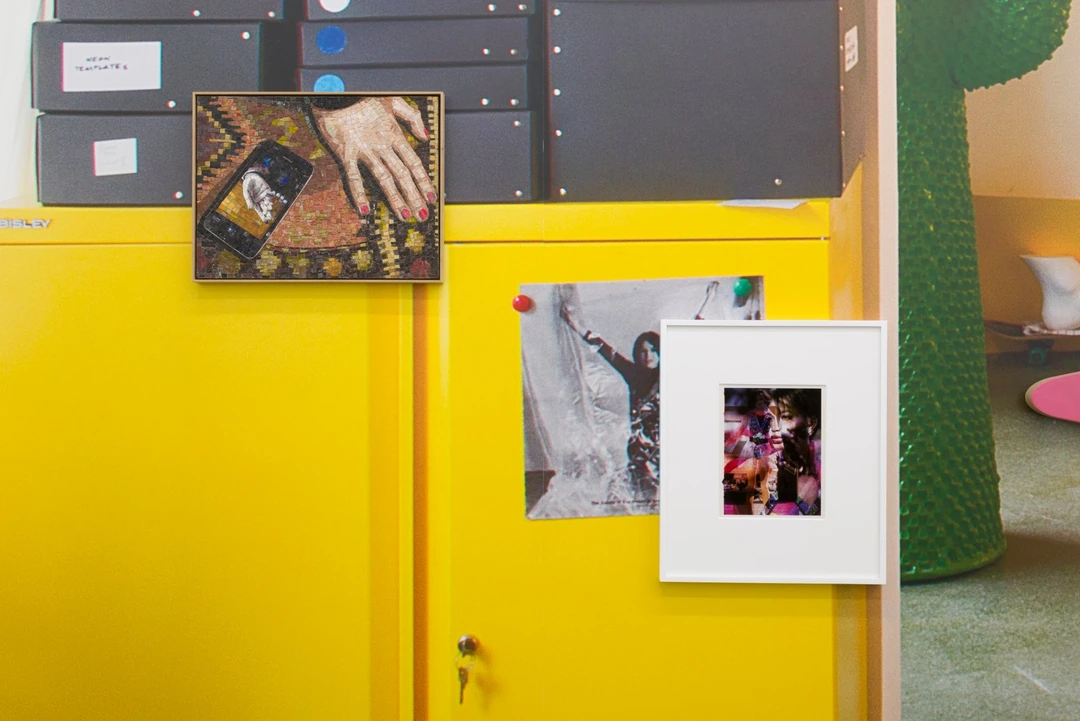
Composed of tile pieces that together form a single picture of a fuchsia-nailed hand next to a smartphone on a tile floor, Isabell Heimerdinger’s mosaic is like a keystone to meaning. This piece combines hominess and commerciality; like a family photo digitally printed on a blanket, its incongruously photographic materiality gives it the sense of having been re-contextualized.
Installation view, “Perfectly Concocted Context” by Jonathan Monk. © the Artist; Courtesy Cherry and Martin, Los Angeles
Like a hall of mirrors, amusing layers of appropriation reverberate in Ryan Gander’s Portrait of Mark Leckey (2009). Within Monk’s collagelike installation of artworks as readymades, this depiction of an artist known for employing found objects becomes a locus for three artists’ similar interests. Leckey as subject, Gander as artist, and Monk as curator/overarching installation artist share and exchange roles, symbolizing the fluid identity of individuals wearing different hats within the art world.
Installation view, “Perfectly Concocted Context” by Jonathan Monk. © the Artist; Courtesy Cherry and Martin, Los Angeles
The show as a whole conveys this sense of artists influencing each other as they do in real life. Picasso said, “Good artists borrow, great artists steal,” but maybe the notions of stealing and borrowing no longer apply. In the art world and everyday life, images and ideas are increasingly pooled, to be retrieved and selected as building blocks for others’ empires. In our hashtag-happy digital era, there’s no shame in sharing–as long as you tag your content’s origin, which Monk does via exhibition checklist.
Installation view, “Perfectly Concocted Context” by Jonathan Monk. © the Artist; Courtesy Cherry and Martin, Los Angeles
His installation celebrates the impossibility of separating one’s own ideas from those of others. Here this timeworn notion is so seamlessly and engagingly integrated that its triteness doesn’t seem to matter. After all, we still haven’t gone beyond postmodernism; many call our current era post-postmodern–a term that seems a self-contradiction for its adherence to postmodern ideas. Postmodernism is so ingrained that it can’t be extirpated, so why not embrace it? Befitting our indeterminate age of infinite digital reproduction, Monk’s show is refreshing for the way it looks backward and forward without sacrificing interest for irony.