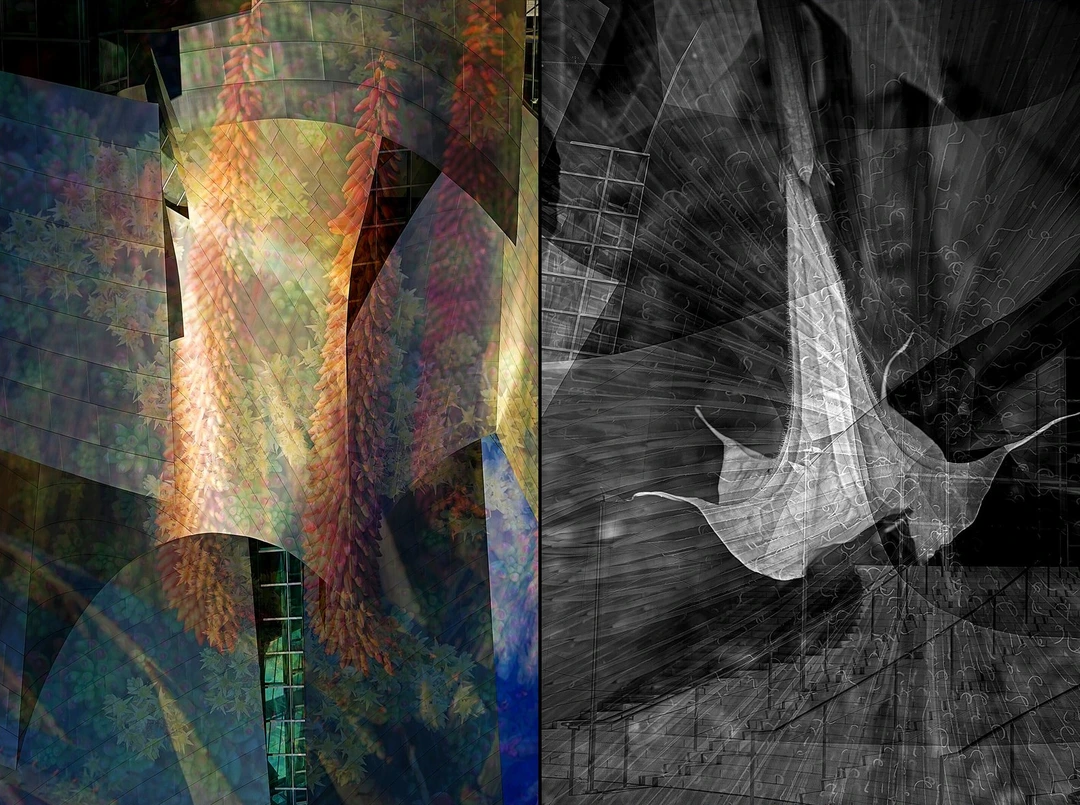
For all the distance between them, Tony DeVarco and Mayako Nakamura have uncanny aesthetic affinities. Both revere the cycles and surprises of the natural environment; both attempt, in the same visual plane, to capture fluid forms and the emotions they evoke; both frame the viewer’s experience as a creative act rather than one of static reception. Whether working alone or together, the artists investigate apparent contradictions: the materiality of affect, the evanescence of solid bodies, the color of touch. While their images convey a fascination with sensory experience, they also tend to decenter the human, addressing how the ecosphere acts on us rather than the other way round. Taken together their works affirm a kind of ecological integrity, figuring artist and audience as connected not just to each other but their ambient contexts, where everything subsists in a maelstrom of alteration and becoming.
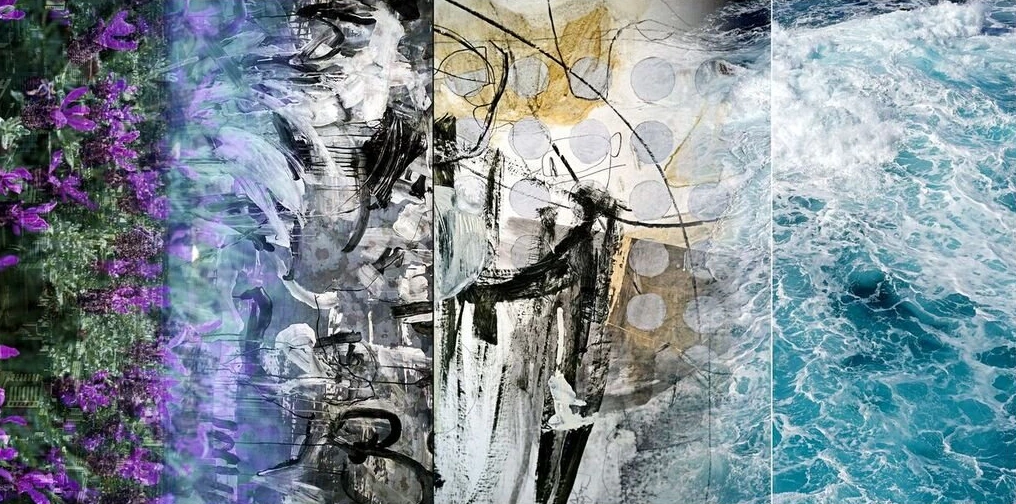
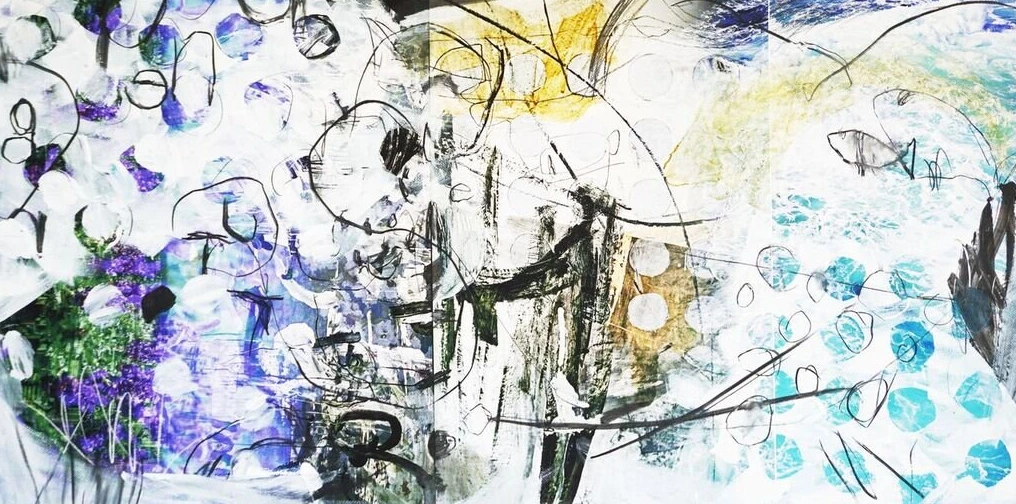
DeVarco and Nakamura initiated their artistic correspondences when he visited her studio in 2013 and her Tokyo show the next year. He thereafter proposed a collaboration whereby he would produce digital photos of her work, meld them with his own high-resolution composites, and send them to her to apply yet more layers. So began a partnership that continues today, with results most recently on display at the Marta Hewett Gallery in downtown Cincinnati. The gallery’s showing of “Regenerations” features their solo works as well as the duets, inviting visitors to consider how the single-authored texts communicate with each other while affording us frames for viewing the shared ventures. The show’s title holds multiple kinds of significance, connoting the artists’ attention to the rhythms of maturation, dormancy, and rebirth, and also signaling the transformation of the images as they cross borders.
To recognize how these transformations occur, we do well to start with the individual output of each artist. DeVarco relies on multiple media, bringing his background as a sculptor, dramatist, and set designer to bear on his efforts in digital photomontage. Merging the interactive ethos of his mentor Mark di Suvero with the shapes and grains of Isamu Noguchi, he filters a range of spatial and haptic experiences into his images, inviting the addressee to enter an assemblage of overlapping visual fields rather than adopt an attitude of distanced contemplation. We see his sensitivity to the aesthetic possibilities of stone in “Terra Ourania (Heavenly Earth),” as a chiseled torso and rounded pavers appear through a scrim of vegetation and distorted architectural details. Similar effects resonate through “Spatial Reality (III),” wherein swaths of jungle coexist with glittery fragments of the built environment as scaffolding and substructure peak through both halves of the image. “Spatial Reality (IV)” suggests the fragility of such structures, transposing polished granite into smoke or billowing sails. All three texts perform tricks with density and depth so that firm exteriors appear watery on second glance, and what seem to be the far recesses of an image morph abruptly into proximate surfaces.
Such play continues in “Spatial Reality (V),” albeit with intensified contrasts as the gaze moves from one panel of the diptych to the other. Pastels become charcoal and bone. A coppery, decomposing cylinder in the left panel gives way to ghostly drapery in the right. Or look again and the apparition becomes a lily reaching back toward the earth. Yet the space is still haunted, not earth at all but a misty wooden attic where things emit an otherworldly glow. The vibrancy of the multicolored panel enters into the dark half of the image through rhyming arches, hints of scaffolding, the enlargement of floating leaves and flowers. Although the range of the palette diminishes with such movement, the image becomes more assertive, its striated patterns reaching toward us with spectral persistence.
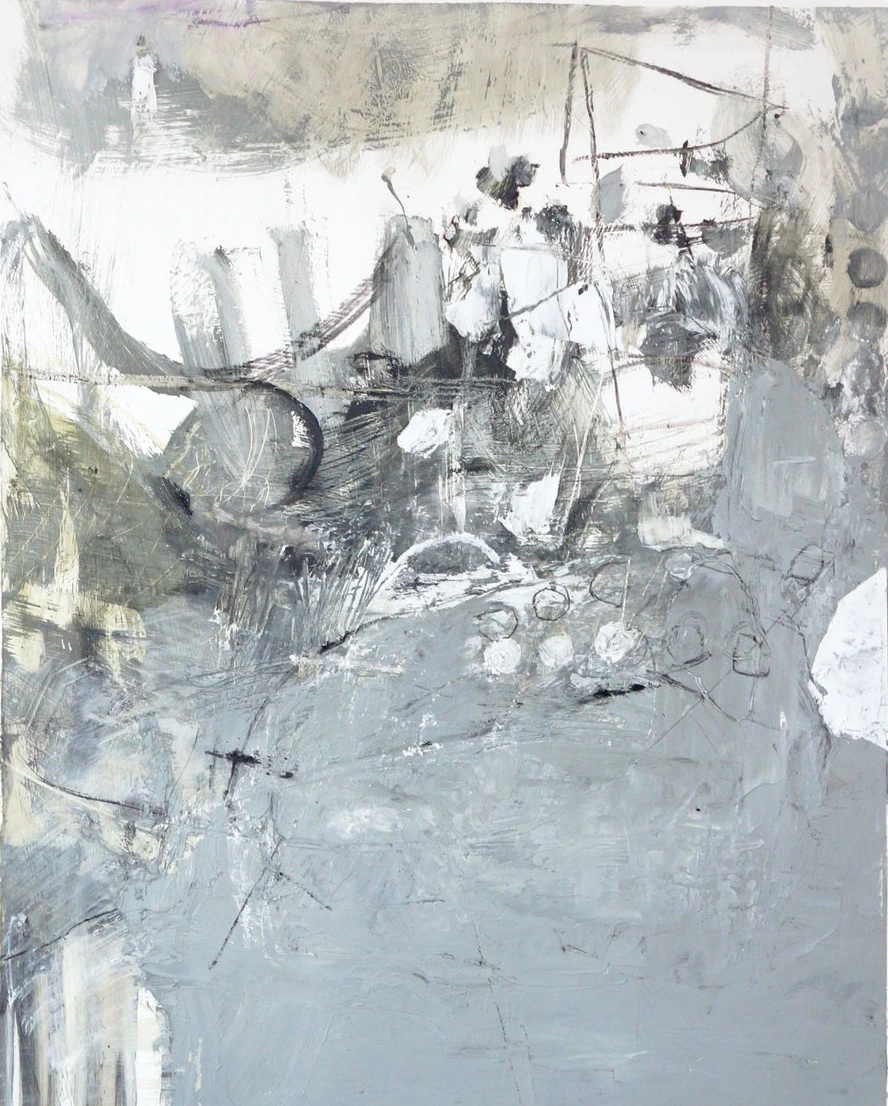
But however carefully we translate the image into words, it rebels against description, offering visual counterclaims and begging for other approaches. Nakamura’s paintings prove similarly elusive, designating sensory experiences in their titles yet pressing toward affective expanses that defy conventional language. Her artistic development was itself unconventional, beginning in earnest only five years before her first meeting with DeVarco. At the outset she aimed to communicate her emotions through “intense and aggressive images” but gradually moved toward more restrained forms of expression (Katoh 135). Inspired by everyday things and activities, she paints “atmospheres” that connote her immediate surroundings while also hinting at “another every day”—a sensory realm that is irreducible to the concrete spaces she inhabits (Regenerations). Yoshio Katoh compares her energetic lines to “childlike doodles” and yet lauds her conceptual maturity: Nakamura’s canvases recall the kinetic, intuitive character of Cy Twombly’s work while featuring a sensuality entirely her own. She composes in the tradition of “automatic drawing,” Katoh explains, and the results come to us “carved out of her subconscious” (135). Rather than just painting the situation in which she finds herself, the situation guides her hand; rather than orchestrating the unruly currents that constitute day-to-day life, those currents flow around and through her. If she is a conductor, it is more as a medium than an agent of command.