
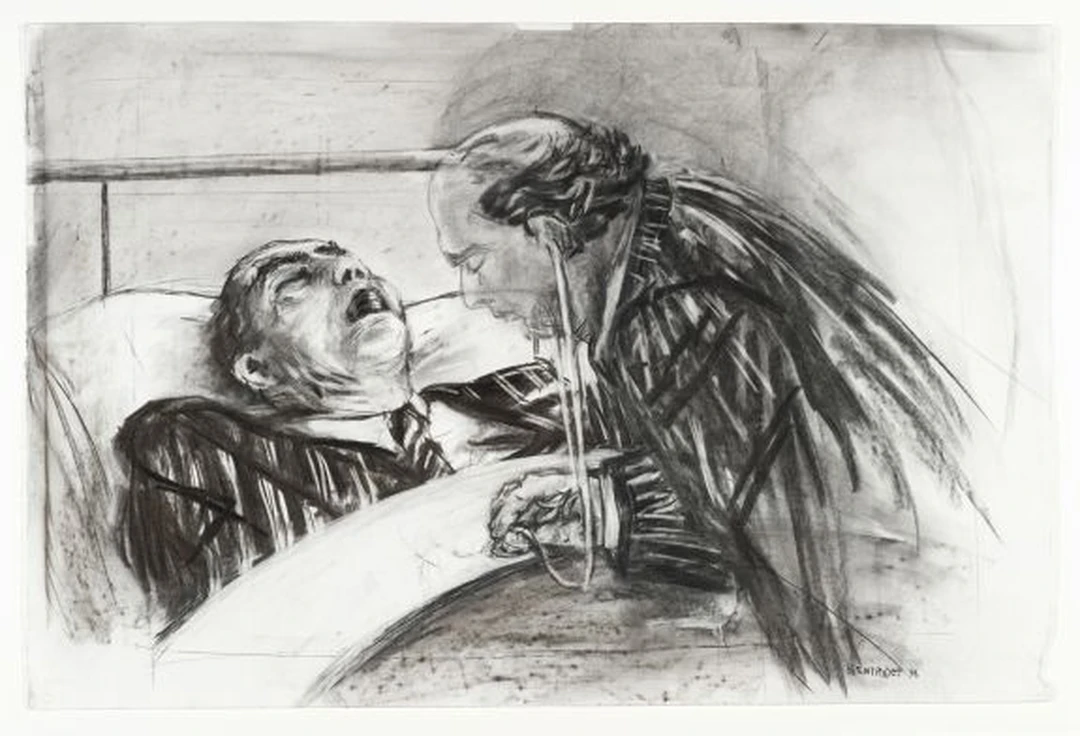
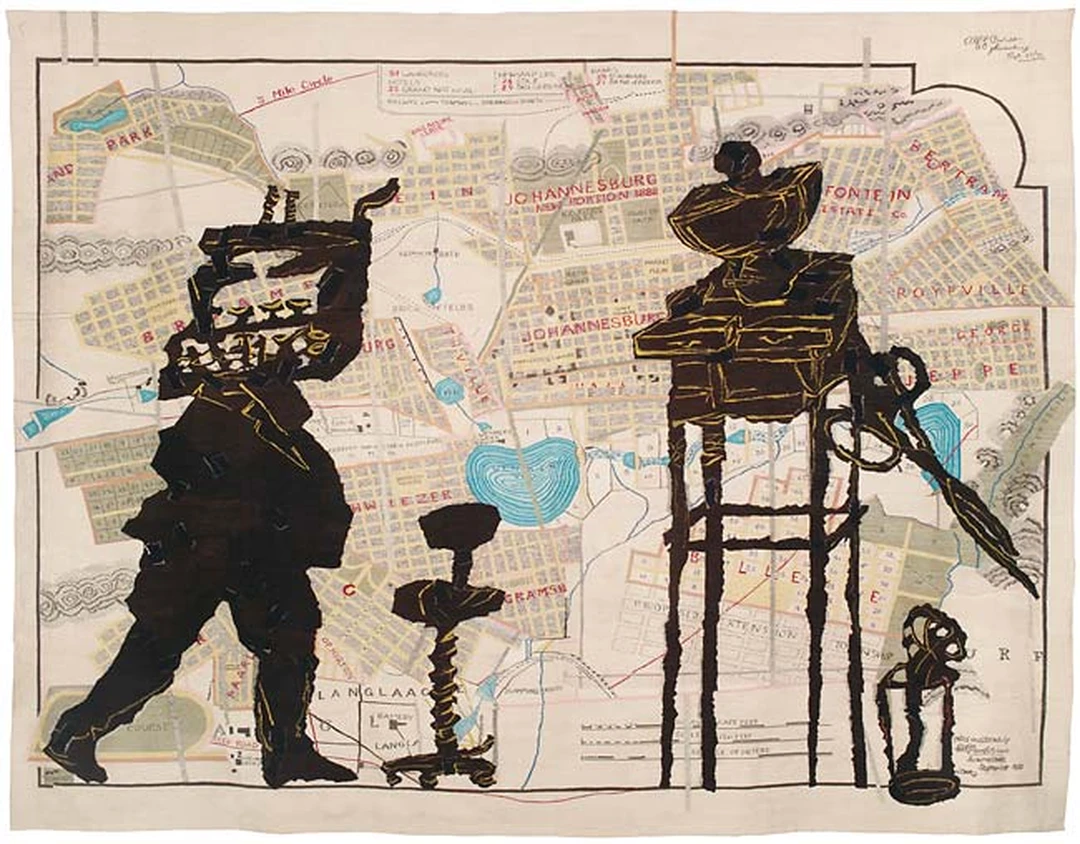
The Drawing Center in New York featured the art work of William Kentridge in 1998, a year after he premiered at Documenta X, Kassel, Germany. The MCA-Chicago first presented the work of South African Kentridge in 2001 in his first American survey and it was during this time period that Kentridge’s star rose in America. Since I first became aware of William Kentridge’s art work, I have been privileged to see his work in the following mediums: drawings and drawing for stop-action films, collage drawings and hand-made puppets of varying sizes for opera.
Seeing Kentridge’s drawings and stop-action films in various museum exhibitions from that time still call up powerful memories. When I saw his art at the Drawing Center, I felt that few artists were using the raw power of drawing in such a direct way to make films: drawing, erasing and redrawing elements to move the narrative forward. People watched his films spellbound.
This most recent MCA exhibition featured two videos: Felix in Exile and History of the Main Complaint, both in the Museum of Contemporary Art’s collection. At the time of their making, this kind of raw, direct drawing method to create stop-motion animation was surprising. No bells and whistles, simply beautiful drawing and the ability to make imaginative shifts in scale or form in telling powerful stories of apartheid and its dissolution. Kentridge constructs these films by first filming a drawing, usually a landscape or interior setting. Then he erases a figure or part of the scene, adding the next element allowing a quarter of a second to two seconds of screen time between changes, before he films the next element he has drawn. He continues this process unrelentingly through the course of a drawing/filming day. A single drawing is altered and filmed this way until the scene ends. He then begins a new tableau, as it were, a fresh sheet of drawing paper where he lays out the basic setting, such as the cluttered office desk of Soho Eckstein, the white South African power broker. Kentridge works in such a unique way, erasing an area of a competent drawing to add a small motion in the eyes, say, then filming and erasing a larger gesture of the arm or of the movement of rioting blacks Eckstein sees from his office window.
This work then, is a palimpsest. Kentridge is preserving the original drawing and he erases to add new layers on top of it as the ancient Greeks scraped away writings to use the precious parchment to write new verses that were then scraped again (from palin + psēn to rub, scrape.) Compare this emotive, hands-on method to Disney’s cel-shaded animation, and you can see and feel the difference between the conspiratorial method Kentridge deploys and Disney’s seamless fool-the-eye flow. With Kentridge, we are in on the act. We can see the ghost head or arm that Kentridge erased. We follow, our hands and mind can work with him, a step behind, but breathing, caring participants in the process and to the story. His erasure technique gives us generous entry into his mind’s eye and we are riveted. We participate in the ghost images as memory, our own memories, our own vision of what did take place, what should have taken place, of who should have risen up to speak to the rights of the black South Africans or to the hero Felix, who remembered the black woman he loved. The surviving drawings along with the films are displayed all as finished works of art. The use of color is minimal yet powerfully symbolic, blue chalk for water, in Felix’s sink or in the pond on the savannah. A simple and moody soundtrack helps keep things simple and keeps the viewer focused on the story.
At the MCA exhibition, a dozen drawings from the two animated stop-motion films that are in the MCA permanent collection helps us see how Kentridge made his films. Traces of a man’s head remain in the sky in a drawing that was used for the transition from inside a South African corporate office to the savannah where a black man lays dead and still bleeding. The drawings bear witness to the process.
In the twenty years since Kentridge’s artwork being disseminated to a wide audience, Postmodernism has crested and fallen. The computer mouse and software are commonplace drawing tools in our post studio/post production era. Artists can and do have manicured hands now. The survey, William Kentridge Museum of Contemporary Art MCA DNA, which opened in the fall and is closing March 17, 2013, might be called “Requiem for a Heavyweight.” I am a champion of classical practices, yet I see the edge gone from these works, compared to current art of enormous scale made by giant scanners and printers outputting photo-based images onto giant swaths of vinyl or coated canvas. Can the human hand compete anymore?
I reflect on this sad fact and compare Kentridge’s rather old-school drawing, (fabulous, deft draftsmanship, good drawing paper, and a graphic punch from primarily black charcoal on white paper) to what appears to be one of the aforementioned giant printed images on the first floor of the MCA. Goshka Macuga’s enormous, Photoshopped tapestry “Of what is, that it is; of what is not, that it is not 1” seduces with its scale, deception (what, not a photograph, a tapestry?) and confusing/compelling images. It helps that a cobra rears up dead center among the throngs of different ethnic and cultural groups. The companion tapestry is currently on view at the Smart Museum of Art at the University of Chicago. Macuga made these two compelling tapestries with the intention that they are never seen together, reinforcing the problems of cultural divides, in this case Afghanistan and Western expectations and traditions. These tapestries were commissioned by dOCUMENTA 13 where they were on view before coming to Chicago. There is no point ringing hands, we most of us use digital technology throughout the day. We love the photographs our Smartphones and laptops offer up. Our eyes are covered with scales (pixels?)









Comments powered by Talkyard.