
Francisco José de Goya was 53 years old, seriously deaf but acutely visual, when he published the extraordinary series of eighty images called Los Caprichos now on view at the Taft Museum of Art. Caprichos—the word means “whims” or “fancies”—in this artist’s hands become the thoughtless, often cruel, frequently selfish extravagances of a society in which the verities are up for question and political and economic uncertainties spawn frivolous behavior. Where are the grownups, one wonders, as foolishness follows foolishness and witches and such like gain due respect.
First published in 1799, these reflections of late 18th century Spain present uncomfortable parallels to our own times. You will find them; I am only going to write about what Goya shows us and how he does it.
He begins with a portrait of himself, top-hatted, mouth turned down at the corners, eyes narrowed. It’s plain he doesn’t like what he sees. In the next seventy-nine works he shows us why. The self portrait, Number 1 of the Los Caprichos series, appears in the entrance gallery for the show, along with a useful introductory label for the exhibition and a few works from other series. The Taft does labels well, expanding the experience rather than hindering it, and in a first for the museum offers both English and Spanish versions. Folders with bi-lingual label text in large type are also available for visitors to carry through the show, as are magnifying glasses for close examination of these small, dense works.
The non-Caprichos works in the entrance gallery include two early etchings, copies of Velazquez paintings, that show the artist exploring the medium and also suggest whom he admired. One work each from three later series—Los Caprichos was the first—indicate that Goya continued to use this expressive form to register his always strong opinions. These series were not immediate successes or money-makers. Los Caprichos went on sale first in a perfume shop, probably to avoid undue attention in a world where the Inquisition was not wholly gone. It sold badly and was quickly withdrawn. The works on view at the Taft are an early first edition, purchased directly from the artist, and belong now to a private collector who has lent them for the exhibition.
The problem of displaying several dozen small works in a large gallery without diminishing their effect and overwhelming the visitor is solved by a series of temporary walls that produce a serpentine way through the show and, while adhering to the original order, lightly group images with linked themes. Numbers two through nine deal with foibles of courtship and mating, deception running high on both sides, plus a concern that surfaces later and could be expressed as “Who’s watching the kids?”
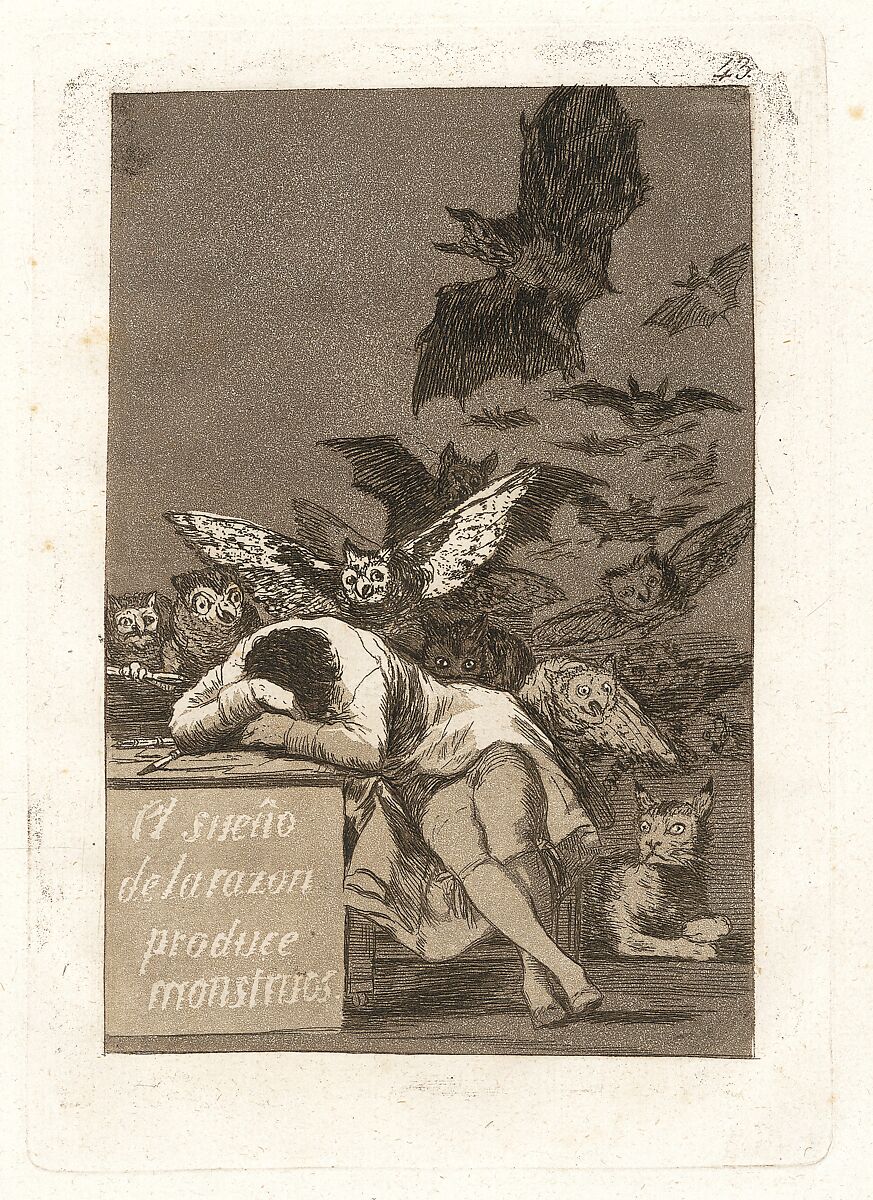
From then on he’s throwing stones in all directions: at the church, at incipient criminals, at superstition, at prostitution and all it entails, at bad schools and worse politics. Aristocrats get it in the teeth; a donkey proudly displays his lineage. In the famous image numbered 43, The Sleep of Reason Produces Monsters, dreams are tormented by big-eyed, feathered and furred creatures. Number 75, Can’t Anyone Untie Us? shows a couple hopelessly and painfully entangled and might hang in any divorce lawyer’s office today. Things only get worse as the series progresses. Perhaps the most shocking is a piece near the end, dealing with pedophilia.
Labels suggest that some of these works are ambiguous. In Number 59, And Still They Don’t Go, is the giant stone Death crushing the people beneath it, or are they pushing back against it? Does Number 61 show Goya’s friend and patron, the Duchess of Alba, or does it deal with delusions of grandeur? Like all the best art, answers are with the beholder. At the very end, Number 80, Now Is The Hour, could suggest that bad things leave at dawn. Might the ideas of the Enlightenment, the movement Goya himself subscribed to, bring a better day? Or not. Your call.
These disturbing thoughts, as relevant today as when they first were posed, are expressed in etchings often enhanced by aquatint. Goya, a consummate master, pushed the barriers for such prints, developing innovative etching techniques and anticipating the concerns of artists to come. Ideas that would motivate as yet unnamed movements—Post-impressionism, symbolism, surrealism—he was already trying out.
.jpg)
.jpg)











Comments powered by Talkyard.