A month ago, during Arte Desobediente Exhibition, I encountered for the first time an artwork by Kerstin Imhoff that has remained with me ever since. It was a visceral piece from her ongoing Bloodline series: a hyperrealistic red vulva rendered in wax-like texture through 3D printing, encircled by a Catholic rosary terminating in a bronze cross. The work was at once devotional and confrontational; an image suspended between martyrdom, sexuality, political violence, and feminine embodiment. It carried the unsettling power of something both deeply intimate and historically collective. Encountering Bloodline now in its expanded installation form feels less like viewing a separate work than continuing to assemble fragments of an inherited narrative. One that is raw, political, bodily, and haunted by religion.
Created as her BFA thesis at Kentucky College of Art + Design, Bloodline unfolds as an installation about inheritance, not of objects, but of trauma, memory, and embodied violence. Emerging from the historical aftermath of the Salvadoran Civil War and her mother’s participation in the FMLN guerrilla movement, Imhoff transforms personal history into a ritualized spatial experience where political violence becomes inseparable from familial intimacy.
At the center of the darkened installation rests a transparent resin cast of the M16A1 rifle once carried by the artist’s mother during the war. The weapon, suspended between relic and ghost, loses the opacity and authority traditionally associated with militarized objects. Yet its violence remains intact. The rifle’s functioning scope contains a video in which Imhoff herself lifts the weapon and points it directly toward the viewer before abandoning it and walking away. This gesture becomes the emotional axis of the work: a confrontation followed by refusal. The inherited instrument of violence is acknowledged, handled, and ultimately relinquished.
Placed upon a pedestal draped in lace, the rifle acquires an unsettling dual symbolism. Imhoff associates the lace with the religious institutions that sheltered her mother after the war, spaces of refuge and reconstruction. Yet the image simultaneously evokes bridal iconography, a spectral bride carrying the burden of inherited trauma into the future. This tension between sanctuary and sacrifice is central to the installation. The maternal body becomes both protector and transmitter; survival itself leaves residues that migrate silently across generations.
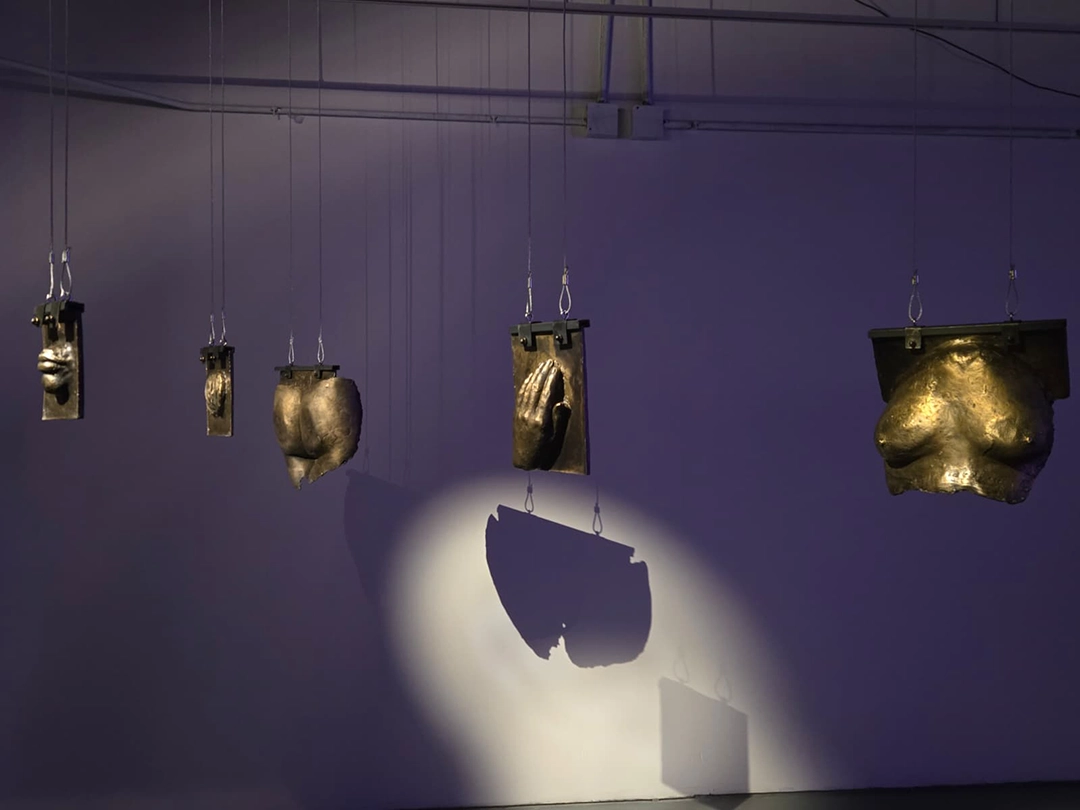
The installation resonates strongly with the language of family constellations theory, particularly the notion that unresolved trauma persists within descendants until consciously recognized. In Bloodline, Imhoff appears to inhabit not only her own subjectivity, but also the emotional afterlife of her mother’s experiences. The body fragments suspended opposite the rifle (bronze reliefs depicting a mouth, hand, breasts, buttocks, and female genitalia) suggest the fragmentation of identity under systems of violence. Cast in bronze, these vulnerable bodily forms acquire the permanence of monuments while remaining profoundly intimate. The rifle points toward them as though history itself continues to target the body, particularly the female body.
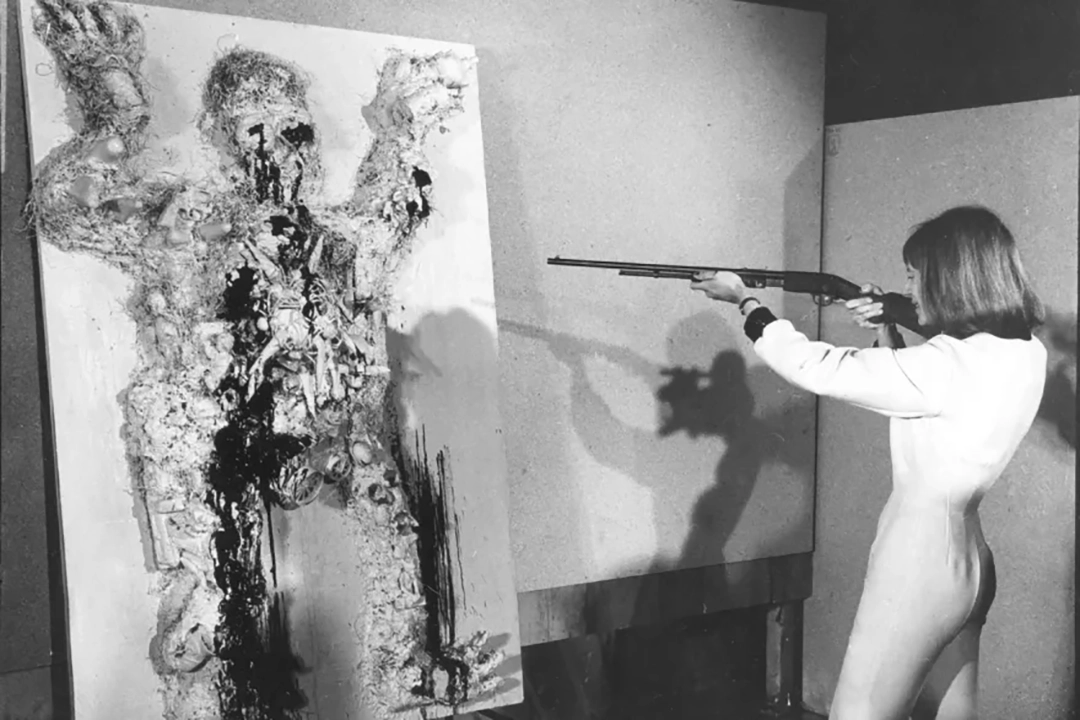
'I shot against all men, big, small, fat, thin, against daddy, against my brother. Because it was fun and it made me feel great – I loved to see the picture bleed and die. I became a terrorist in art. Painting is crime. I killed the painting.'
Art historically, Bloodline enters into dialogue with artists who transformed weapons into instruments of psychological and political inquiry. Most notably, Imhoff’s work recalls Niki de Saint Phalle and her Tirs (Shooting Paintings) of the early 1960s, where firearms became performative tools for releasing rage and confronting patriarchal structures. Yet while Saint Phalle externalized violence explosively, Imhoff internalizes it, presenting violence as inherited memory lodged within domestic and familial space.
What makes Bloodline particularly compelling is its refusal of closure. There is no simplified redemption narrative here. Instead, Imhoff stages healing as an ongoing negotiation between memory and agency. By physically walking away from the rifle within the video, the artist performs an act of symbolic interruption, an attempt to break the trajectory of violence carried through her bloodline. The installation ultimately becomes less about war itself than about what remains afterward: the inherited psychological architectures descendants must learn to name, carry, and perhaps finally transform through art.













Comments powered by Talkyard.