
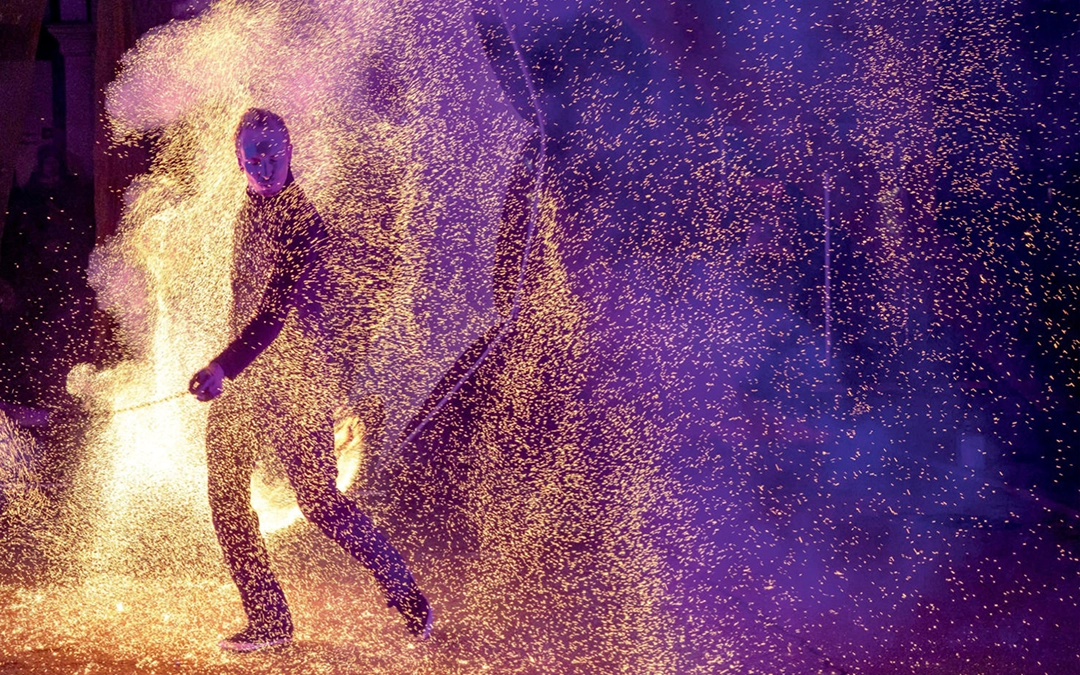
Why share an image that, from an aesthetic standpoint, I find unpleasant? Of all possible complementary color pairings, this is probably the only one I would never use in a design or in a work of artistic intent. Together—yellow-gold and cold violet—they vibrate in an unbearable way, imposing a visual rhetoric saturated with meaning. Perhaps because, over centuries, they have been associated with institutions now perceived as decadent, with a solemnity that fails to justify itself. If someone offered me the choice of wearing, for a year, a gold Rolex or a plastic Casio, I would choose the latter without hesitation.
And yet, among the several images I am studying in order to write another text, this is the one that unsettles me the most.
Let us turn to the context.
In Ljubljana, the capital of Slovenia, between Christmas and New Year, the Ana Mraz Winter Street Theatre Festival takes place. It is an urban theatre festival that transforms many areas of the city into stages offering live arts, sensory experiences, and performative acts of strong visual impact.
This photograph captures the Czech artist Vojta Stolbenko during one of his performances. Stolbenko moves through curtains of sparks in what might be described as a dance of fire. We sense a movement synchronized with rigorously controlled pyrotechnic devices, where danger shifts into an experience of strange poetry.
Fire dances exist in all cultures. They celebrate endurance in the face of the elements of nature: cold and the wolf. They also speak of a profound relationship with food.
I have been turning this image over in my mind all day—at intervals, between the good things in life. It is, of course, about fire and about dance.
The former is hypnotic by nature. It activates deep layers of perception and biological memory: it is a primordial experience. When we observe it from a prudent distance and know it to be controlled, we notice how its own dance turns it, at every instant, into a new fire. It does not bore because it constantly twists into unprecedented contortions, and there is no way to anticipate the variations of its tongues. It produces a lucid mental rest. One should not forget that our nervous system was trained over thousands of years to watch it, because even when you possess it, it is never truly yours, and no matter how well you feed it, if you place your hand upon it, it will burn you.
Dance is equally powerful. It most likely emerged alongside the mastery of fire and, without question, before language. Dancing, beyond the need to keep warm, may have been a way of expressing the joy of being alive. It is attached to the bones from birth and quickly infiltrates tender muscles; this is why all creatures move and clap long before they become conscious of themselves.
I like dance—modern dance, ballet, popular dance when performed by virtuosos. Fire, although I observe it with a certain reverence, does not hold my attention for long.
Ana Mraz is a combination of Slovenian words that mean something like “Frozen Ana.” The festival has gained a degree of international recognition for its blend of theatre, dance, music, acrobatics, and site-specific performances. Its annual program attracts artists from neighboring countries and diverse audiences. During the December holidays, Ljubljana becomes a point of convergence for lovers of urban theatre. The Ana I know best is so warm she melts any winter.
No matter how much I look at it, I still do not like the photograph, and I would not play with fire again for anything in the world. Nevertheless, engaging seriously with something that does not motivate me at all—without cheap or irrational disqualifications—is a worthwhile moral exercise.









Comments powered by Talkyard.