
Perhaps since the beginning of time, yet within the landscape of contemporary visual culture, polemic, interpellation, and reply operate as devices of symbolic production that act directly upon the processes of meaning and the circulation of images. These controversies, or provocations—beyond merely situating themselves within a context that already shapes the imago—become structuring agents that reconfigure spaces of reading, disarticulate iconographic hierarchies, and redefine interpretive frameworks.
It so happens that ideological artefacts or performative signs—emerging from contexts of popular extraction—acquire an unforeseen semantic density when inscribed within fields of real political, media, or ideological conflict. Some of them, banal in appearance, come to crystallise into nodes of discursive condensation where identity and power converge in unison.
From this point of departure… what may we begin to confirm? That contemporary symbolic networks can no longer be understood as a stable system of signs, but rather as a dynamic web of resignifications, traversed by processes of appropriation, ironisation, and conflict. And it is precisely within this latter domain that polemic functions as both a catalyst of visibility and a vector of semiotic transformation.
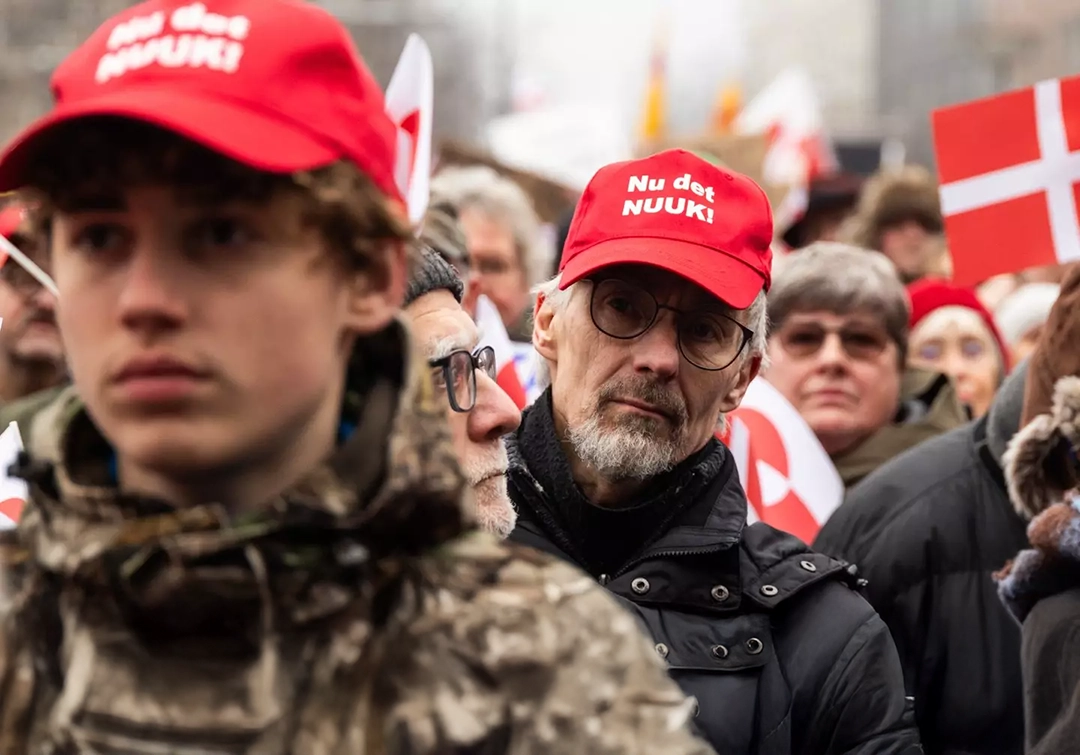
A “hot” example: the Danes have subverted the Make America Great Again cap of President Donald Trump in order to deliver a message of unsurpassed clarity. Greenland is not for sale.
Upon the same red cap—whose designation, in my own line of thought, already sounds awkward—they stamp “Nu det Nuuk,” a play on words that replaces “Nu det nok”—the Danish expression meaning “enough already”—with the name of Greenland’s capital, exploiting their phonetic proximity. A minimalist alteration that turns the phrase into an ironic and forceful declaration.
Allow me to repeat it once more: Nuuk is not for sale.
European leaders, the Danes, and the Inuit people of the semi-autonomous Danish territory pronounce a resounding nej/no/nei/no to the delirium that imagines the United States might appropriate Greenland either by bank transfer or by force.
The American narrative maintains that the island is strategic to the security of the United States and that its European allies should understand this and allow it. Deeply irritated by the lack of support outside the White House for his plan, Trump has threatened new tariffs.
It betrays wounded feelings and a clear misunderstanding of who truly holds the authority to decide the awarding of the Nobel Peace Prize. In a text message to the Norwegian Prime Minister Jonas Gahr Støre, he complains that Norway failed to recognise him with a Nobel for stopping “8 MORE wars” and declares that he no longer feels “an obligation to think purely in terms of peace.” “The world,” he wrote, “is not safe unless we have complete and total control of Greenland. Thank you!”
Thus matters stand: radicalisation not only intensifies political conflicts, it also transforms the way we read and understand the symbolic field that surrounds us. Everyday objects, slogans, or gestures come to bear equally radical meanings and to function as signals of identity, rejection, or confrontation. Visual culture becomes yet another symbolic battlefield. A single image, glimpsed obliquely, can activate emotions, reinforce divisions, and shape our almost always hazy perception of reality.
Is it in Denmark, precisely, that something smells rotten? I am not so sure.







Comments powered by Talkyard.