I have known Pedro since 2004, perhaps even earlier, from the time I began attending the exhibitions held in the dozens of galleries and institutions of Old Havana. I do not remember how we became friends; it seems we were so before we had properly met. Pedro is one of the great Cuban photographers of the past decades. Some of his photographs would make Cartier-Bresson raise an eyebrow.
The Annex Gallery specializes—more precisely, shares a vocation for photography. It is neither modest nor humble to inaugurate this new stage with a retrospective of Abascal. Not only because of who he is within the world of Cuban photography, but because he is an exceptional human being and, above all, one of the few Cubans of his generation in whom bravado intersects with a singular emotional sensitivity, an instinct for anticipating that decisive and beautiful instant.
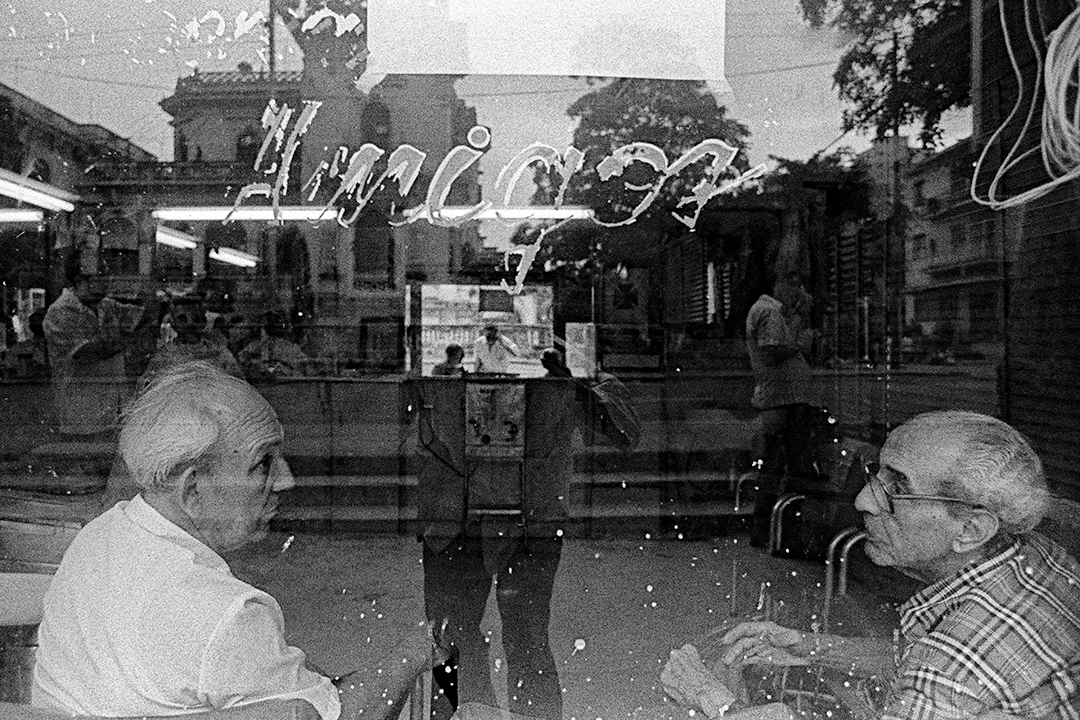
Enrique ‘Quique,’ at left, with an expression unmistakably his own.
One may identify a second zone of intersection.
I preserve almost no photographs of my godfather, Enrique López Tamayo. He was born in Las Tunas, and through his sister Eina—who also passed away recently—he still belongs, because he is remembered by all, to one of those extensive and picturesque Cuban families which, by their local weight and influence, may without embarrassment be compared to the Buendía clan.
Enrique died in the early nineties. At that time, the possibility of making photographs was remote. Several years still remained—almost a full decade—before digital photography would come within the reach of a few.
Much later, Abascal spent an afternoon in my studio—when it was on 42nd and 3rd, in Miramar. We went through many of his photographs, and in one of them, among those I consider most accomplished, I see my dear godfather Enrique, waiting his turn at the barbershop on 17th and H, with Panchito, who was his favorite barber.
Abascal’s photograph must date from 1989 or 1990, for I see “Quique” in excellent form. My godfather was a chef—first at the restaurant El Volga and later at Sofía—from whom I learned much about the art of cooking.
Many texts could be written about Abascal. I prefer that, about him, readers turn to the one I shall now share, written by Ibis Hernández, the curator and architect of this exhibition and another indispensable figure in the visual arts, not only in Cuba but throughout South America.
Finally, I do not wish to fail to underline this convergence of fortunes: a curatorship by Ibis over a remarkable selection of Pedro’s photographs. Sometimes the most intricate channels intersect. Sometimes, after the rain, the sky clears just enough to allow a beam of light to enter at an angle. Out of nowhere a rainbow appears, tracing a parabola in the air, soundless and without explicit intention. It lasts almost nothing. It persists only while sun, humidity, and a precise distance coincide. Like any other miracle: it simply happens.
So it is as well when an artist, a curator, and a gallery that lets in the light come together.
This text and this exhibition are dedicated to Karina, of course.











Comments powered by Talkyard.