
Paul Coors’ new solo exhibition at Clay Street Press is something of two different worlds. Beneath the surface of a quintessential contemporary exhibition, Tell Me What Else You Need From Me reveals a multiplicity of approaches to conceiving of and executing visual art. Coors, a 2004 graduate of The Art Academy of Cincinnati and formerly of the now defunct and highly respected Publico, is one of Cincinnati’s most gifted designer/printmakers. In this current show, the viewer is asked to locate her/himself within a space that never proposes stylistic or formal unity, a place where one is offered a series of objects bound together only by their common creator and then challenged to fashion the links between them. It is as if we have been invited to spend time examining variations on a theme without ever having the theme formally stated.
The clearest expression of Coors’ background as a printmaker are found in a series of compelling monotypes all bearing the title of Living Room (2010). A collection of candle wax prints that embody a feeling of the biomorphic and the fluidic, these images look mobile; an analog to a stain or substance that spreads across the surface from the center of the paper. The works also contain subtle, interesting relationships of value which, upon close inspection, give them the illusory impression of three dimensional form. The title piece of the show, a work of cut black vinyl, effectively uses text as a design element that does not distract, but rather adds, to the overall composition of a large work that at times feels like it could be the love child of T.S. Eliot and Ellsworth Kelly’s 1957
Sculpture for a Large Wall
Single Takes (2010), as the title suggests, is composition of small, one-off ball point sketches that give us insight into Coors’ process as a designer. Tightly rendered and deceptively simple, these stylized depictions of hair make use of such antiquated notions as line, space, shape, and value, to an amiable result.
The fatal flaw in several of the works in Tell Me What Else You Need From Me rest in their over reliance on conceptual interrogation rather than serious engagement with aesthetic concerns. Works like This Side (2010) and That Side (2010) are composed in a situation where not only is failure not an option, it’s not even a remote possibility, at least from a visual standpoint. The aesthetic decisions made in works such as these arise as the default outcome to a preconceived notion. Success in any endeavor occurs only when the prospect of failure, however remote, is at hand. When failure appears most likely, success becomes ever more meaningful. In the case of This Side and That Side, there are no plausible negative visual consequences to covering an entire wall with the same postcard held up by push pins; it is simply not possible for the piece to fail or to look “bad” because there are no substantive aesthetic decisions which need to be made. And the decisions which are made are of such little importance that the resulting works convey no sense of visual significance, and offer no feeling of gravity. The very same issues hold true for Cincinnati Cape (2010), a work that is in essence a tissue paper reproduction of a business card designed by Coors. Contrast these two works with the Living Room series, Single Takes, or the lithograph Scoreboard (2010) where artistic choice, even on a limited scale, drastically impacts the final appearance of the work. These pieces have the inherent potential to get out of control, to make wrong turns, and ultimately crash and burn. That they come out on the other side as interesting, successful images contributes not only to our respect for Coors as an artist, but also to our satisfaction with the work.
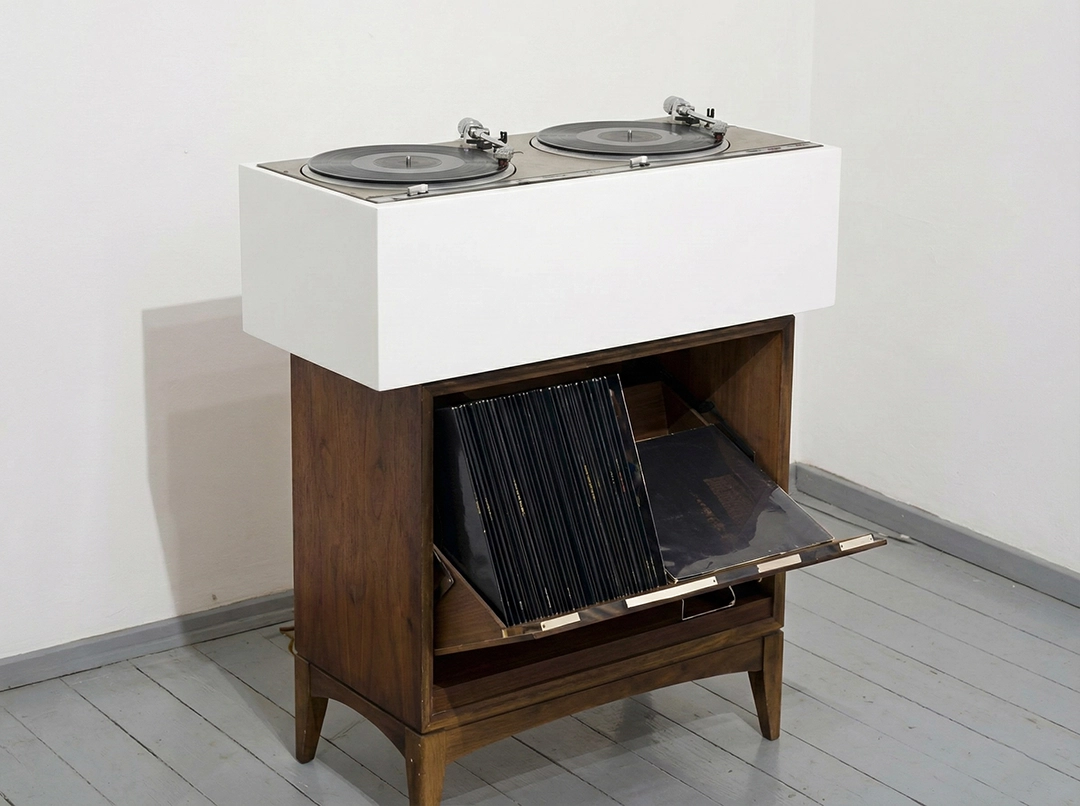
This Can Be Life / Paul Coors feat. Jay Z is undoubtedly the most complicated piece in the exhibition. A collaboration of sorts which features two turntables mounted on a vintage lp credenza, each with a vinyl pressing containing a single track that stitches together every ‘uhh’ heard in the Jay Z catalogue can strike one as either a supreme act of artistic disinterestedness, creating something valuable only in and of itself, or as an equally matchless exercise in otiosity. (Full disclosure: the cartridges were not place in the turntables at the time of the visit, and this viewer did not hear the results.) As a work of free standing sculpture This Can Be Life / Paul Coors feat. Jay Z does at a minimum succeed in emphasizing clean lines and craftsmanship, a sense of symmetry, stability, and balance. For an object that is physically heavy it projects an aura of lightness and surprising elegance. Here too however, consideration of the role of artistic decision must come into play. Though This Can Be Life / Paul Coors feat. Jay Z is possessed of a stately formal beauty, it is as a result of fairly inconsequential aesthetic decisions. (Though the care taken in discretely tucking away the receiver and the limited visibility of external wires was not lost on this observer.) As a result the viewer is left in a sort of netherworld, unsure of where to place primacy of experience: on the object itself, the sound that it creates, or the effort required to laboriously scour Jay Z’s back catalogue. In essence, works like these provide multiple points of entry while insulating themselves against genuine attempts at criticism because they can claim (not without some merit) to be all things at all times.
Worth noting, though not technically a part of this exhibition, is I Want This Forever (2009), a book-form piece made in collaboration with Dana Ward. Flipping through the pages one is struck by its contents as well as its composition. The work is intriguing, tactile, narrative, and formless simultaneously. I Want This Forever appeals to our human desire for the object and for those objects to have meaning. One gets the sense that this is Coors at his best: the creation of articles in conjunction with others that stimulate and satisfy. Coors’ skill and technique as a printmaker is on full display and it’s hard not to feel that you are holding something that is both precious and lavish.
RELATED ARTICLES

In CityBeat
News & Opinion
Art: Paul Coors at Clay Street Press
Paul Coors gave the city a great gift when he and his group of friends ran Publico, an alternative gallery in Over-the-Rhine until 2008. Since then he’s stayed active by helping organize art shows and exhibit his own works.
By Matt Morris
May 25th, 2010
Paul Coors gave the city a great gift when he and his group of friends ran Publico, an alternative gallery in Over-the-Rhine until 2008. Since then, Coors has stayed active by helping organize art shows at The Comet in Northside where he works, exhibiting his own work in many local venues and being included in a recent exhibition at the Joshua Liner Gallery in New York.
On Friday, Coors opens Tell me what else you need from me, a new exhibition at Clay Street Press. The press release quotes Franco Berardi: “The social content of capitalist production contradicts its own semiotic framework. It produces a system of misunderstandings, contradictory injunctions and perverse juxtapositions.” There are hints that Coors’ work for the exhibition draws from freelance design projects for his friends.
The opening reception is 7-11 p.m. Friday. The exhibition runs noon-4 p.m. Saturdays and by appointment through July 16.








Comments powered by Talkyard.