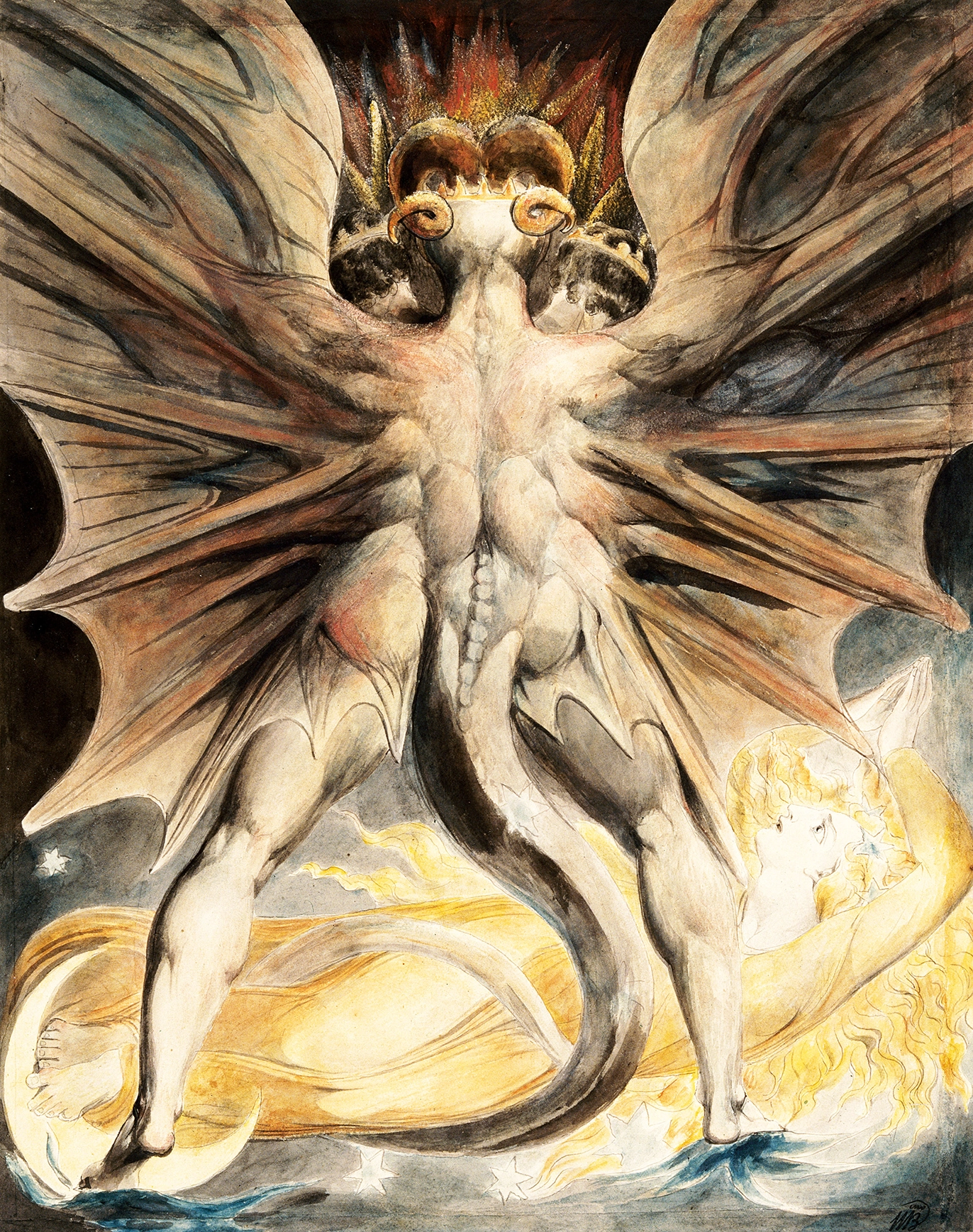
A monumental dragon, seen from behind, occupies almost the entire composition. The outstretched wings overflow the margins of the paper, the taut musculature reveals itself beneath a reptilian skin, the tail coils downward. At its feet, tiny, a naked and luminous woman lies with her arms open, waiting to give birth. Blake here inverted the iconographic convention — the monster shows us its back, and the viewer is dragged into its very position, facing the defenceless woman. The painting is one of four watercolours Blake devoted to the apocalyptic dragon of the Book of Revelation, and the only one in which the beast turns its back on the observer, a device that multiplies the effect of imminence and dominion. It is the image that entered contemporary popular culture through cinema and became an unwitting icon of horror.
The Great Red Dragon and the Woman Clothed with the Sun (Rev. 12:1-4), c. 1803–1805
William Blake (London, 1757–1827)
Black ink and watercolour over traces of graphite and incised lines, on wove paper
Image: 43.7 × 34.8 cm | Sheet: 55.1 × 43.3 cm
Brooklyn Museum, New York. Accession no. 15.368
Commissioned by Thomas Butts, Blake's patron; gift of William Augustus White to the Brooklyn Museum, 1915
The work is generally kept off permanent display owing to the sensitivity of the watercolour to light.
The Great Red Dragon and the Woman Clothed in Sun is a Romantic Etching and Watercolor Print created by William Blake in 1803. It lives at the Brooklyn Museum in New York. The image is in the Public Domain, and tagged Satan, Angels and Allegory.
There is something bitterly ironic, and in some way unjust, in the posthumous fate of William Blake. An extraordinary poet and engraver, he spent his life defending imagination as a sacred faculty, denouncing slavery, and dreaming of a spiritual Jerusalem on earth. He has nevertheless ended up recast, in the contemporary imagination, as a numen, or tutelary spirit, of evil. His name and his images appear tattooed on the skin of serial killers, whispered into the ears of victims in television series, quoted by literary psychopaths as if they were the scriptures of some dark gospel. Blake, who branded as "satanic" the dark mills of the Industrial Revolution where human lives were ground down, is now the favourite poet of fiction's darkest monsters.
The most memorable case is Red Dragon, Thomas Harris's novel, brought to the screen as Manhunter in 1986 and again as Red Dragon in 2002. Its antagonist, Francis Dolarhyde, slaughters entire families on nights of the full moon at the bidding of an alter ego he calls "the Great Red Dragon", drawn directly from a series of watercolours Blake painted around 1805 to illustrate the Apocalypse. Dolarhyde wears the dragon tattooed across his back, and, in a scene of sombre beauty, travels to the Brooklyn Museum and devours the original painting in order to absorb its power. The device caught on and bred imitators. In The Mentalist, the killer Red John whispers the opening lines of The Tyger into the protagonist's ear; Agatha Christie had already opened her novel Endless Night with the closing lines of Auguries of Innocence. The formula recurs so insistently that we have ended up sedimenting an image with little truth in it: a sinister Blake, a gothic prefiguration of horror.
That image may well be the result of several misreadings accumulated over two centuries, and it is relatively straightforward to dismantle them if we wish to know the actual artist. The first and most persistent is that of a Blake imprisoned by madness. It was founded on the only review his solo exhibition of 1809 ever received, where a critic dismissed him as "an unfortunate lunatic". The compliment endured. Blake claimed to see spiritual figures and to converse with them, and for an age that was already beginning to classify as dementia what had once been considered mystical experience, that was enough to file him as a clinical case. His thinking is nevertheless perfectly coherent once one accepts that it operates within a visionary tradition that includes Swedenborg, Boehme, and Christian mysticism. Deluded or not, Blake was building a cosmology of his own.

Newton appears naked, hunched over himself, seated at the bottom of the sea on a rock covered in algae and coral formations. Bent over a scroll, with a pair of compasses he traces a geometrical diagram, utterly absorbed, blind to the prodigious universe that surrounds him. The submarine beauty of the scene, the anemones flowering among the rocks, never reach his eyes. It is one of the most devastating visual portraits ever made of Enlightenment rationalism — the genius reduced to a calculator, the eye abolished by the compass. Blake placed here his most concentrated philosophical critique. The compass Newton holds is a smaller version of the one wielded by Urizen, his mythological figure of mechanical order, in The Ancient of Days. The work belongs to the twelve Large Colour Prints Blake produced in 1795 by an experimental procedure he himself called fresco, a technique of monotype coloured and retouched by hand. The print was later reworked around 1804–1805. The iconic force of the image remains intact — in 1995, Eduardo Paolozzi turned it into the monumental sculpture that today presides over the piazza of the British Library in London.
Newton, 1795 (reworked c. 1804–1805)
William Blake (London, 1757–1827)
Colour print, ink and watercolour on paper (monotype) | 46 × 60 cm
Tate Britain, London. Accession no. N05058
Presented to the Tate by W. Graham Robertson, 1939
One of the twelve Large Colour Prints produced between 1795 and 1805.
The second misreading is that of an isolated being, a misunderstood genius working sealed up in his garret. He had in fact several artist friends — John Flaxman and Thomas Stothard — knew Henry Fuseli, and counted on loyal patrons such as Thomas Butts, who bought his work for years. Toward the end of his life he gathered around him a group of young admirers, the so-called Ancients, among whom Samuel Palmer stood out. His style and his themes, moreover, were shared by an entire generation: George Romney, James Barry, and the Westall brothers worked in registers very close to his own.
A further misunderstanding is that of an apolitical Blake, a pure mystic withdrawn from the world. The facts contradict it. Blake was a radical. He sympathised, brazenly, with the French and American Revolutions; he attacked slavery when doing so was unfashionable. He denounced the exploitation of chimney-sweep children in his Songs of Experience, criticised the institutional Church and the Empire. His verse was among the earliest to denounce nascent industrial capitalism. There is nothing here of contemplative retreat — instead, an acute political conscience and a steady taking of sides with the oppressed.
A final distortion, more subtle, is the label of "Romantic". Blake despised much of what we now call by that name. His models were Michelangelo and Raphael, the Mannerism of the Italian Renaissance; he loathed Rubens and Rembrandt and everything to do with tonal, atmospheric painting. He wanted pure lines, defined contours, idealised forms. His first engraving was based on a figure by Michelangelo. Rather than a Romantic of the standard variety, he was a heterodox neoclassicist who pushed the line into visionary delirium. The Romantic label, convenient for the manuals, obscures the real genealogy of his style.
Stripped of his confused masks — the madman, the recluse, the apolitical, the Romantic — a less picturesque, less demonic Blake emerges. He was, if you will, a brilliant artisan who controlled the entire chain of production of his own work. He himself engraved the copper plates, printed them by hand, and coloured each copy alongside his wife Catherine. No book of his is exactly identical to another. He was an intellectual who claimed, against the dominant rationalism of his age, that imagination was neither escapism nor fantasy, but the faculty by which we perceive invisible realities, the only one that allowed us to see beyond Newton's measurable, mechanised world. He was an artist who dissolved the frontier between poetry and image, writing and drawing, high culture and manual craft, anticipating by more than a century what we now call the artist's book. He was likewise an early critic of the rampant materialism of his time, and his ideas and his work speak with startling currency to any contemporary conversation about technology, efficiency, and the disenchantment of the world.
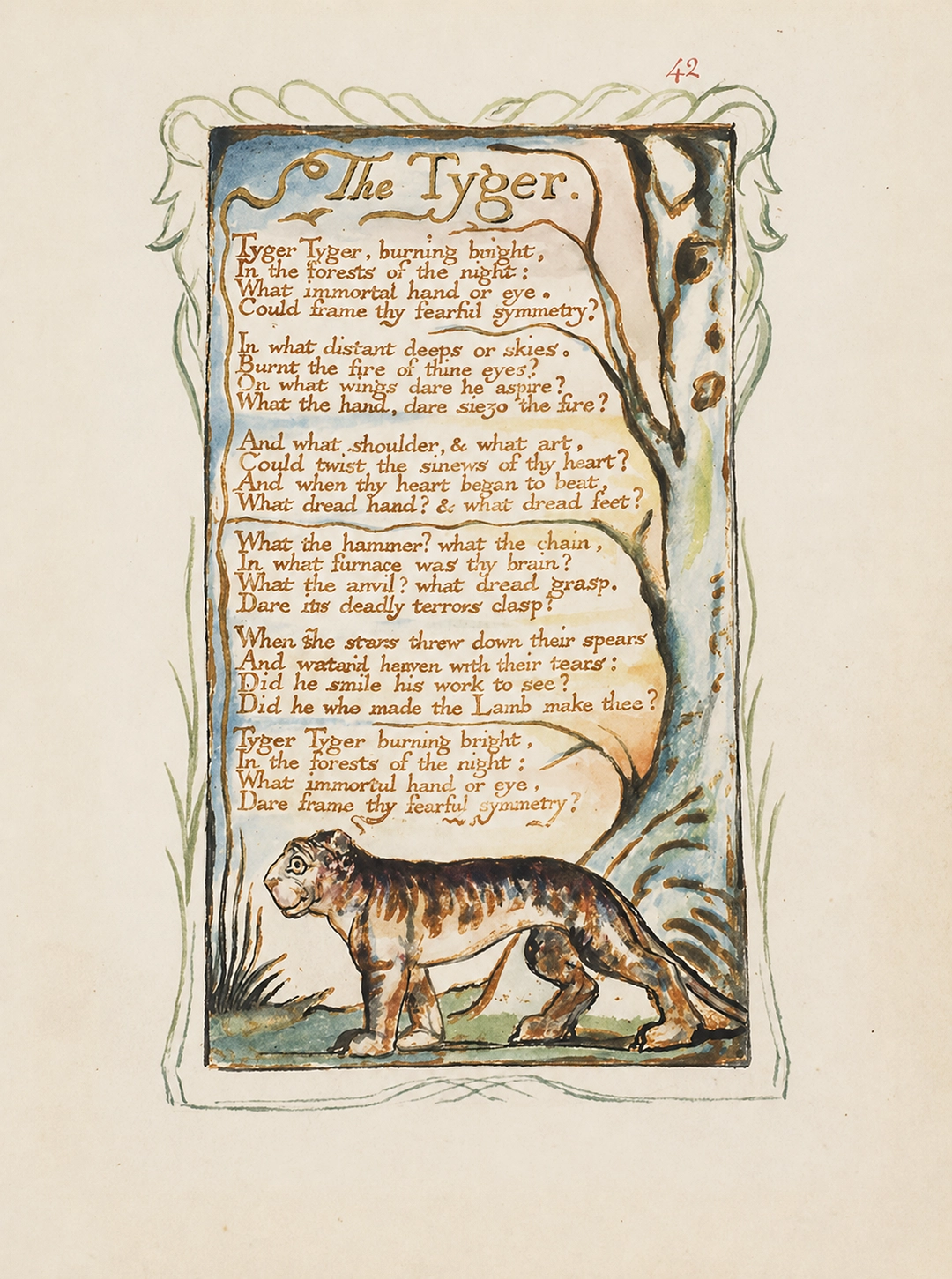
On the page, the poem coils like a living creature. Blake's calligraphy snakes downward following the line of a tree that frames the text, and at the foot of the composition, on the grass, a hand-coloured tiger gazes at the reader with a startlingly meek, almost childlike expression, in flagrant contradiction with the verse that names it as a fearful symmetry burning in the forests of the night. The contradiction is deliberate, and it is one of the page's deepest mysteries. Blake has integrated word and image on a single copper plate etched in relief by means of the procedure he himself invented and christened illuminated printing, writing the text in reverse on the metal with quill pen and acid-resistant varnish, so that after etching and inking, text and figure would emerge as a single body. Once printed, each copy was hand-coloured by Blake himself or by his wife Catherine. No two pages ever turned out identical. The copy held at the Metropolitan, from one of the last sets Blake prepared around 1825 for the engraver Edward Calvert, is illuminated with watercolour and shell gold, and has the delicate, almost sacred air of a medieval book of hours passed through the apocalyptic imagination of the poet.
The Tyger (plate 42 of Songs of Innocence and of Experience)
William Blake (London, 1757–1827)
Original composition: 1794 | This copy (Copy Z): c. 1825
Relief etching printed in orange-brown ink, hand-coloured with watercolour and shell gold | 15.7 × 14.1 cm
The Metropolitan Museum of Art, New York. Accession no. 17.10.51
Copy prepared by Blake around 1825 for Edward Calvert (1799–1883), painter and engraver of the Ancients circle.
That contemporary popular culture has retained only his gothic iconography — his burning tigers and his red dragons — says less about Blake than about us. His real contribution is to have shown, with his life and with his work, that one can think against the current of one's own age without forfeiting rigour, that imagination is a form of knowledge and not its opposite, and that an artist may at once be poet, engraver, printer, and prophet without any of those vocations contradicting the others.
Two hundred years on, as we live through another crisis of faith in instrumental reason, Blake is waiting for us where he has in fact always been — on every illuminated page where word and image hold each other up. The tattooed backs and all those films are good entertainment, though they will never replace serious historical reading. They are, of course, also fascinating!
The exhibition William Blake: The Age of Romantic Fantasy*, on view at the National Gallery of Ireland, Dublin, until 19 July 2026, places Blake precisely within that web of affinities, the better to undo the myth. The show brings together fewer than one hundred and twenty pieces — only about a third of them by Blake himself — most of them on loan from Tate, London, and sets his work alongside that of Henry Fusili, George Romney, James Barry, John Martin, Francis Danby, and J. M. W. Turner.*













Comments powered by Talkyard.