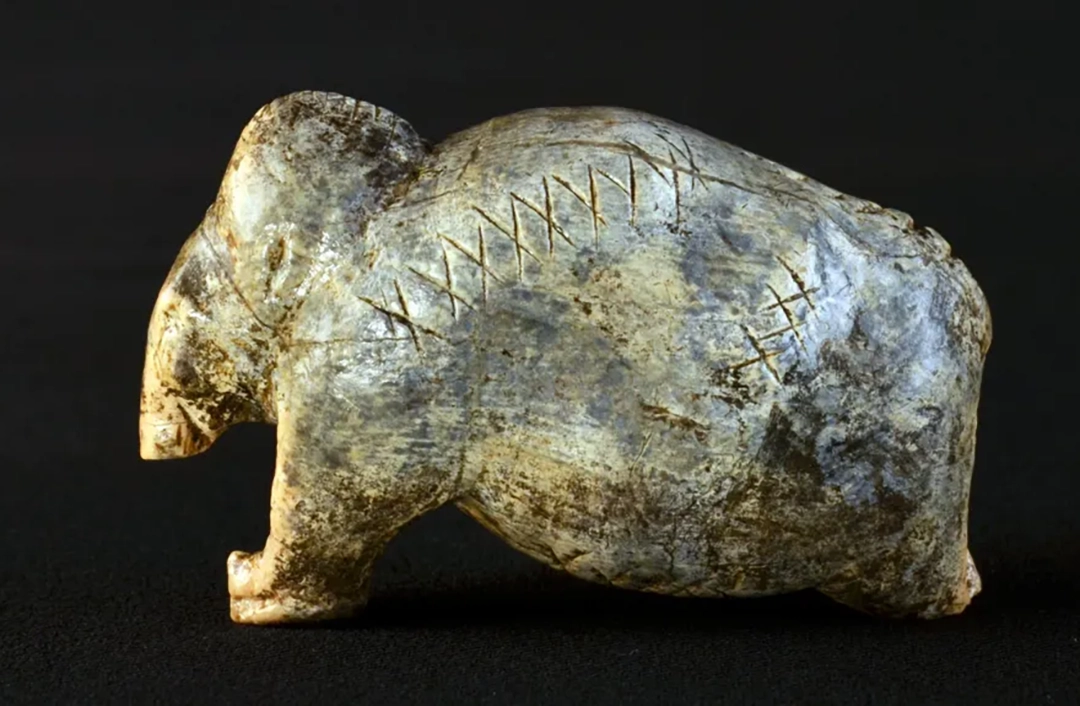
A 40,000-year-old mammoth figurine with engraved rows of crosses and dots.
It takes only a glance at my MSN (Microsoft Start) homepage to think that every day someone discovers something that forces us to rewrite the history of humanity. I imagine historians exasperated, stalled again and again on the first page.
One of those stories—always amusing—claims that 'a set of geometric markings engraved between 34,000 and 45,000 years ago on small sculptures and tools is forcing a revision of the history of human communication.'
The little lines—two straight diagonal strokes crossing at the center, like the ones we use in Tic Tac Toe—decorate the flanks and back of a small mammoth, carved in ivory and found in the Vogelherd Cave.
In total, there are 260 objects, most of them from the Swabian Jura in southwestern Germany, a region key to understanding the origins of European art. There, in caves such as Vogelherd, Geißenklösterle, Hohlenstein-Stadel, and also Maltravieso, archaeologists have recovered for decades figurines of animals, human-animal hybrids, ivory plaques, bone tools, and personal ornaments—many of them covered with geometric sequences.
These notches, lines, and scratches have been regarded by researchers from Saarland University and the Museum of Prehistory and Early History in Berlin as elements with a level of complexity and informational density comparable to the earliest systems of notation in ancient Mesopotamia.
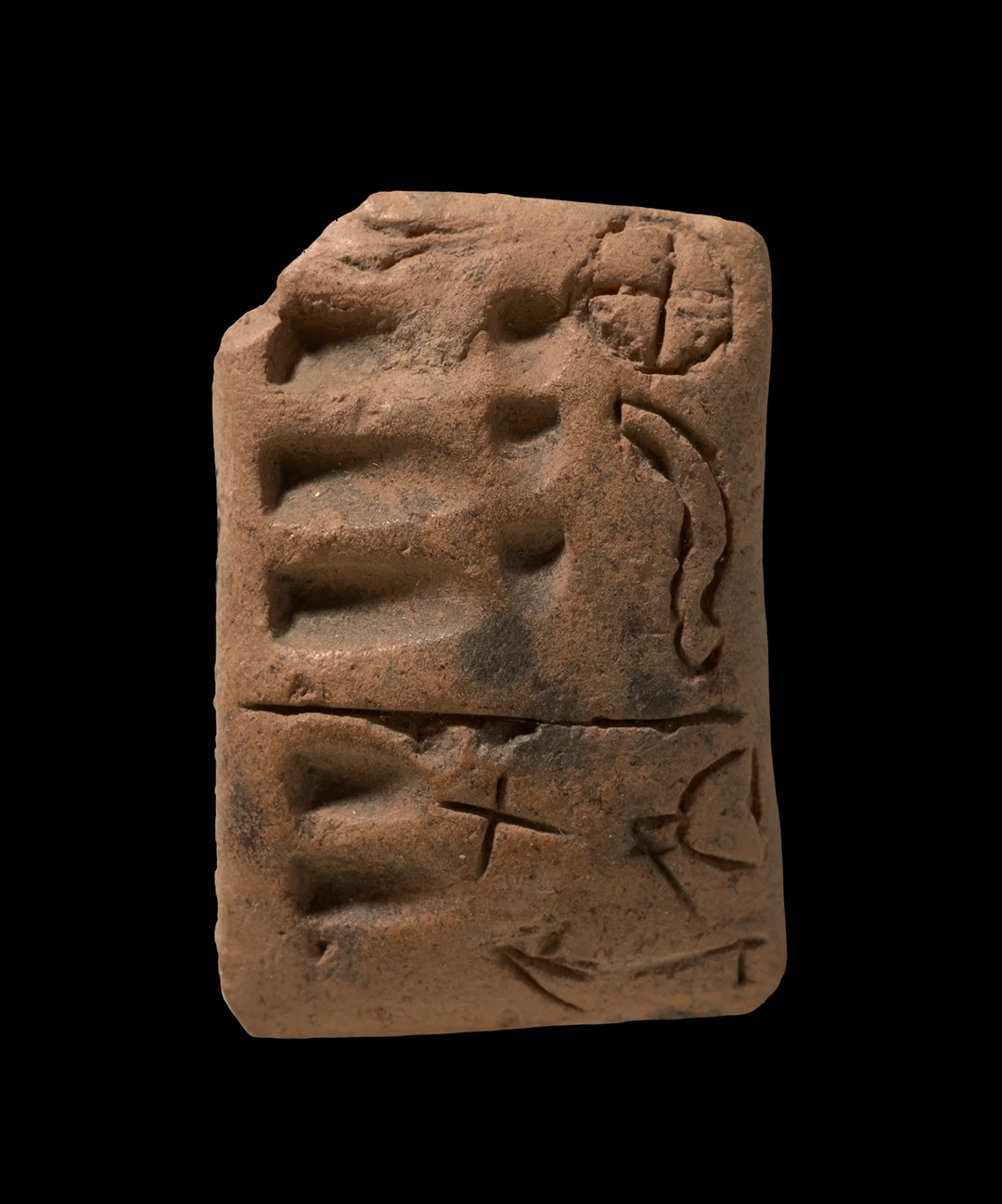
A protocuneiform tablet. Staatliche Museen zu Berlin, Vorderasiatisches Museum/Olaf M. Tesmer
The figurines fit in the palm of a hand; everything suggests that their owners carried them to remember something, like a grocery list. Not unlike Mesopotamian tablets, intended to record accounts and transactions. They belong to the time when the first Homo sapiens settled in Central Europe under the wary gaze of Neanderthals, when the continent was covered in ice.
Alongside these incisions, these groups produced figurative art, musical instruments, personal ornaments, and rather sophisticated tools. A fairly modern behavior.
How did researchers arrive at the idea that this might constitute some form of language?
The linguist Christian Bentz and the archaeologist Ewa Dutkiewicz explain that they never attempted to translate anything. That would have been rather foolish. They focused instead on measurable properties. They digitized nearly 3,000 geometric incisions distributed across the entire set of objects and classified them into simple categories: small crosses, lines, dots, notches, and shapes resembling an “X” or a “Y.” They applied statistical models and machine learning algorithms and concluded that these functioned as a basic system of notation. In other words, that they might have served some purpose.
Their argument rests on the ordered repetition of these elements, comparable to that of the earliest proto-cuneiform tablets, likely used for counting or record-keeping. They were not writing as such, but they were organizing information intentionally and according to certain rules.
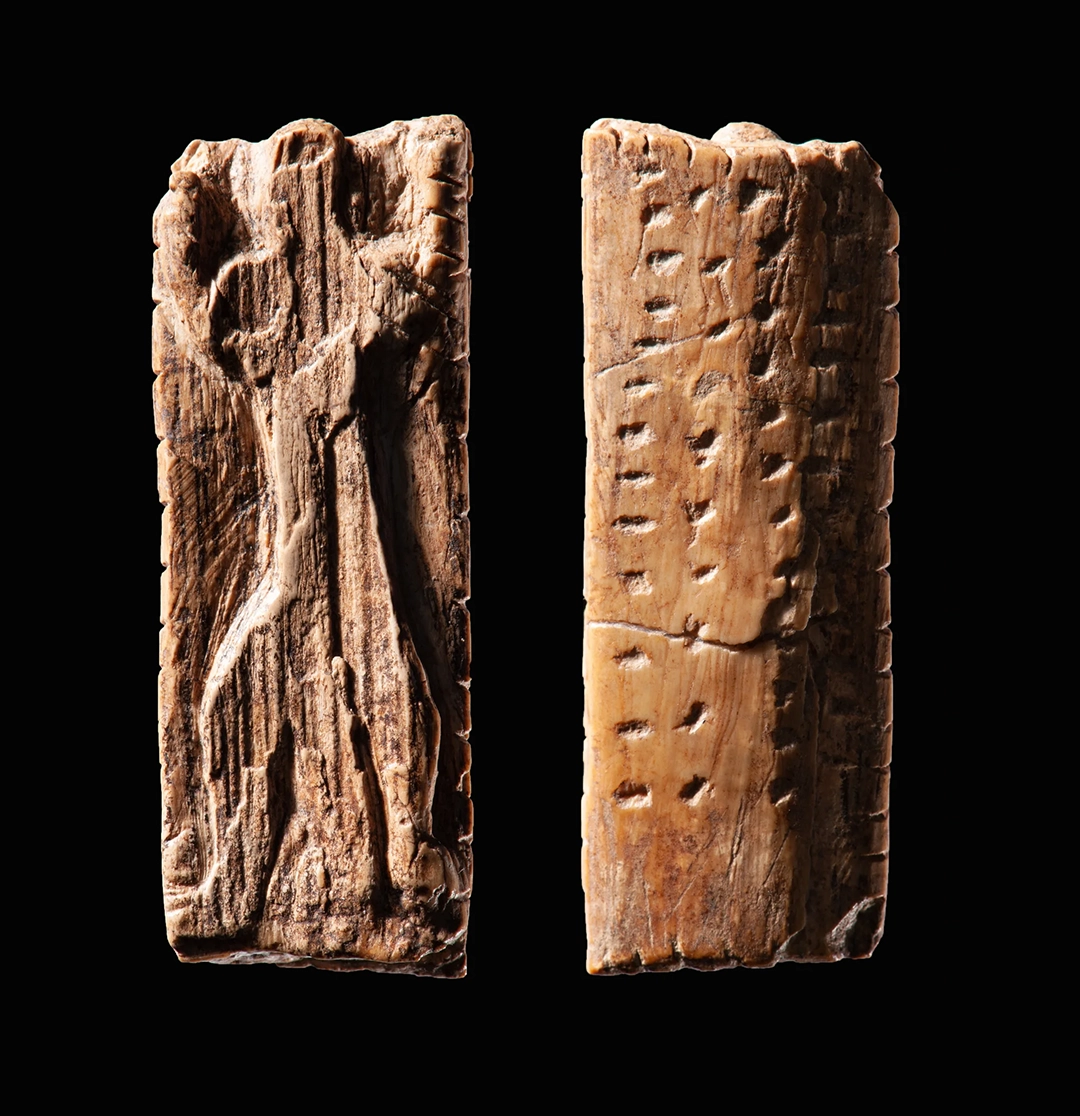
A 38,000-year-old figurine from Geißenklösterle Cave in Germany.Landesmuseum Württemberg/Hendrik Zwietasch
Some forms appear on animals and tools, never on human figures, suggesting a possible functional distinction. Other combinations concentrate on specific supports, reinforcing the idea that these were codes learned and transmitted across generations.
They propose that such systems may have been shared among artisans for some 10,000 years, applied consistently to specific types of objects. That they could mark key moments in the life cycles of animals—such as mating or birth periods—ultimately tied to practical concerns.
They therefore conclude that their makers possessed cognitive capacities comparable to our own. That they were already exploiting the potential of these graphic resources thousands of years before the first Sumerian tablet. That the human ability to encode information is far older than previously assumed. And, of course, that it is time to rewrite history—at least until the next definitive discovery.
These forms remained stable for millennia, at least in terms of their supposed informational density. Until, one day, they vanished without a trace. Shortly thereafter, in barely a thousand years, proto-cuneiform—still far from being a full writing system—evolved into a system capable of representing Sumerian.
Now imagine that in 1931, during Gustav Riek’s excavations at the Vogelherd Cave, a local boy wanders through the site. No one is watching. He finds one of the small figures and, with no intention other than leaving his mark, scratches it with a blade. He begins with a line, then another, repeats a few crosses out of sheer compulsion, the way we all do with our keys on the walls of a building. The next day, the piece is catalogued. The incisions become part of the object. Decades later, they will be read as patterns, as codes, even as proto-notation—when in fact they might be nothing more than the banal trace of a childish prank, entirely foreign to the time that would later insist on giving it meaning.
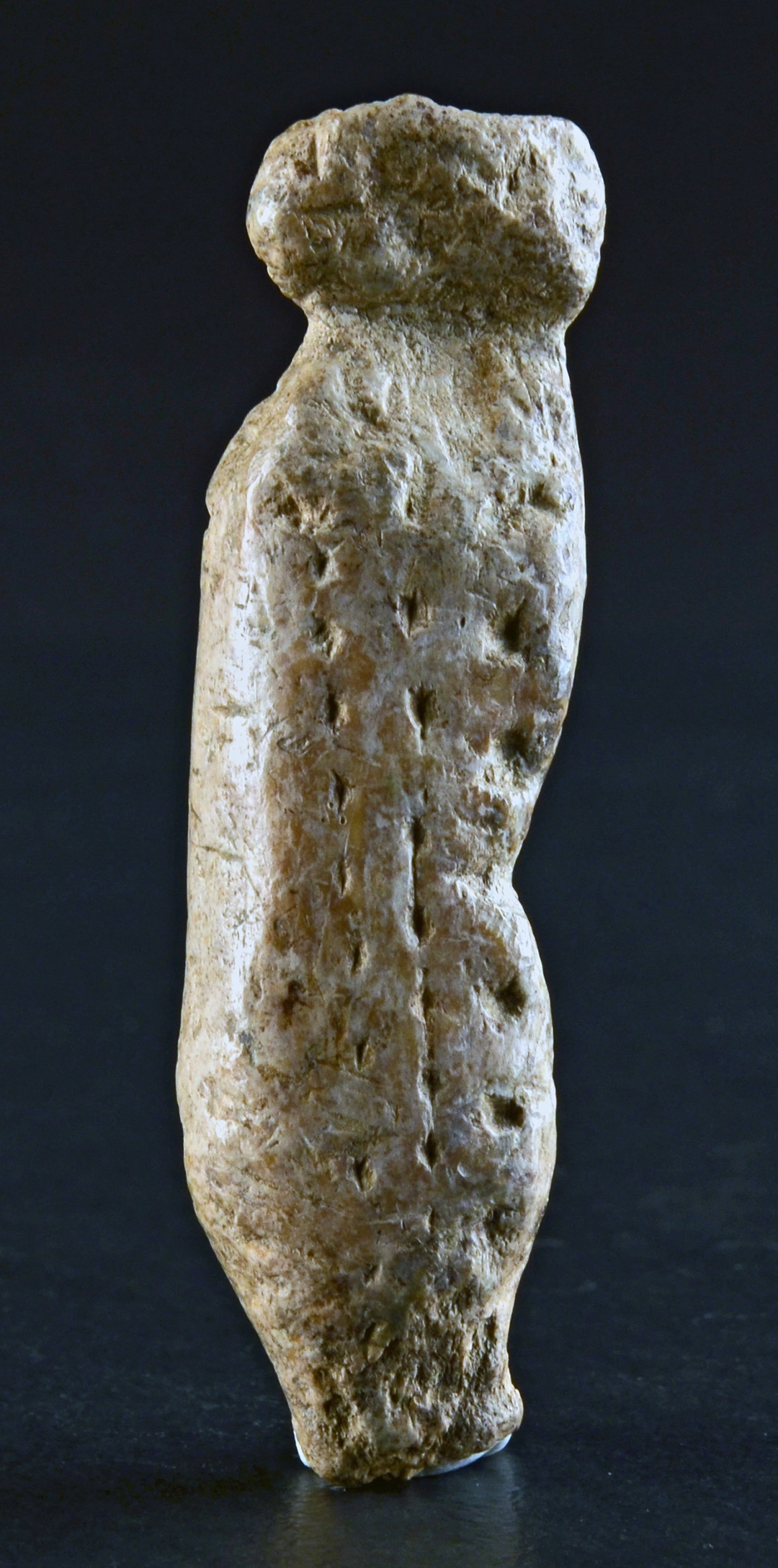
Vogelherd anthropomorphic statuette.
Length 69 mm, depth 10.5 mm, width 19 mm according to Müller-Beck et al. (1987).













Comments powered by Talkyard.