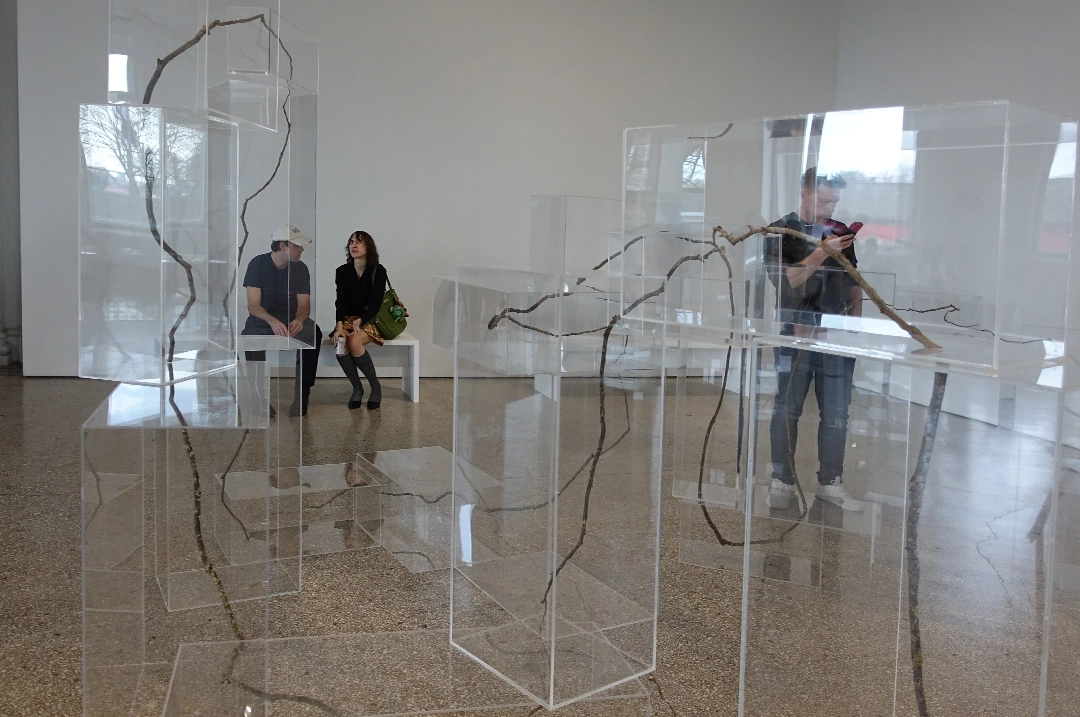
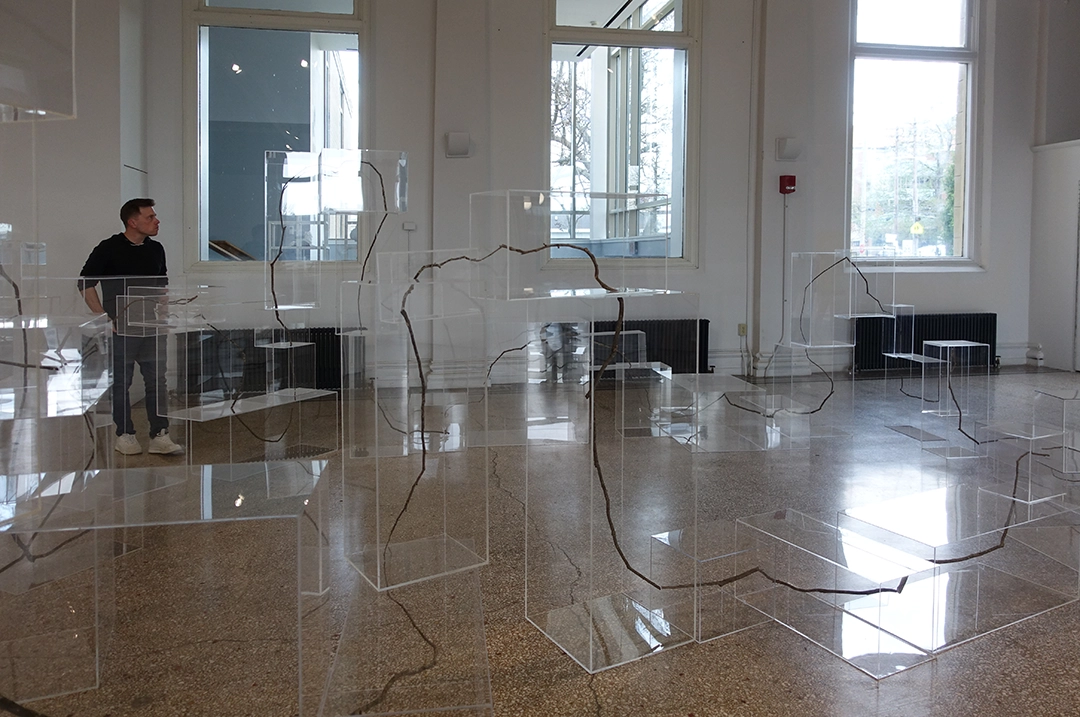
The natural progression of the exhibition is equally notable. The first works already suggest the spacious character proposed by the installation. EN/円 #2 by Manami Ishimura reads, at a glance, as a scaled model of the exhibition as a whole. A slender, lifeless branch cuts through a series of plexiglass structures. The gesture is deliberate and technically precise. Openings in the plexiglass have been cut to match the exact thickness and angle of the branch. It does not submit to the limits imposed by geometry. It moves through them with a kind of candor that can only stem from a certain naivety, advancing from one structure to the next, instinctively. In the way life operates, and even more so, in the way memory does. The primordial echo of human action escapes the spaces history has constructed to contain it. A metaphor at once lucid and unyielding, exposing the futility of attempting to confine what cannot, by nature, be contained. The artist renders this visible. It confirms the exhibition’s underlying narrative of resistance to overly rational structures and functions as a thread running through the work, and through the curatorial framework as a whole.
Another defining aspect is the near-total monochrome of the works. A fortunate decision. The task at hand is to observe the historical register, to read intention within residue. Color distracts. It generates content and meaning on its own. The sudden reduction of chromatic intensity in the visual field, as a perceptual strategy, compels a slower reading and diverts us from what a first glance would impose. The tempo shifts. It is evident in each gallery and even in the design of the brochure. One enters from a world saturated by the strident colors of advertising—colors we no longer see, even as they surround us.
There are many works, many artists. It is not always productive to recover the meaning of each piece. Over time, I have learned to experience them. In the way one has approached the beauty of the natural world for millennia. Art is a vital dimension of human expression and experience, and it admits multiple forms of understanding. The intellectual approach is valid. It is not the only one.
Notes on The Body Isn’t a Battery That Discharges Upon Death
This text reproduces in full the curatorial essay published in the exhibition brochure. Credit is due to Sean J. Patrick Carney, curator of the exhibition.
The BODY isn’t a BA++ERY
that DISCHARGES upon DEA+H
Sean J. Patrick Carney
The body isn’t a battery that discharges upon death sits on the Ohio–Kentucky seam, a gateway between the Midwest and the South. Two climates overlap here, as do contested histories and possible futures.
I had originally intended to apply some grand metaphysics to such an interstitial American environment, but what emerged instead was a profoundly ordinary fact: places hold traces of what happened in them. Moments, materials, and sounds linger long after an event has passed.
This exhibition gathers works attentive to those afterlives, afterimages, and material residues. Each piece is an instrument, tuned to a minor key, using monochrome, drone, and repetition to slow perception down to the point where resonances reveal themselves.
In the main gallery, Manami Ishimura sets the tone with “EN/AM #2” (2022), a monumental sculpture in which a long-dead tree branch snakes through a metropolis of clear plexiglass boxes. It is an imposing but ethereal work, towering quietly like grief, filling the room, leaving nowhere to hide. Ishimura’s branch becomes a metronomic drawing in space, decomposing at an imperceptible rate.
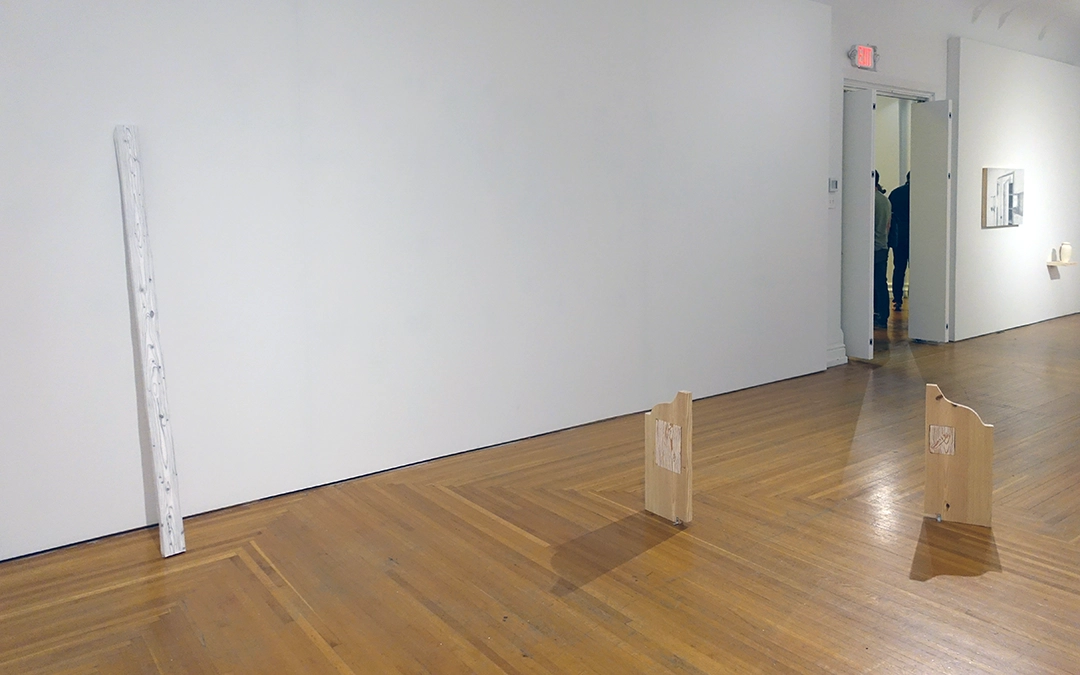
Wood recurs in Justin Hodges’s “Gallery Furniture” (2026), a tableau staging two simple chairs built by dismantling gallery pedestals and refashioning them into functional seating influenced by Shaker traditions. Beneath the winking joke of turning display infrastructure into usable objects is an earnest rural ethic of restraint and craft. Shaker design understands wood as a material brought to life by devotion and labor, as opposed to ornament.
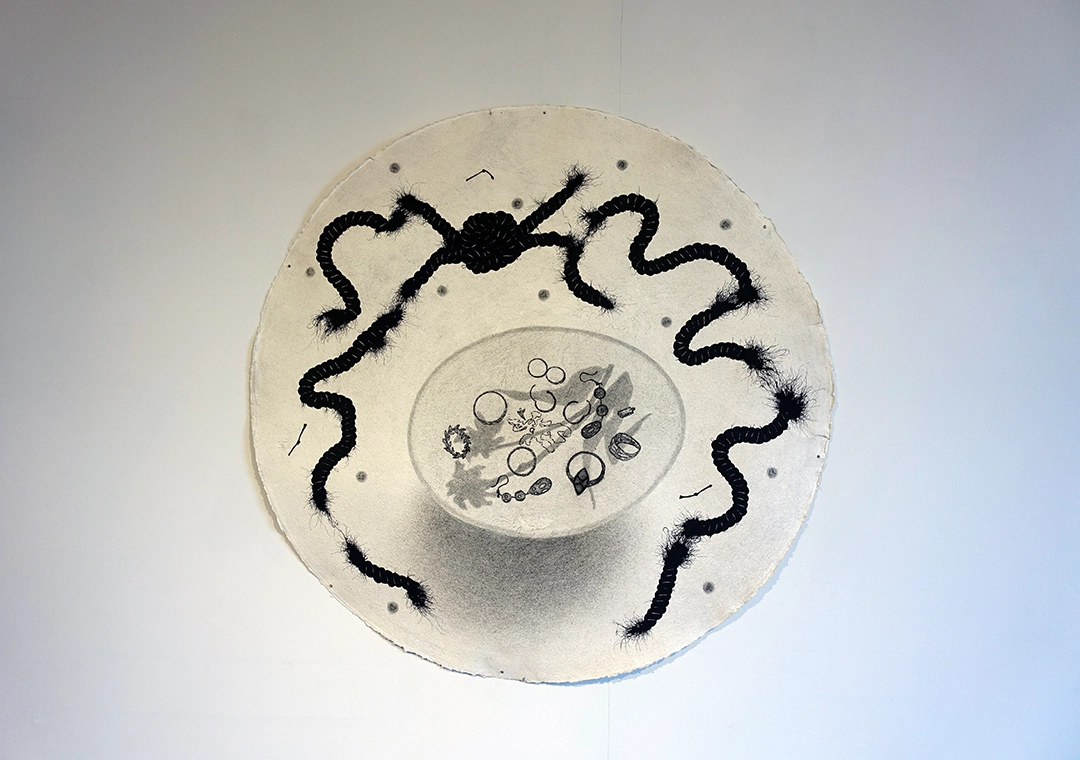
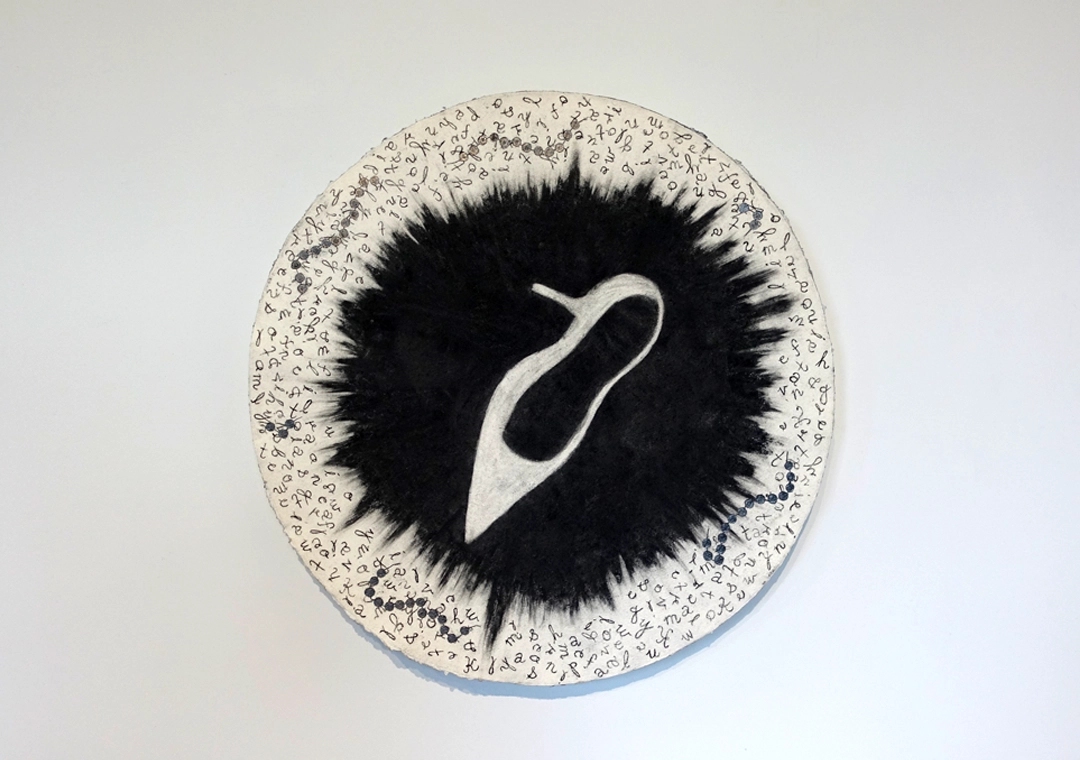
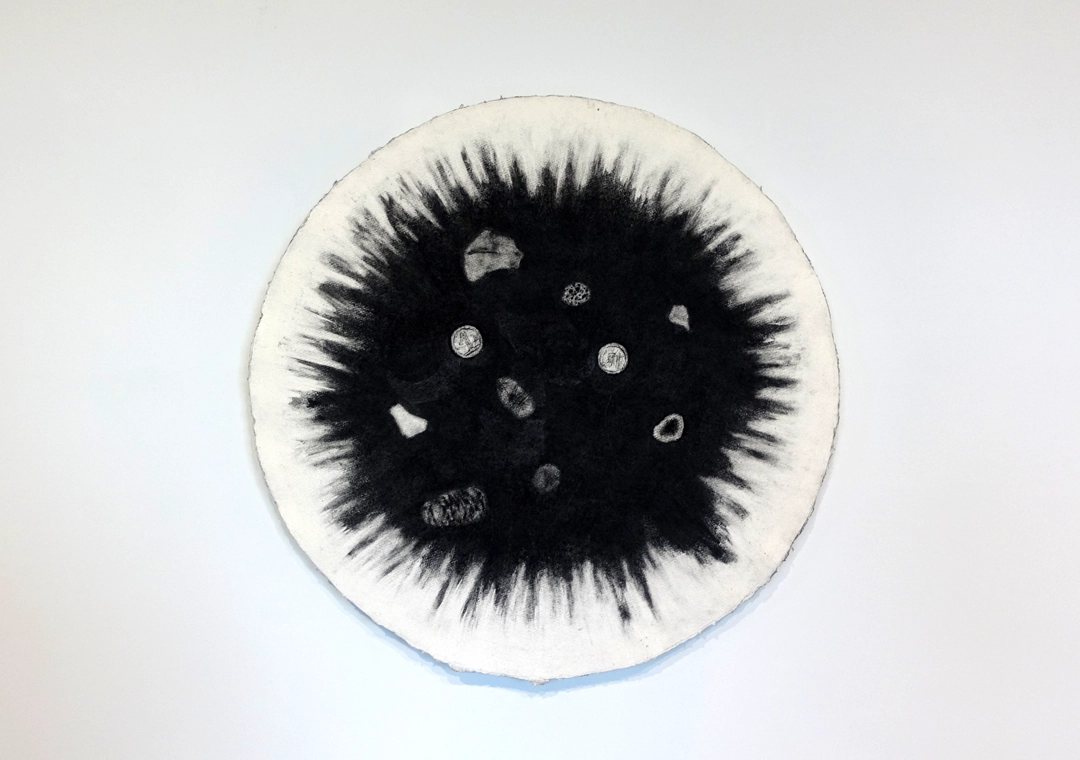
Through the Carnegie’s rotunda, upstairs, the works turn more spectral. Natalie Lerner’s circular black-and-white drawings of grave trinkets, snowdrifts, and portals hover at the edge of documentation and apparition. Graphite marks oscillate from jet-black voids to dissipating breaths of fog. Part of my attraction here are the echoes of zine aesthetics: Lerner’s monochromatic images—like Ishimura’s branch or Hodges’s schematics—could be effectively Xeroxed and recirculated.
Ian Hersko’s idiosyncratic constellations of photos, sculptures, and drawings conjure domestic spaces being reclaimed by vines and soil. Once-ordinary objects—a house key, a candle, window blinds—bend into dioramas of loss and return, staged with a deadpan wit. His notebook pencil doodle of a hearse, “1992” (2025), is pure gallows humor, simultaneously something a millennial tween might have vandalized on a chemistry textbook and an austere, cross-cultural icon for departure.
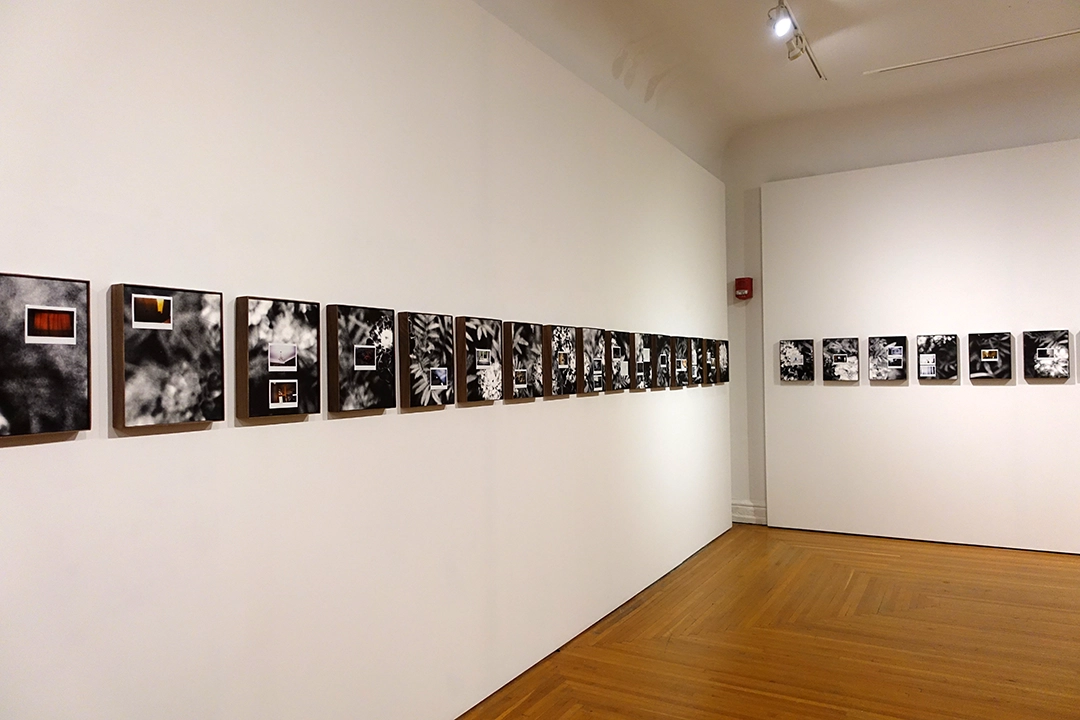
A photograph of marigolds is the substrate for Jesse Ly’s “Our Gardens” (2026). Marigolds signify longevity and protection in China, the sun in Hindu traditions, and, in Mexico, cempasúchil carries a scent said to create a bridge between the living and the dead. Enlarged to fill windows in an earlier project, the image is cut down at the Carnegie into 36 tiles in handmade wooden frames, each overlaid with intimate snapshots from daily life. This reuse carries a Midwest economy, a kind of creative composting, and a Dayton specificity, where Ly has built a life and a home.
Reverberating through all of this is an original sound work by Plume Girl (Soumya Somanath), a classically trained Hindustani singer and multi-instrumentalist. Somanath draws from the raga system, where melody and mood unfold through return, variation, and sustained attention to tone. Her score drifts from an upstairs room, down through the rotunda, and gently into each corner of the galleries. Every work is lightly bathed by Somanath’s improvisations and overtones, a permeating lilt winding its way like a branch through airy architecture.
The body isn’t a battery that discharges upon death opens in April, as the Ohio River and the Seven Hills start to wake up. Honeysuckle reanimates along mortar lines; herons and egrets come back; winter’s grief loosens and settles into compost. Springtime is a bridge between dead matter and new growth, the start of the Zodiac, and the initiation of new cycles. The body begins in a minor key and gradually modulates as the season turns.
Summer arrives with sunlight lingering into the evening. Shadows of chairs and branches shift; floorboards warm. The air thickens, subtly changing how sound carries. There is a gothic comfort in certain inevitabilities.
Manami Ishimura
(b. 1987, Tokyo, Japan) is a visual artist and educator based in Ohio. Her work has been exhibited nationally and internationally, including at the Shiga Kogen Roman Art Museum, Nagano, Japan; Tokyo Metropolitan Art Museum, Tokyo, Japan; and the Fresh Winds Art Biennale, Suðurnesjabær, Iceland. Ishimura received her BFA in Sculpture from Tama Art University in Japan and earned her MFA in Sculpture and Ceramics from Texas A&M University—Corpus Christi.
Ian Hersko
(b. 1991, Cincinnati, OH) is an educator, curator, and multimedia artist. He received his MFA from the University of Cincinnati’s College of DAAP and is currently Assistant Professor and Chair of the First-Year Experience at the Art Academy of Cincinnati. He was the founder and co-curator of Rainbow, an alternative gallery and project space for national artists and queer programming.
Justin Hodges
(b. 1985, Alabama) is an interdisciplinary artist and educator. He received his BFA in Photography from Georgia Southwestern State University in 2012 and his MFA in Photography from the University of Cincinnati in 2015. Hodges lives and works in rural South Georgia, where he currently teaches photography and digital media at Georgia Southwestern State University. Hodges’ works are held in storage closets throughout Georgia.
Plume Girl
is the alt-experimental solo project of Indian classical singer/composer, Soumya Somanath (b. 1991, Texas). At the heart of a web of musical influences lies an ode to the rāga system—a melodic framework that embraces sonic chroma, atmosphere, and mood. Through improvisation, Somanath kneels close to the boundaries of nature, memory, and identity, singing inside an unanswerable question.
Jesse Ly
(b. 1997, Ohio) is an Asian-American image-based artist. They hold a BFA from University of Cincinnati’s College of DAAP and currently are the Graphic Design and Photography Media Facilities Coordinator at the University of Dayton. Their work has been exhibited across the US and internationally. Some notable awards include an Individual Excellence Award from the Ohio Arts Council and being named a finalist for the Aperture Portfolio Prize in 2023.
Natalie Lerner
(b. 1992, Sarasota, FL) lives and works in Brooklyn, NY. She received a BFA from Ringling College of Art & Design in 2014, where she participated in the AICAD/NY Independent Study Program. She was a resident of the Orein Arts Residency in 2023. She has exhibited in the US and abroad, including 839 Gallery, Parent Company Gallery, SEPTEMBER, Underdonk, Mouse Gallery, Feinkunst Krüger (Hamburg, Germany), Picture Theory Gallery, Stockton University, Camayuhs, Left Field Gallery, Underground Flower (Fremantle, Australia), and Geoffrey Young Gallery. She is currently represented by 839 Gallery in Los Angeles.
Curated By Sean J. Patrick Carney
(b. 1982, Traverse City, Michigan) is a writer, composer, researcher, visual artist, and educator. He is the creator and host of Time Zero, a podcast about the nuclearized world. His essays, criticism, and interviews appear frequently in publications including Aperture, Bulletin of the Atomic Scientists, Artforum, High Country News, Art in America, Do Not Research, VICE, Southwest Contemporary, and the Holt/Smithson Foundation’s Scholarly Texts.
The body isn’t a battery that discharges upon death is presented by The Annex Gallery.
PROGRAM SPONSOR
Programming for The body isn’t a battery that discharges upon death is supported by 12 Paws Pickle Ball Club.
This project was funded in part by a grant from the Greater Cincinnati Foundation.
Supported by the generosity of community contributions to the annual ArtsWave Campaign, the region’s primary source for arts funding.
The Kentucky Arts Council, the state arts agency, provides operating support to The Carnegie with state tax dollars and federal funding from the National Endowment for the Arts.
The Carnegie receives ongoing gallery support from:
FotoFocus
The Andy Warhol Foundation for the Visual Arts
The Carnegie receives ongoing operating support from:
Cincinnati International Wine Festival,
The Greater Cincinnati Foundation,
Carol Ann & Ralph V. Haile, Jr. Foundation,
Kenton County Fiscal Court,
City of Covington and Suits That Rock.








Comments powered by Talkyard.