The solo exhibition Amazonia, opening on May 22, brings together a body of work produced by Julia out of her sustained engagement with the Shipibo Indigenous community of the Peruvian Amazon. The show is structured around four groups of pieces and combines watercolor and ink on paper, embroidered textile work, installation, and cyanotype. Together, the pieces operate as a series of visual reflections on the use of medicinal plants, the experience of the Amazonian "dieta," the artist's family inheritance, and her condition as a migrant.
Julia is Argentine and has lived in the United States for nine years. Before settling there she lived in Mexico, so that her biography traces a sequence of displacements-Argentina, Mexico, the United States, and, in recent years, Peru, where she undertakes extended residencies in the Amazon. She does not regard these journeys as a form of migration, but as part of a wider process of relating to different territories. Her migratory experience has led her to the conclusion that she has no single home, but several, scattered across distinct geographies. She maintains with them a relationship built through the land-understood not in its aesthetic sense but as territory inhabited-a category that includes the human beings who dwell in it.
This perspective shapes the way she approaches her work in the Amazon. She insists on distancing herself from any colonial approach to the place and positions herself explicitly as a guest. She arrives in the territory to learn from it, she does not come from there, and she understands her stay as a process of listening. She defines her practice as the intersection of her own consciousness, her relationship to the land, and her bond with communities, and she conceives of identity as something unfixed, subject to the continuous impact of past, present, and inhabited place.
The Shipibo "Dieta" and the Work with Plants
The experiential core of Amazonia is the artist's work with the Shipibo, a Peruvian Amazonian Indigenous people with a long-standing tradition tied to the use of medicinal plants. Julia works under the guidance of a Shipibo maestra in a center that, in practical terms, functions as a hospital. The maestra interviews those who arrive and, depending on their ailments, prescribes specific combinations of plants. The artist carries out a volunteer role there, learning to prepare the plants and guiding other participants.
This practice is known as samá-"dieta," in Shipibo. It is a near-monastic experience, close to a silent retreat, in which the participant ingests daily, in varying doses and at different hours, non-psychoactive plants known as master plants-bobinsana, chiric sanango, and piñón blanco. It involves a strict alimentary restriction (no salt, no sugar, no oil), as well as a routine of rising early and remaining in solitude. Three times a week, on alternating days, participants gather in ceremony to drink ayahuasca, the decoction of two plants-ayahuasca and chacruna-that constitutes the central experience of Shipibo work. According to the artist, this culture is rooted in the work with ayahuasca, a practice that later spreads through Brazil, Ecuador, and Colombia.
Julia distinguishes two planes within this process. The "dieta" functions as a nucleus of reconnection and reconstitution through the master plants; ayahuasca operates on another level, as a way of accessing an alternative reality. The "dieta" also has a preparatory function. It cleanses and disposes the participant's body, both physical and spiritual, for the subsequent encounter with ayahuasca. The artist stresses that the strongest work does not take place in the ceremonies but in the sustained discipline the retreat demands.
No. 1. Amazonia-Paintings
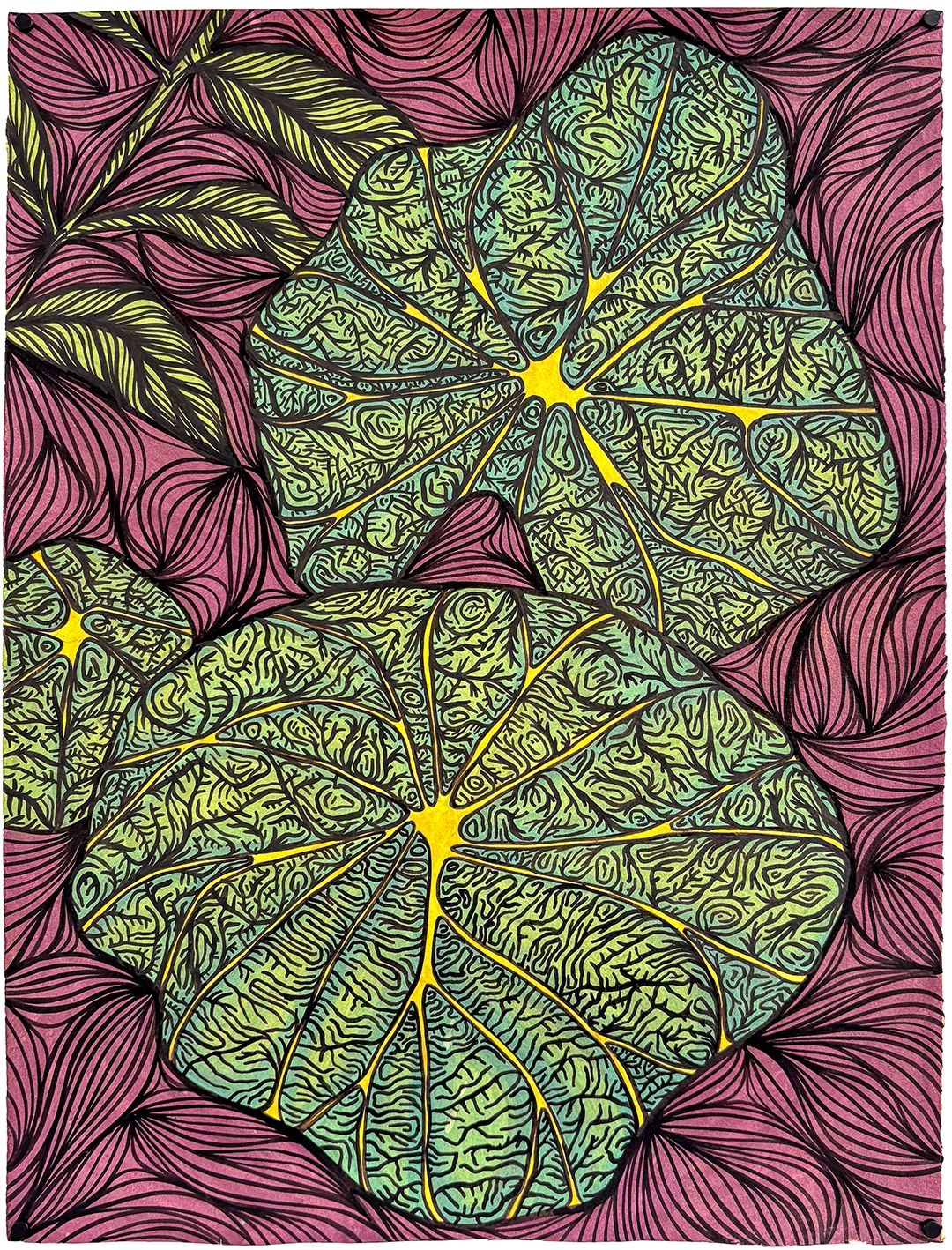
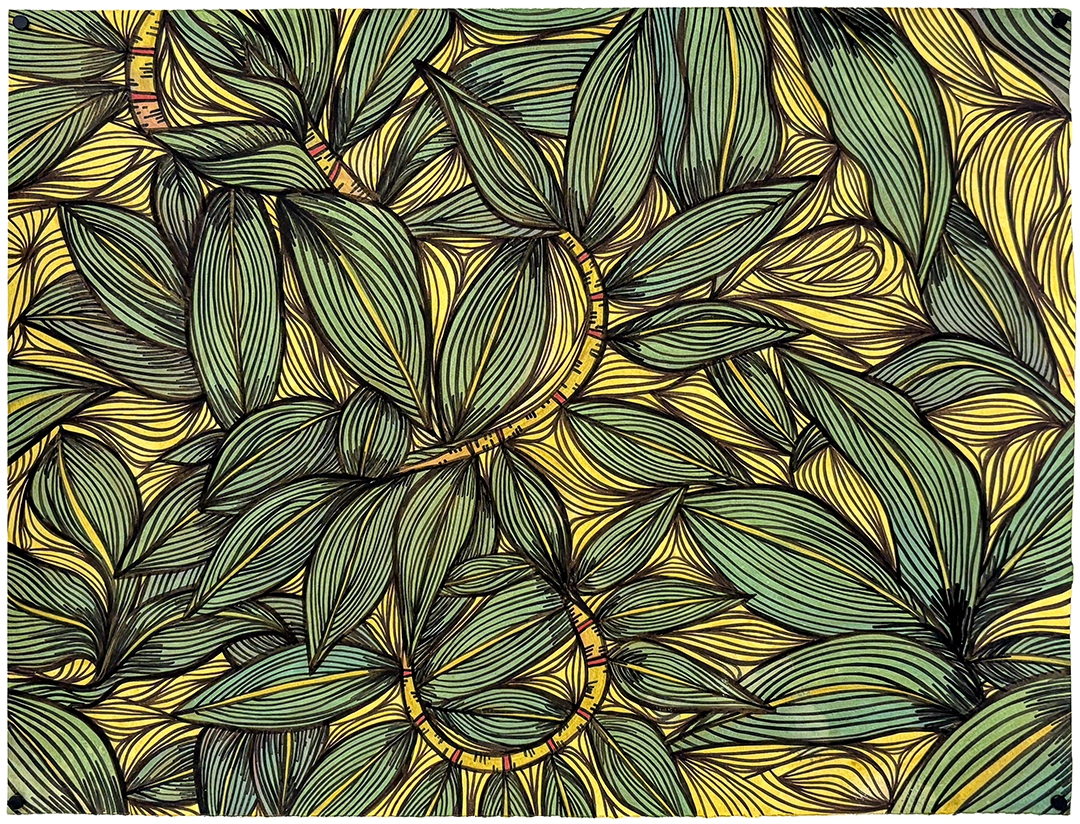
The first group of works consists of six paintings in watercolor and ink on paper, 16½ × 21½ inches-four vertical, two horizontal. They were made during the artist's first "dieta" in Peru, between 2024 and 2025, from photographs she took herself at the AyaMadre center. The technique combines watercolor with linework in ink on heavy, non-industrial paper. Each piece required roughly five days of work, with sections that could occupy several uninterrupted hours of line drawing, in a process the artist describes as meditative rather than as an exercise in concentration.
The series documents the direct observation of Amazonian flora, attentive to the exceptional scale of its foliage-leaves that exceed the size of a human face-likely the effect of abundant rainfall, which the artist identifies as an essential component of the experience. She points to the way water gathers in the cavities of the leaves and to the sound it produces on impact. The paintings extend an earlier practice begun during her first migration to Mexico, when she started drawing plants from photographs taken on her walks, recording alongside each drawing the Latin name, the GPS coordinate, the date, and the time. That body of work, which she refers to as her Herbarium, is the direct precedent of the series. Plants operate in her work as companions and as a model of resilience. They teach her to put down roots and sustain herself in foreign territories-something she ties directly to her condition as a migrant.
No. 2. Take Care in Your Dreaming-Textile Diptych
The second work is a textile diptych titled Take Care in Your Dreaming, made in early 2025 in Buenos Aires, immediately after her first "dieta." The piece was built from a pillowcase the artist had used during her stay in Peru. The pillowcase was cut in two and used as the support for a composition that combines cyanotype, embroidery, and cuts in the fabric.
Cyanotype is a nineteenth-century photographic technique based on a light-sensitive emulsion. When sunlight strikes an emulsified surface, that surface turns blue, while areas covered by opaque objects remain lighter. The artist uses it to render plants by placing them directly on the cloth. In the background of the diptych appear those she gathered on the rooftop of the house she rented in Buenos Aires. Over them she also printed the images of a snake, two hummingbirds, and toé flowers. She then embroidered onto the fabric the line "Take care in your dreaming / and love when you can," drawn from a song by The Avalanches that she uses, in her practice, as a prayer. Lastly-as small windows-she cut openings in the fabric and covered them with stitched scraps of golden tulle.
The use of fabric fragments has been part of the artist's practice since 2015, when she introduced them in the installation Trapitos al sol. They reappeared later in the banners of her 2023 solo exhibition Under the Canopy at the CAC. Pulled away from the wall and lit from behind, the cuts produce an effect of projected light that adds a physical dimension to the whole and pushes the work past its apparently two-dimensional character. The artist identifies this piece as a turning point. From it onward she begins to take textile work more seriously and formulates a set of operative rules for its recurring production.
The embroidery in the piece is also inspired by the Shipibo tradition of kené. From a young age, Shipibo women consume a plant called ipo kené, which produces visions in their dreams. They translate those visions into patterns they will embroider over weeks or even months. These patterns are linked, in an analogous way, to the ícaros, the songs that the practitioner receives during ceremony and that serve as both veneration of the plant world and protection of the participants. The artist learned to embroider on her own, taking this tradition as a reference but maintaining an explicit distance so as not to fall into an extractive practice. Her stitches, she points out, do not reproduce the patterns proper to Shipibo culture.
No. 3. Luna-The Illuminated Cyanotypes
The third group, titled Luna, comprises six illuminated cyanotypes on watercolor paper, mounted on wooden supports. It originates in a series of sticky notes with messages of encouragement that a friend of the artist's, Chandra, gave her before her trip into the jungle. Julia kept those notes in her tambo-a basic hut or cabin, often raised off the ground on stilts-throughout the month her first "dieta" lasted, and brought them back with her. Luna alludes to the name Chandra, which in Sanskrit means moon.
The compositions are simple: rectangles printed in cyanotype from plants taken from The Wellness Garden, a garden the artist established in 2024 in the Camp Washington neighborhood. To those impressions she added stencils with animal figures-the jaguar, the owl, the condor, the kambó frog, the hummingbird, and the snake. Except for the condor, all are animals that have appeared to her during ceremony and that she regards, in Shipibo terms, as power animals. In these cultures, when an animal appears recurrently in visions it is interpreted as a guide who can be invoked to ask for help; in return, that animal must be honored through dance, song, or other forms of expression. The condor is included for its central role in Andean cosmology, although it has not yet appeared in the artist's visions.
The cyanotypes are illuminated with watercolor and intervened with gold leaf, the same material that traces the words taken from Chandra's notes. The artist links this series to the work of the verb to illuminate as a visual translation. The plants and the ceremonial practice illuminate the participant from the inside outward and allow one to see the world, and oneself, with clarity.
No. 4. The Dream-The Installation
The fourth work, The Dream, is a textile and luminous installation consisting of a mosquito net suspended from the ceiling. The fabric is embroidered with snakes and hummingbirds cut from transparent voile, and is lit from within by a fluorescent tube. The piece is meant to be observed from outside.
The choice of support has a direct experiential motivation. During the "dieta," the mosquito net was for the artist an object of protection, not only against insects but also against outer forces she perceived as threatening during her work with the medicines. She brought it back with her from Peru, and it is the same color as the one used in her tambo. The installation seeks to translate the experience of an enclosed space that protects and, at the same time, illuminates outward.
The joint presence of the snake and the hummingbird is not decorative. Both are power animals in Shipibo culture and central figures in Andean cosmology, in which there are three worlds-the Uku Pacha, or underworld, guarded by the snake; the Kay Pacha, or world of the living, guarded by the jaguar; and the Hanan Pacha, or upper world, guarded by the condor. By shedding its skin, the snake is associated with the process of transformation and is one of the forms taken by the spirit of ayahuasca in the visionary process, generally as a boa or anaconda-the one that guards the process of the vine. The hummingbird, for its part, is the messenger that can cross and connect the three worlds. In the artist's personal trajectory, the hummingbird was the first animal to appear to her in a vision, several years ago, while the snake was the most recent, during the 2024-2025 "dieta."
I Look for Thee: The Three Banners
The last group of works incorporated into the exhibition is I Look for Thee, a 2026 textile work made up of three banners of 20 × 20 inches in cyanotype, embroidery, and tulle on fabric. The piece is inspired by the chant "Door of My Heart," by Paramhansa Yogananda, a prayer to God. The artist often uses song lyrics in her work, read as prayers, and understands her artistic practice as devotional in a broad sense-a homage to the plants and to the spirits that accompany her, within a logic of reciprocity she considers characteristic of Indigenous peoples and contrary to Western notions of self-sufficiency.
On each banner the phrase "night and day" is embroidered alongside an animal-the snake, the jaguar, and the condor, the three guardians of the three pachas of Andean cosmology. The cyanotype impressions were made two years ago in her garden, which she also calls Jardín del Sol, using herbs grown there and arranged in a structure that evokes an altar, a central element of the artist's ceremonial practice.
Migration, Family Inheritance, and Manual Work
The textile component of the exhibition connects with the artist's family history. Julia comes from a lower-middle-class family of immigrants. Her grandmother, originally from Misiones, in the northeast of Argentina, migrated to Buenos Aires in the 1960s, fleeing a situation of domestic violence. She arrived in the capital with four children and began working as a domestic worker; her first pieces of furniture were apple crates, and she clothed her children by altering garments she received from her employers. It was she who taught Julia to sew. That inheritance is integrated into the practice as a way of making something out of little, or out of what has been discarded-an operation Julia identifies with the English term resourcefulness.
On the question of cultural appropriation, the artist holds a considered position. She acknowledges the risk of extractivism in working with Indigenous cultures, particularly within a historical context of colonial continuity, and describes her way of operating as an attempt at restitution and reciprocity. She works physically at the center she travels to, contributes time and labor, and differentiates her practice from the embroidery of kené insofar as she does not reproduce the patterns proper to the Shipibo tradition, but rather a more general embroidery technique inspired by it.
Painting, Repetition, and Process
Lastly, Julia describes the meaning that sustained manual work holds for her-the hours given over to a section of lines, the weeks invested in an embroidery. She approaches it as a practice akin to automatic writing or journaling, painting as a way of processing rather than necessarily of ordering. Repetition does not operate in her work as a cathartic release but as meditation, as a span of time in which content is gradually understood in the very act of carrying it out.
Amazonia arrives, then, as a body of work articulated around a concrete experience-the Shipibo "dieta"-that opens onto a wider frame: the artist's relationship to landscape in the condition of guest, her family inheritance of migration and manual labor, and a reflection on reciprocity in the encounter with traditions that are not one's own. The opening will take place on May 22.













Comments powered by Talkyard.