 Go to English Version
As a worthy walk-on, more than once I have stood inside a still life: the living scene of a dead nature staged with everyday objects. Between Morandi and Chirico — take your pick of Giorgios — lit by the fierce Miami sun or beneath the drizzle of a summer afternoon, I have slipped into the heart of the anomaly, into the "temple of otherness."
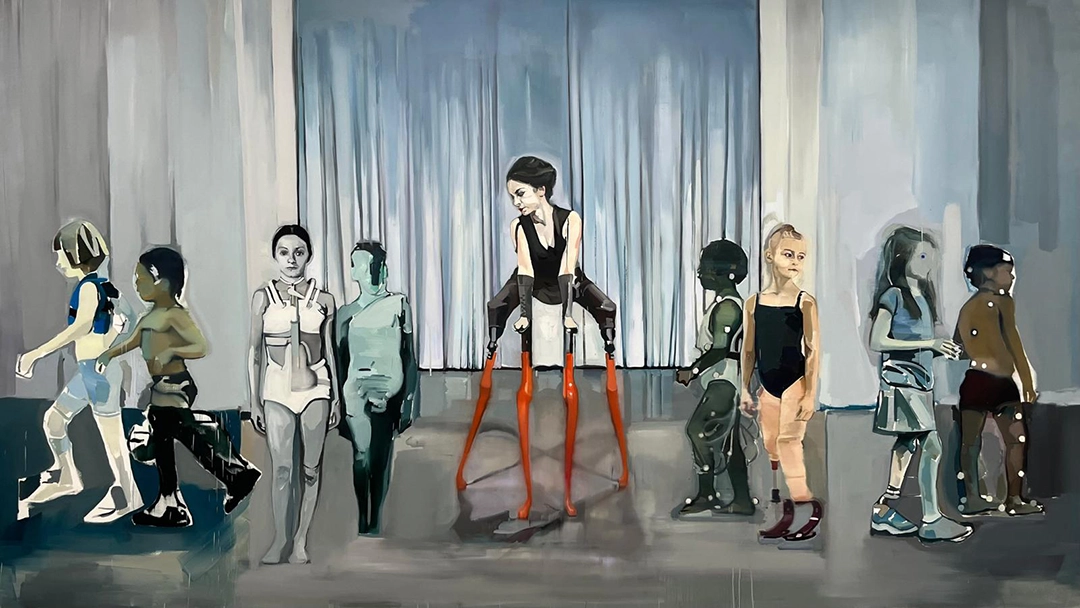
I closed that paragraph with the translated title of an exhibition of large-format paintings by visual artist and philosophy graduate Lucía Maman (Buenos Aires, Argentina, 1988): Temples Of The Otherness, curated by Luna Palazzolo. Invited by a couple of friends, I went to the opening at Maman Fine Arts in Wynwood. I walked the length of the white halls, overwhelmed by what rose before me, though my head had already been shaken, the moment I stepped in, by the enormous oil on canvas The Ascension Of The Liminal Theater (2022). There are nine bodies on a stage, and yet it seems there is only one, dead center: a legless woman dressed in black, mounted on four long red prostheses, towering above the rest. Like one of Louise Bourgeois's spiders, she fixes her gaze on the floor.
I tried to imagine the tension in the muscles and tendons of that woman while, on the canvas, she achieves or attempts comfort and balance. Her bra strap is slipping. On her face I think I read a conviction, an acceptance. She is steeped in solitude, though the void is only apparent.
Eight figures surround her like specters. Some walk, others stand still. Facing the oil, from the gallery floor I "ascended" to the stage of the liminal theater recreated on the canvas.
I could have written it this way: for an instant I was the ninth "ectoplasm" in The Ascension Of The Liminal Theater. Beside me I saw bodies with prostheses on one or both legs, half-erased faces, an almost total absence of any detail that might betray an identity, as happens with the figure waiting to the right of the spider-woman. Suddenly I imagined the possible extreme biography of that (un)drawn body in high contrast, and I also thought of exclusion as an atrocious variant of the exercise of violence.
Executing a slow tracking shot in the same direction, the next body in the oil is that of a girl in gray, white, and a corset. She holds the gaze of whoever stands before the work. I could only contrast the impassivity of her face with the certainty of pain, of discomfort, of sting. I almost spoke the name of Frida Kahlo, though it had no bearing on anything.
There is another specter on the side opposite the "spider." The girl wears prostheses on her lower limbs. Of the supposed phantoms, she is the only one that struck me as alive.
"I work with these notions of difference for the subversive potential they carry by drifting away from the norm, and because I believe they are important when it comes to dismantling established concepts such as ableism, and all those pertaining to discrimination. And mainly, because difference strikes me as fascinating and incredibly beautiful, and because I believe society is responsible for achieving gender equality, racial equality, and also genetic equality," Lucía said in an interview for Infobae titled "Lucía Maman: difference strikes me as fascinating and incredibly beautiful."¹
Alone, or with my wife, I have seen in Miami Beach (Florida) and in Willimantic (Connecticut) a rabble of men and women "drifted from the norm." Does that distancing or exclusion from the norm, from "the normal," make them kin to the lived experience of the subjects Lucía Maman recreates in her Temples Of The Otherness series?
I am speaking, yes, of the fire of madness, the maddening calm of the homeless. At Saint Patrick Church and at Calvary Chapel, both in Miami Beach, I heard the lingua franca of the exile, of the émigré, of the dreamer and the loser; at Saint Paul Church (The Covenant Soup Kitchen) in Willimantic, the same. I have seen old age, loneliness, and the antechamber of death in the collapse of an old man undone by the unanimous heat, or by the stench rising from bodies wrapped in layers of grimed cloth in the (nearly) eternal summer of Florida or the (nearly) eternal winter of Connecticut.
Most own only hunger, illusion, and stress as their sole estate. The rest, and they are not few, hoard on top of that a capital of scraps and discards crammed into suitcases, backpacks, plastic bags. Nothing more akin to the tapestry Desamparo con alevosía (Helplessness with Malice Aforethought, 2024) by the Cuban artist Sandra Ceballos (Guantánamo, 1961), made of dresses, sheets, cotton, batting, stockings, brassiere, synthetic hair, and plastic bags, belonging to the series La expresión sicógena (The Psychogenic Expression, 1995–2024). Nothing as eloquent as the headless doll, with a false pubis, confined and simulating a free fall inside the bundle bound with white and immaculate cords.²
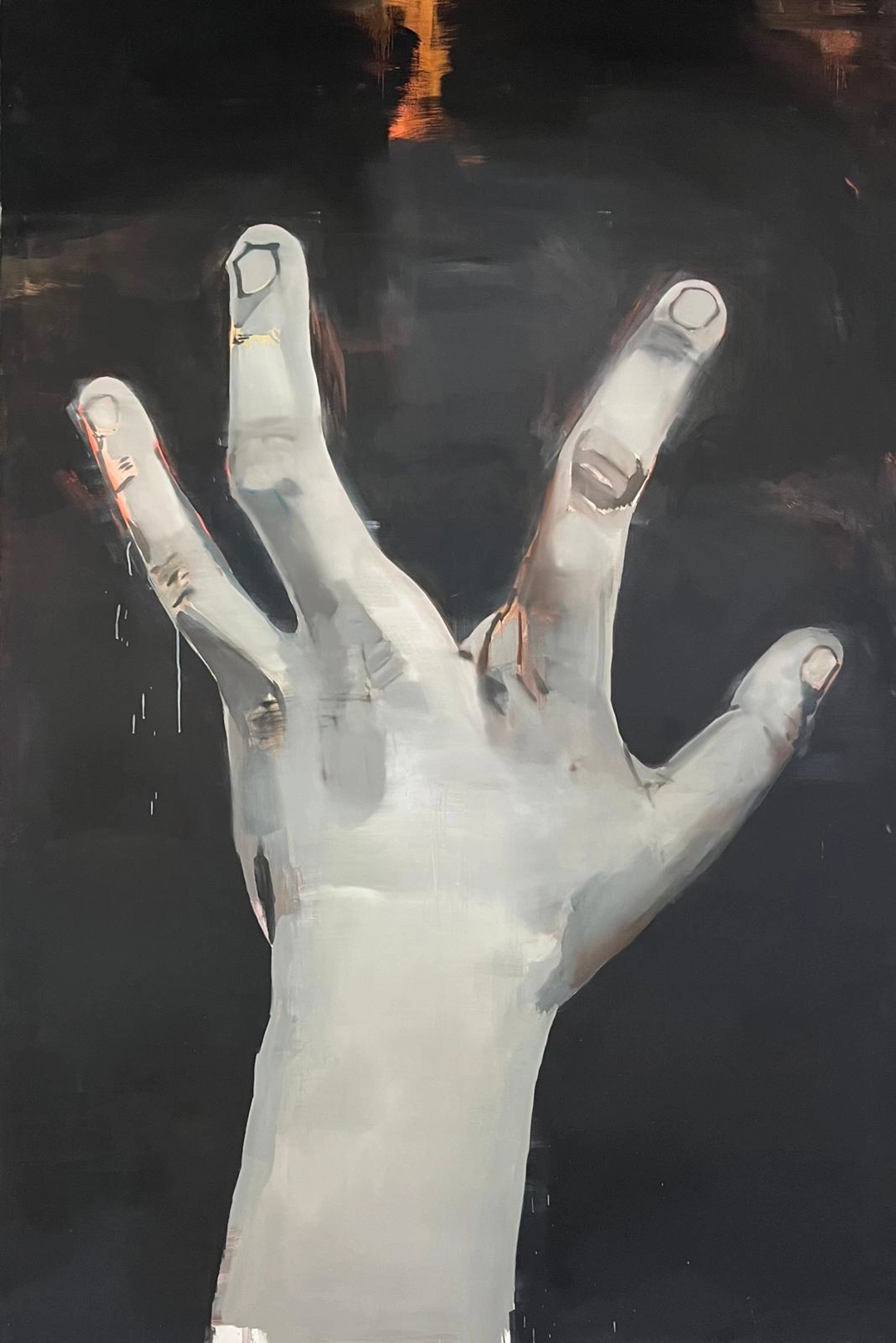
It is existence and being beyond social media.
These subjects — Black, mulatto, white — smell rather bad. Hungry, they share the wait for free food, often expired or about to expire, with those who still have a roof guaranteed, people like me, women and men placed in a kind of limbo.
We waited in line for a bag of raw or cooked food. The choice depended on the degree of vulnerability. Without it mattering much which side we were on, many of us made the round trip on the same trolley in Miami Beach.
As a walk-on in this drama where I was at once a lead, the border of my existential bubble was melting into the borders of the others. Perhaps I exaggerate, but I was and still am there, on the edge of precariousness, even while enrolled in a master's program at the University of Connecticut. I will keep stepping in and stepping out. I am still part of the still life.
Were I to take Sandra's paradigms as my own, I would see the dirtiest, most stripped-down zone as the "psychogenic expression" of a political tale. With Lucía, meanwhile, I can perform a kind of translation that moves from the clinical to the metaphysical. Between the two of them, the beauty of the sordid moves at the antipodes. Yes, I drift along those two currents.
Seen that way, those of us in line waiting for our turn to receive the products discarded or donated by The Fresh Market, Trader Joe's, Publix, Whole Foods Market, Aldi's, or Stop & Shop became one enormous body of multiple faces and multiple biographies.
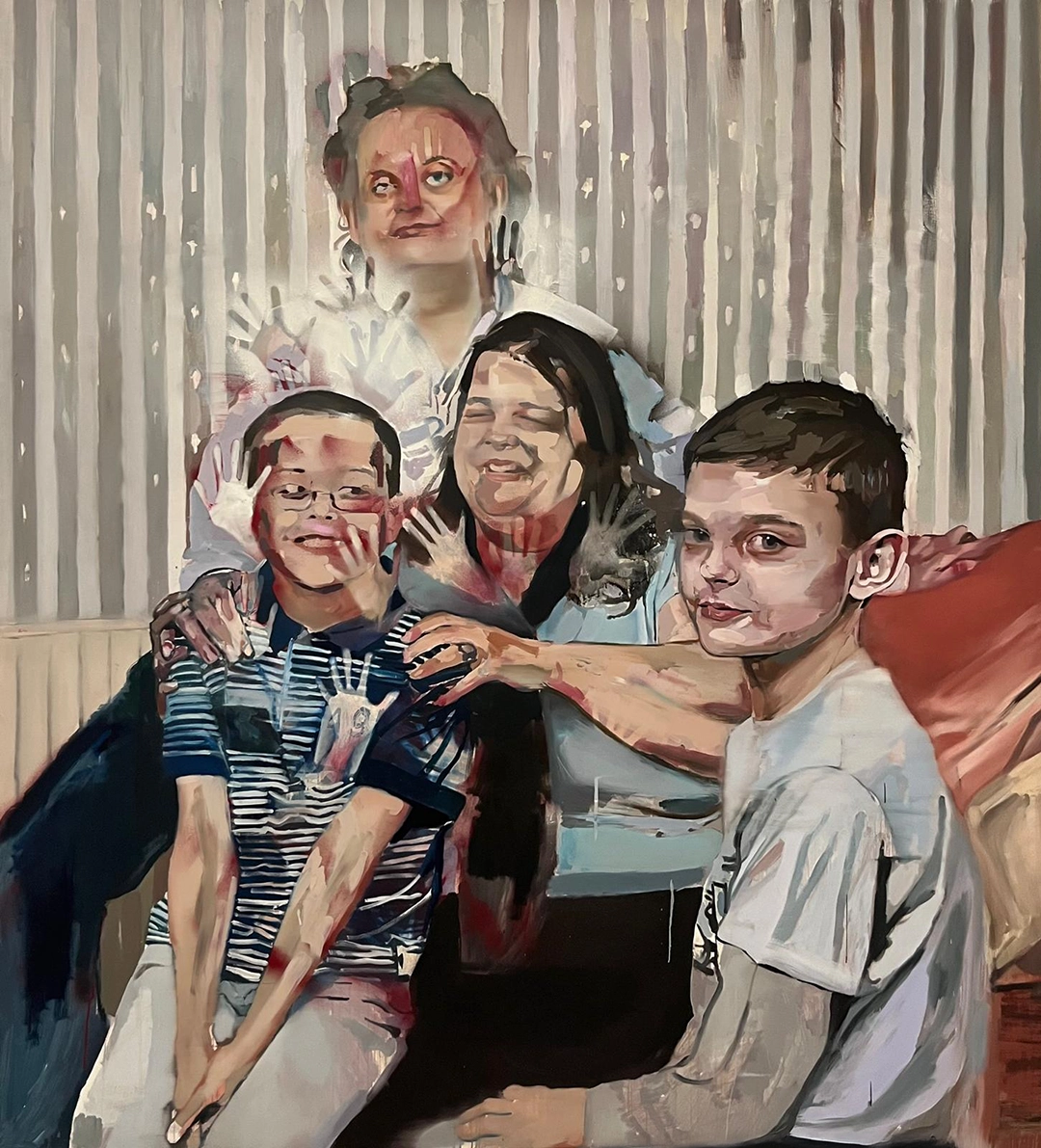
Suddenly, I let the curtain of my eyes fall and lit the zenithal light of memory. Inside the walls of my head there assembled themselves the church, the platforms stacked with provisions, the parishioners working as volunteers, and, of course, the line where I see myself and see them, where I hear them and hear myself. We speak. On the faces I make out the strokes of Sandra in Self Made Woman, No More (2019)³, and those of Lucía in Carer (2017) and The Mother, The Son And The Wingless Spirit (2022).
In the line for the food bags, after recognition a support network can be set up, more or less firm, something like a friendship, like a brotherhood, or each of us simply certifies how lost the other is and pulls away. Some prefer to wait their turn in silence. They see each other, or we saw each other, every Monday, Thursday, and Saturday. Yes, like holding a part-time job. With time some of us may prosper and never return, or lose our minds entirely, or die. New faces will always turn up in the lines.
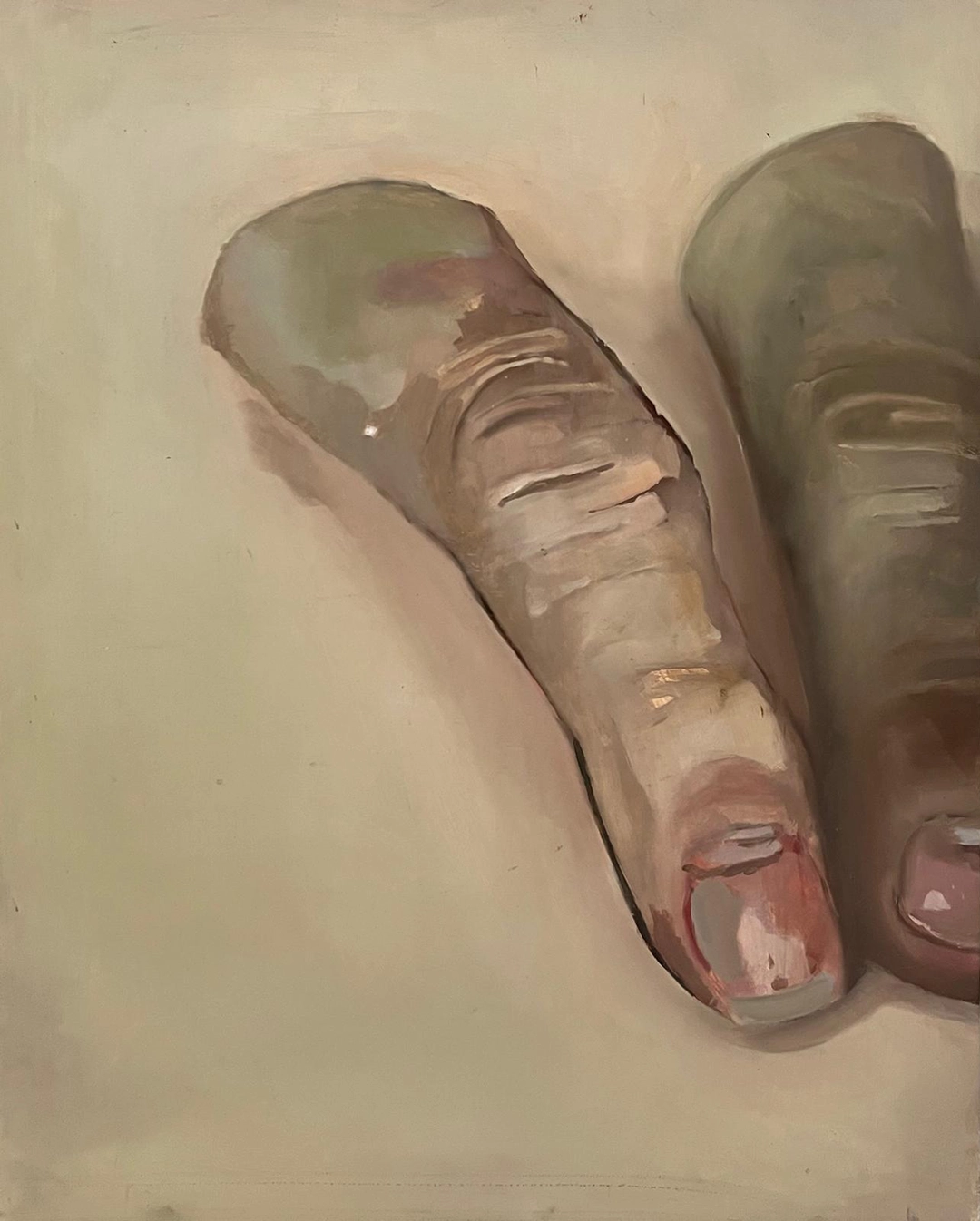
The mute voice of thought told me, "take it easy, jíbaro, you didn't come here just to kill time."
Not being there is the ideal. The equation of life and destiny ought to exclude such a variable. I have reached for a metaphor tied to mathematics in order to understand, describe, and calculate a passage, a culture, a flight, a response, a supposed adaptation to the medium. Inside the equation I have undergone a kind of life lived on large-format canvas.
"I work with themes of otherness, specifically with genetic anomalies within the human species. In these images, which I obtain from medical archives, the subject becomes an object of research, loses identity. He becomes a mere informational element exhibiting his pathology so as to be classified or to help establish a classification," Lucía said in the Infobae interview.
Am I a mere informational element exhibiting pathologies so as to be classified, and along the way to flee the label with which I confine and confirm myself?
Speaking of definitions, this is how Sandra described herself in one of her Instagram posts:
"My carnal wrapping and also bone-mass wrapping after 8 hours without electricity in the posture of the mechanism, Cuba/Survival experiment; an example to the world of a new human species mutating to live in a slaveholding society, without electricity, without water, and without food, in the middle of the 21st Century."⁴
Borrowing Sandra's "lingo," I also ask (myself): what posture would my physical and defensive mechanisms take in this new reality? Stretched out in the shade, naked, legs hoisted and propped against the back of a sofa?
I have found myself besieged by the intensities of both artists' works in the small cabin — sometimes cool, sometimes scorching — of the trolleys that cover the South, North, Middle, and Collins circuits of Miami Beach. I have had those intensities in front of me and behind me in the long refrigerated compartment of the New Flyer buses on routes 79 and 100. Through the window of the van of the Guatemalan upholsterer who hired me and conned me, I saw it at the feet of a pair of bridges on 79th Street. I have taken photographs of all the above. I have also seen it at the Covenant Soup Kitchen: subjects ruminating life over a plate of hot food in the middle of a winter whose temperatures almost always sit five or ten degrees below zero at best, people who, through the long and windy winter, cannot wash themselves in the river or sleep in ruins or sheltered by thickets.
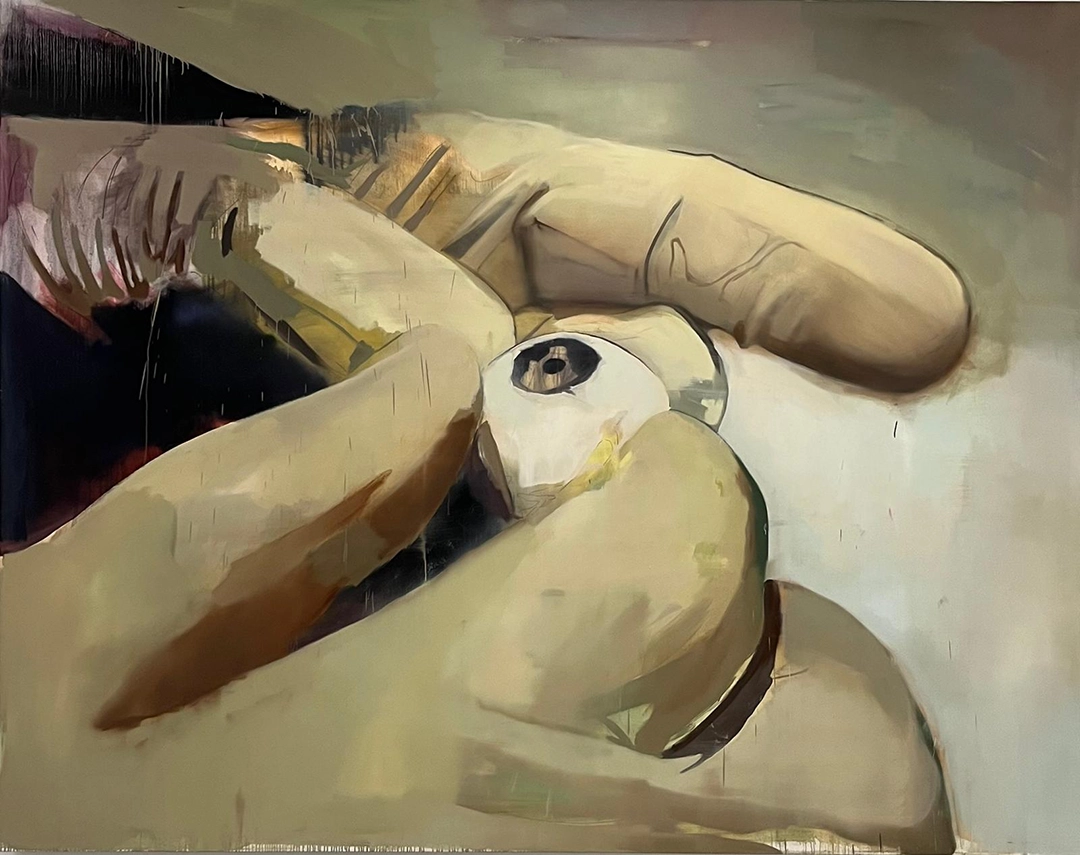
Concerning the series La expresión sicógena, Sandra tells us in her statement:
"What interests me (…) is to call into question the self-sufficiency of the human species, which believes itself superior to every other living being, when in fact a highly developed brain becomes — in almost every person — a destructive weapon so lacerating that it generates its own cellular death.
The mind sickens the human being; the information the cells receive (…) arrives and persists bearing traumatic, destructive charges, generating an accelerated entropy.
These works express symbolically human fragility and its inevitable decadence."
The elements Sandra uses "are real objects" and form part of the supplies used "in hospitals or healing clinics: sheets and surgical instruments, treated blood, human hair, clinical records, needles, syringes, catheters, cotton, gauze, medicines." Along with objects fashioned from inorganic elements — plastics, metals, etc. — she reaches for organic compounds such as "soil, hair, dried plants, human fluids, treated blood."
Sometimes Lucía takes a piece of sandpaper and raises layers on the canvas. This small significant detail brings her close to the harsh, scatological visuality of Sandra or that of Louise Bourgeois. Seen this way, we stand before three different modes of showing the most extreme, vulnerable, and savage side of life.
Yes: to scratch, to flay, to leave the corpus exposed to raw flesh, to strip the superfluous from a ramshackle universe. In her process, Lucía wants to reach the end, and she also wants to reach the bottom. Looked at closely, Sandra operates at the bottom.⁵
After the impact of the first oil I saw at Maman Fine Arts came acceptance and calm, a kind of communion understood as likeness, correspondence, bond. Inside the canvases I sensed a strange stillness and a very singular light in dialogue with the shadows. At times I came face to face with an intense contrast that placed the subjects, or the objects, beyond the clinical file or the portrait completed by a naturalist.
By way of light and its mystery, and by the atmosphere of silence, perhaps Lucía moves between Morandi and Chirico. At a risk, I added an imaginary soundtrack that could also accompany the La expresión sicógena series: the faint noise of a sob, the sigh, the echo of a howl, perhaps the cracking of bones or the scrape of a chair pulled across the floor. I can imagine others, all at very low decibels: that of medical instruments on a tray, a yawn, the limping gait of the lame, the warbles and stammerings of someone trying to communicate and at the same time to understand what surrounds them. Sounds of a small beast, tender or wild, tempered / stoked by paradigms, by discriminations.
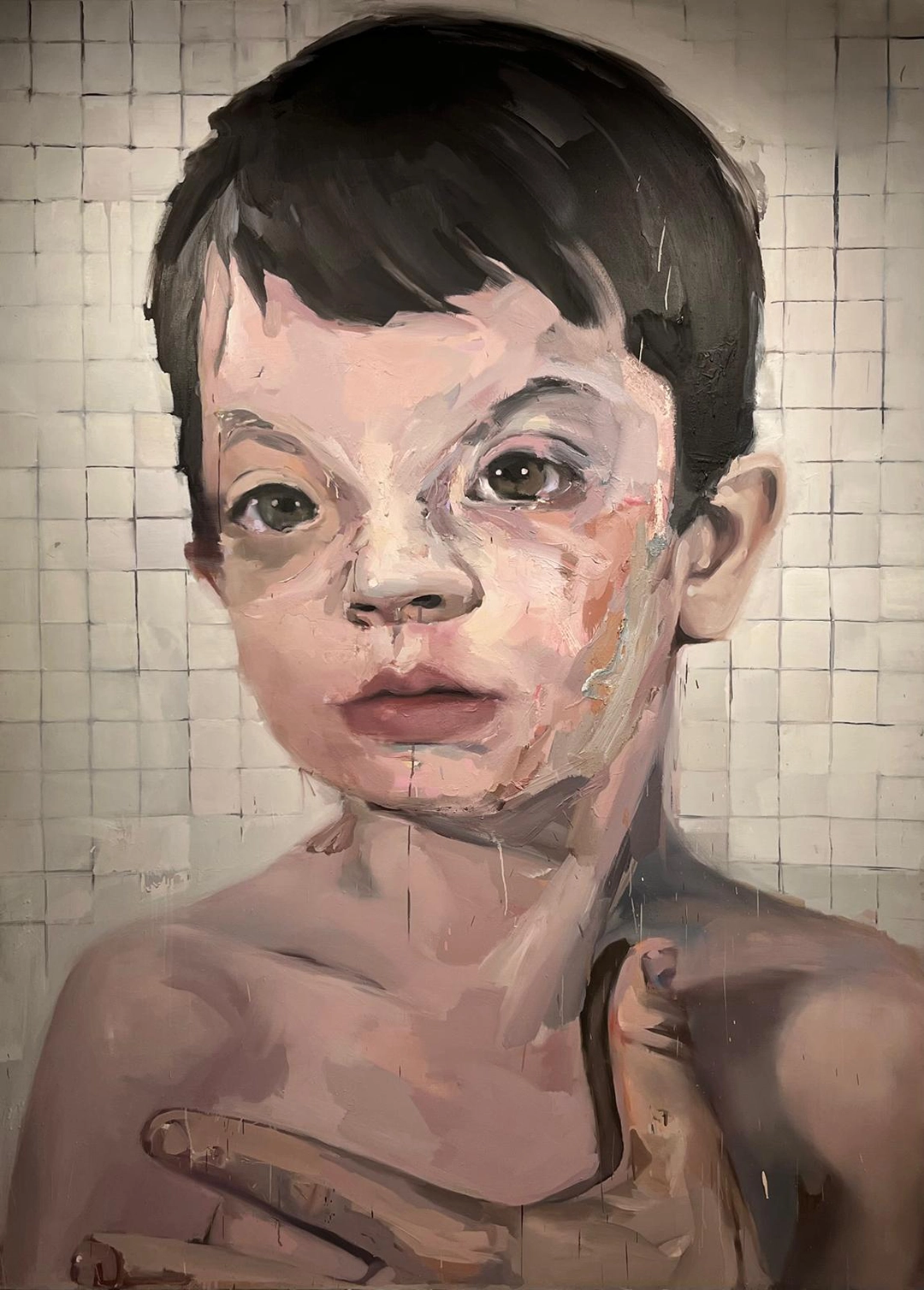
I think, in addition, of the silence that happens in alienation, in repose, or in resignation.
On the short flight of steps at Saint Patrick Church, at Calvary Chapel, or at the Covenant Soup Kitchen I have seen them swallow kilos of food while talking about I don't quite know what. Sometimes they laugh, other times they take off on a speech. I offered them, out of my donation bags, certain foods I had decided not to eat. There, in that instant, I take the chance to look them in the eye, to listen to them. I imagine they have arrived at their own ceasefire, at their solace. Perhaps it is only an apparent truce.
About them, a friend said, "some have decided not to be part of the system and to stay on the margin; they don't want to work, they don't want to pay taxes." In his van, the upholsterer told me, "they're a bunch of bums, they live shooting up drugs, drinking alcohol, and begging for money." I preferred to keep my opinion to myself.
Situated within different "normalities," two people were explaining to me a sort of anomaly that no longer felt foreign to me. "In every tone, in jest or in earnest, 'normal' remains a word of control," wrote Herta Müller in "The Tick-Tock of the Norm" (Hunger and Silk, Siruela, 2011).
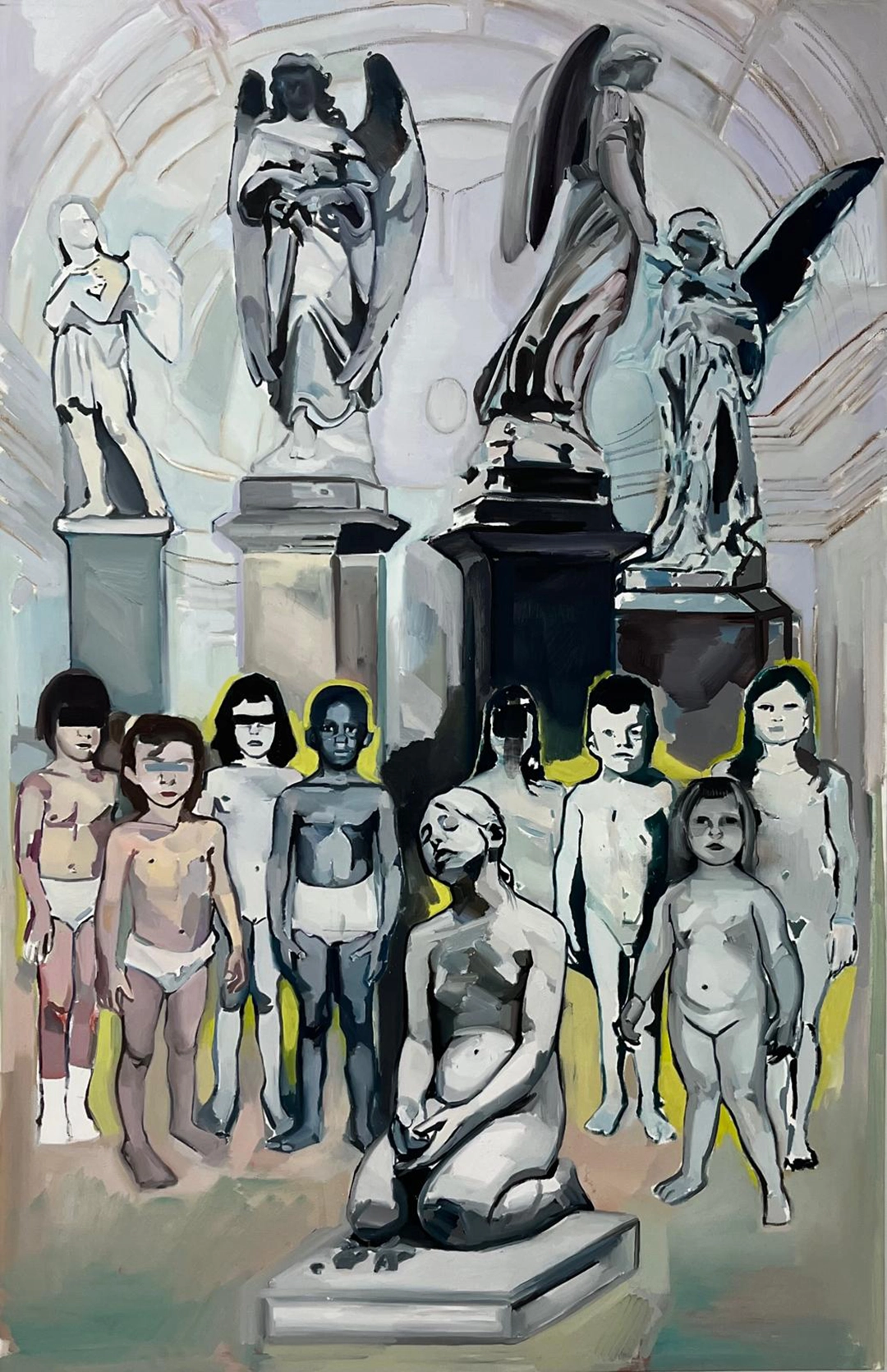
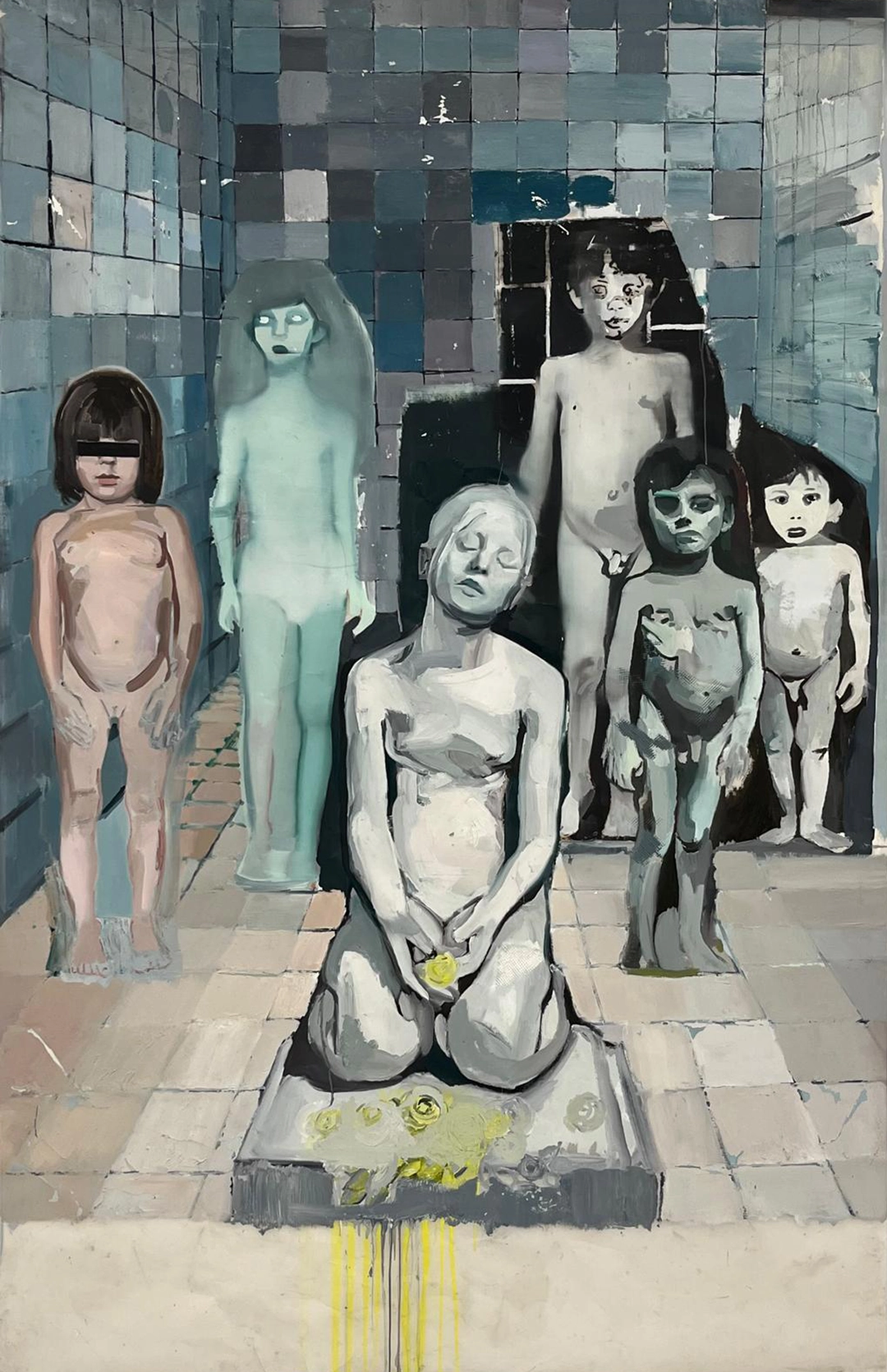
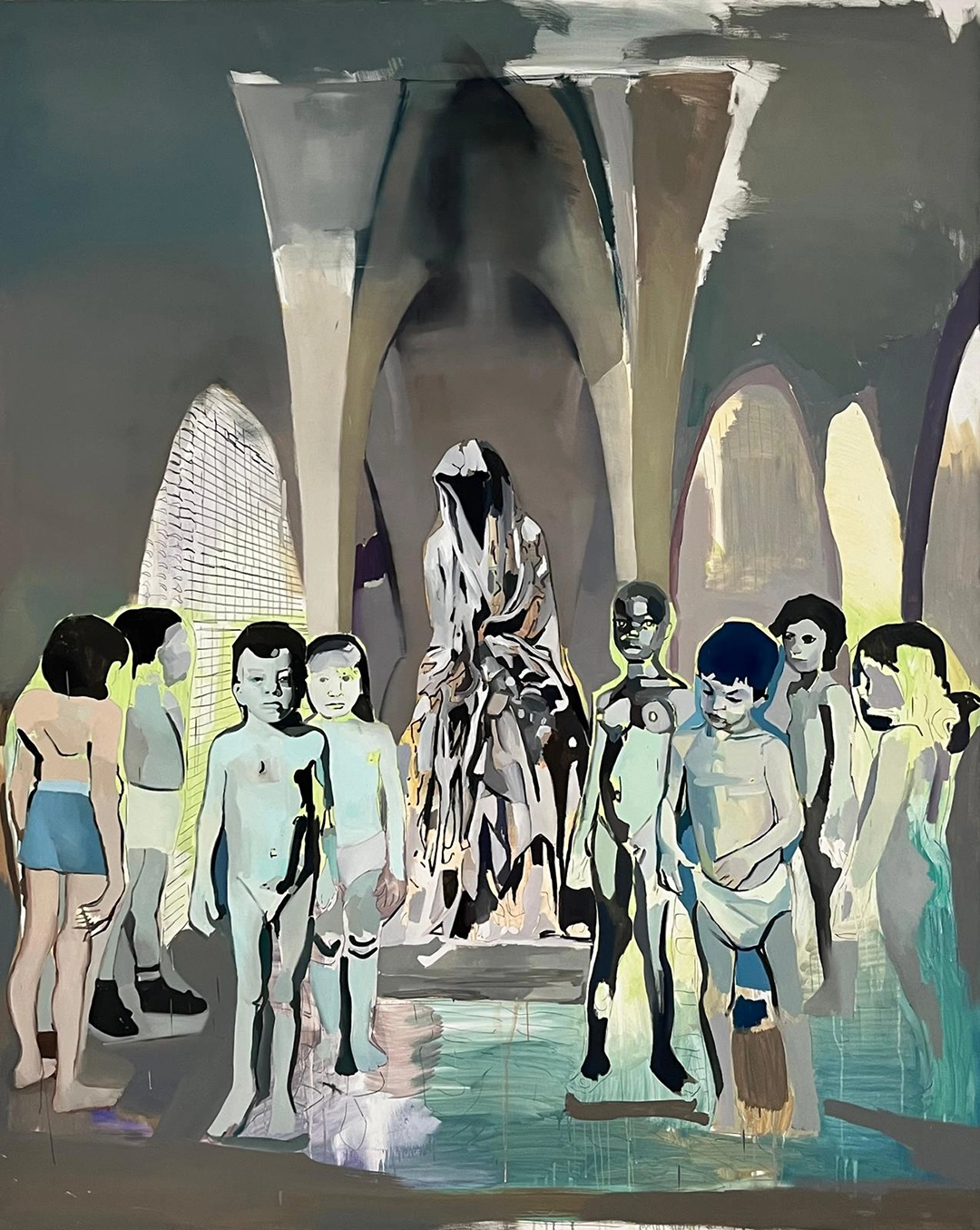
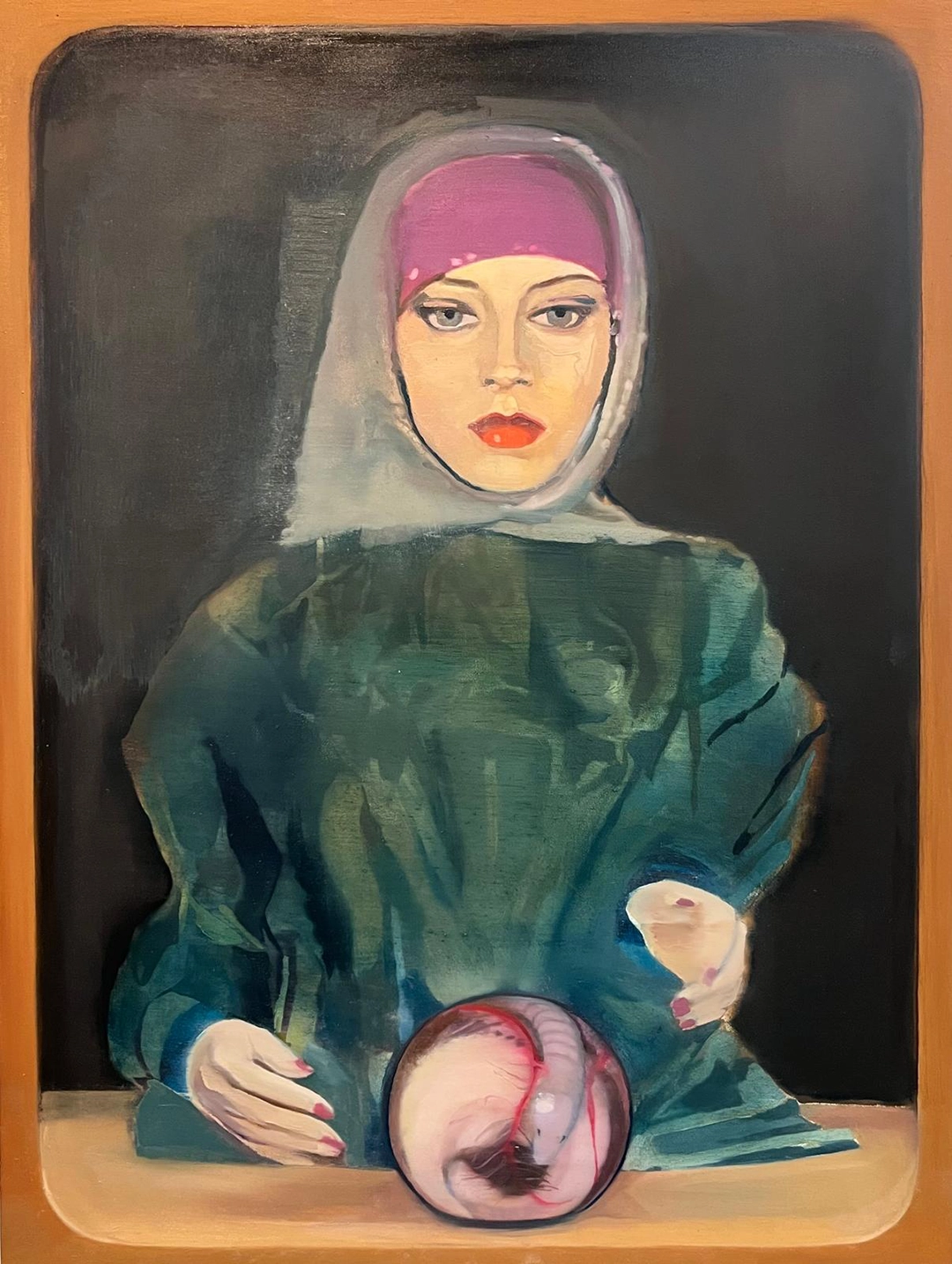
At Maman Fine Arts I tried to translate whatever might be happening inside the heads of the individuals portrayed by Lucía. Children, adolescents, adults. Lucía does not catalog them as ill, but as bioneurodivergent identities: "identities with distinct configurations of body and mind that move away from the bodily and mental state delimited by normative restrictions." According to the artist, "there is identity in the anomalous," and I confirm it in the work Sacra Conversazione (2022).
I come from one identity, and I go in and out of another. So I believe. It happened almost always at Saint Patrick Church, at Calvary Chapel, at Saint Paul. There, those subjects "delimited by normative restrictions" thank me in their own way for the shit I left them. In the food donations there is no shortage of spicy food, caloric bombs, the gale of added sugars, the outlandish blends and colors, the bruised fruits and expired products alongside others that are genuinely valuable because they are organic and have not passed their expiration date.
At the feet of the lofty house of God, surrounded and irradiated by gestures of charity toward me, with the deepest gratitude I take and I choose.
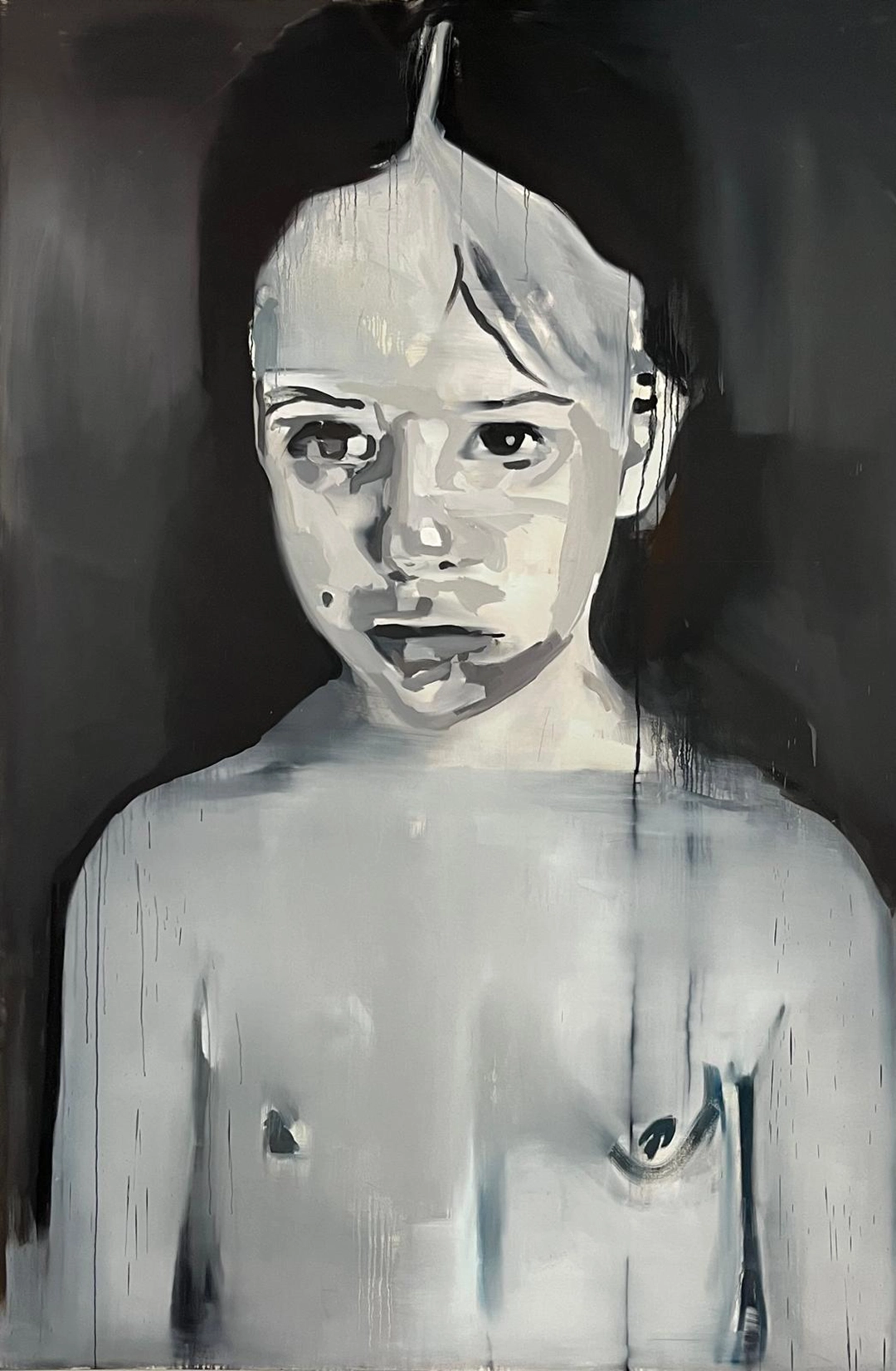
Lucía circles the classical, the canon, with the other canon. If in certain canvases such as Sacra Conversazione, Temple Of The Otherness (2020), and the ones she titles Limbo (2019–2024) she recreates among the subjects a series of sculptures that perhaps represent beauty and the harmony among the body's various parts, or normality carved in marble, those perfect figures set against "the crippled," "the slow," "the one-eyed," "the deformed" reveal an operation invested in the inversion of "normality," I say from my new intermittent identity, the one I step out of and back into.
Normality is now the strange thing in the ecosystem of bioneurodivergent identities. "This act of placing the pathological before the human is a methodology that shields discriminatory thoughts or actions behind biologistic foundations."
In the works of Sandra and Lucía I saw the thin woman, covered in multiple layers of skin-tight clothing and stooped high-heeled shoes, who left only her face exposed while she cut long strips of cloth to tie to her limbs. I saw the gaunt man accompanied by four dogs he carried in the basket of his bicycle. I saw the schizophrenic dancing in rags. I saw the autistic girl kicking, untamable. I saw the South American woman with reddened eyes, wet and dirty hair, and a loaf of bread in her purse, who, under four heavy layers of winter clothing, without meeting anyone's gaze, walked stretches of miles on foot.
I have thought about the stillness of the South American woman and about her gaze. There the density of lava on the brink of solidifying gathers itself. I have thought about the jokes in English from a volunteer dressed Carlos Santana–style who got too close to her and gave her a bottle of water and a lollipop, to which she answered with the eloquence of stone.
Metaphysical school, deserted and silent places, oneiric light, solid volumes bathed in light, one might say of Morandi, and I say it to speak of what I likely still do not understand, where an intimate tale is born or lodges itself, a confidence never fully disclosed, like the iceberg.
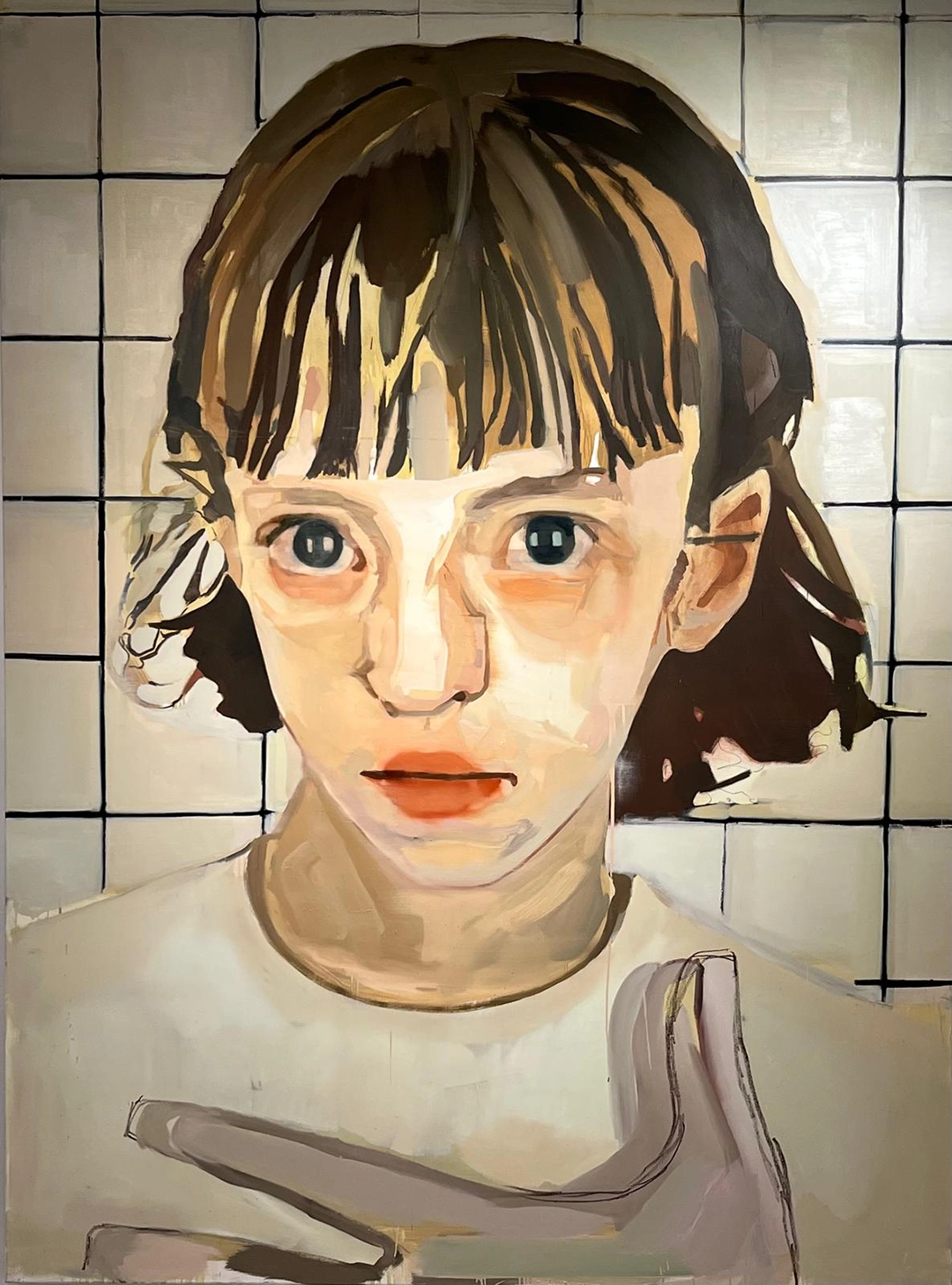
Do these bioneurodivergent identities protect their own existential bubble? I have seen them flare up when some volunteer tries to touch them. Latin Americans, North Americans, and Eurasians reaching for something close to the wrath of Achilles, son of Peleus. "Don't touch me, please! Don't touch me, man!" — the exclamation point at the end like a sword or a club. "Why did you say be safe? Why do you think I'm not safe?" The question mark wielded as a scythe on the day the overcast sky of North Miami Beach was announcing the approach of Milton, a hurricane in transit from Category 5 to Category 4.
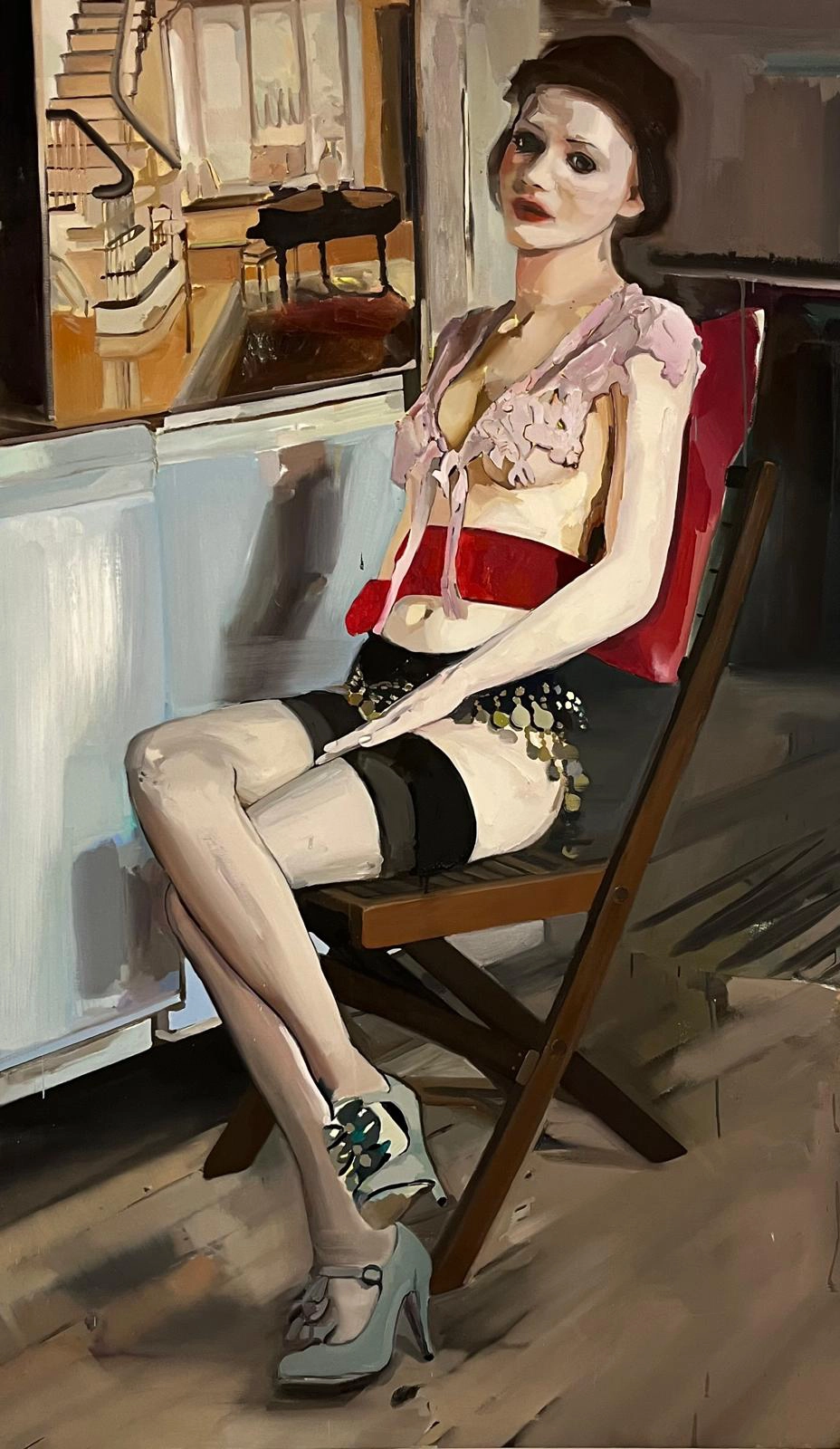
In the scenes recreated in Temples Of The Otherness, between the figurative and the abstract, between the real and the metaphysical, whether in a domestic space, the stage of a theater, a hall of enormous windows, even a tiled room in a boarding school or a sanatorium, I see multiple stains. I make out veils that strike me as ectoplasms too, black rectangles over the eyes to erase identity. And I remember organs, limbs missing due to congenital malformation or amputation. More than once I have asked myself whether I exaggerated by comparing the work of Lucía and Sandra with what I have seen in the lines for food donations.
In those lines I have come across more than one Cuban. I struck up a friendship with one of them. He told me his story, he showed me photographs. At some point in his life, the Cuban repressive machinery showed him what stuff it was made of and what it would be capable of. This friend had been in Miami longer than I had. Ten years, I believe.
"It is in the desolation and disorientation of the new freedom where the traces of the dead dictator really begin to appear," wrote Herta Müller in the essay "Hunger and Silk," included in the book of the same name. "They behave like the echo after a scream. The misery of the country cannot be eliminated overnight."
Is it in the desolation and disorientation that happens within the chained sequence of sleepless nights inside my supposed new freedom where the traces of Fidel Castro really begin to appear? The mere possibility of formulating this question carries with it the propensity toward a recognition and an understanding of the map and the territory of my supposed new freedom.
Lit by the fierce Miami sun, sweating buckets in a warehouse under the orders of the upholsterer who hired me and conned me, or on the brink of a couple of brawls in English with two hallucinating, violent men, with no small composure I have looked at everything that surrounds me, I have taken notes, and I have slipped into the heart of the anomaly.
But I must understand, once those notes are displaced into life, what they mean.
Notes
1 Lucía Maman: lo diferente me resulta fascinante e increíblemente bello.
2 Lucía Maman, Instagram post.
3 Lucía Maman, Instagram post.
4 Lucía Maman, Instagram post
5 Lucía Maman, Instagram post.
This text is part of the forthcoming book Miami Grand Prix, a project that was awarded one of the Artists at Risk Resilience Grants in 2026.










Comments powered by Talkyard.