
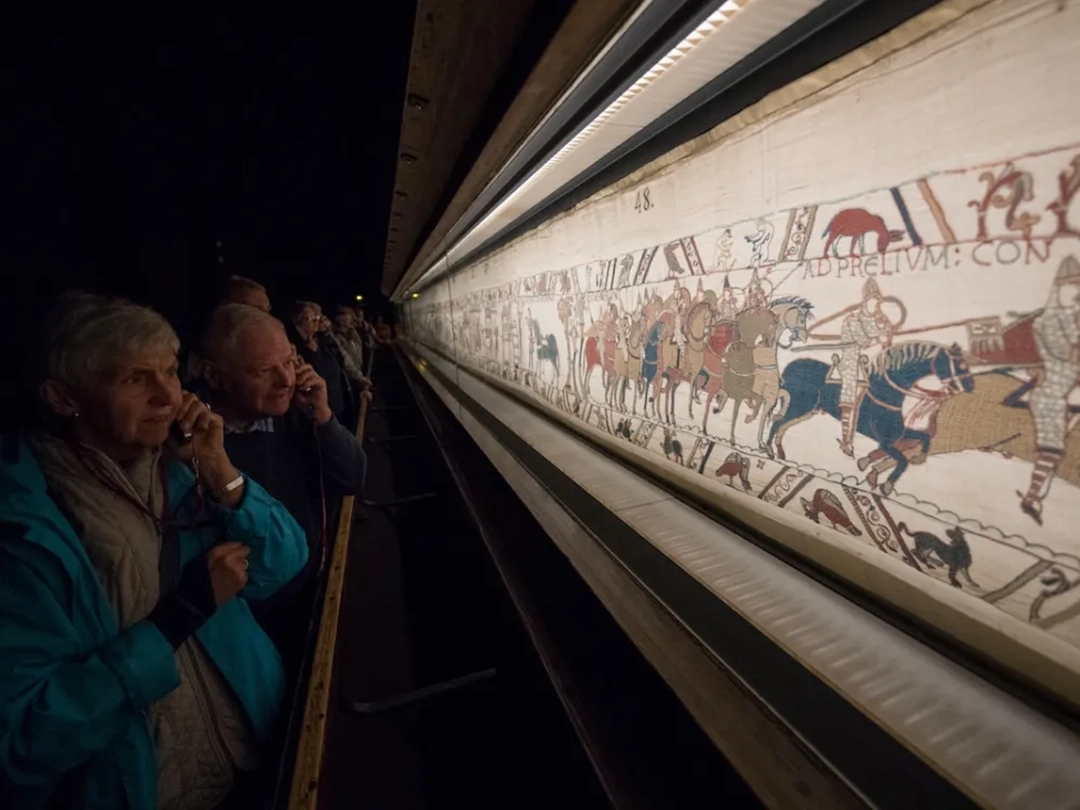
A few months ago I wondered in these pages what Macron was getting out of lending the Bayeux Tapestry to the English. Forty thousand French citizens signed a petition to block it, citing textile fragility and, I suspect, a touch of cross-Channel rancour as well. The other question remained: what would the British Museum get out of it.
Thirty-three pounds for a peak-hour ticket. About forty-five dollars. Forty minutes with the tapestry. Do the math: 82 pence a minute. A penny, in dollars, comes to one cent and thirty-six. One penny for every 73 hundredths of a second of Romanesque thread. Each of the 626 embroidered figures —or 623, depending on which British scholar happens to be counting— costs the visitor a touch over five pence. The horses come free.
There is an 'off-peak' fare for those who go on weekdays before 5:10 in the afternoon (£27), and a 'super off-peak' fare for the last slot of each working day, between 3:30 and 4:20 (£25). The first two and last two weeks of the show are billed at 'peak' regardless. Students and disabled visitors pay £25 no matter the hour. Members get in free, with a ceiling of two visits across the ten months of the exhibition. Lest they grow tempted to abuse the privilege.
Peak, off-peak, super off-peak, time slots, a forty-minute window, a quota of two visits per member. This is the grammar of a budget airline, or of a concert at the O2 Arena. That a seventy-metre Romanesque embroidery should enter Ryanair's pricing system suggests something is shifting in the imagination of the museum.
The detail I find most entertaining about the news is that the British Museum, founded in 1753, is one of the few museums in the world where the permanent collection remains free. Anyone may walk in tomorrow and contemplate the Parthenon Marbles —which, by the by, the Greeks have been asking back for two centuries without much success— without paying a penny. And now, to spend forty minutes with a tapestry on loan from the French, one must leave forty-five dollars at the till. Seen from a certain angle, it is rather like being let into the building for free and charged for the lift.
The Art Newspaper noted in a piece it ran yesterday —with that diplomacy I so enjoy in the English press— that the price is 'only slightly more expensive' than the museum's usual temporary exhibitions, which run between £18 and £25. True enough. So is the fact that an Aston Martin is 'only slightly more expensive' than a Volvo.
The museum has also announced an outdoor installation called Tapestry of Trees, designed by landscape architect Andy Sturgeon, made of the plants and trees that appear stitched into the piece. A reconstructed "medieval" wood out front, for those who will not or cannot afford the main course. Experiential marketing of the sort one learns about at Harvard Business School, though 'Medieval Disneyland' describes it more accurately.
The deal Macron struck with the British included a reciprocal loan. Pieces from the Sutton Hoo ship burial and the Lewis chessmen will travel to Norman museums. Plus €13 million from the Dati ministry for the Bayeux museum, €2 million for restoration, and the uncertain promise of the tapestry's safe return in 2027. The operation, viewed from Paris, has its logic. Because the money is needed by a museum ageing by the day, because a little cultural standing in front of London never goes amiss, and because it closes elegantly an internal argument that had been bogged down for years.
From London, the logic is different. The British Museum, a public institution in the middle of refurbishing its Greek galleries —with a budget that demands serious figures—, gets hold of the most coveted heritage object of the year and prices it like a global event. Forty-five dollars a head, for ten months, in a city that come September will still be teeming with tourists prepared to pay whatever it takes to push the experience up onto their social feeds.
Those forty thousand outraged Frenchmen of last summer were right, even if they did not know exactly about what. Their tapestry is moving for reasons that go beyond the diplomatic or cultural. It is moving because a minute spent looking at it is worth more in London than in Bayeux. People who know about money call it arbitrage. In heritage terms, I am not sure what to call it. But the word will eventually surface in some text, at some point.
And so September is slowly closing in. The queue to get in will wrap round Great Russell Street. There will be lines, there will be selfies in front of the entrance sign, and a gentleman solemnly collecting pennies. William the Conqueror is still sending the English the bill.









Comments powered by Talkyard.