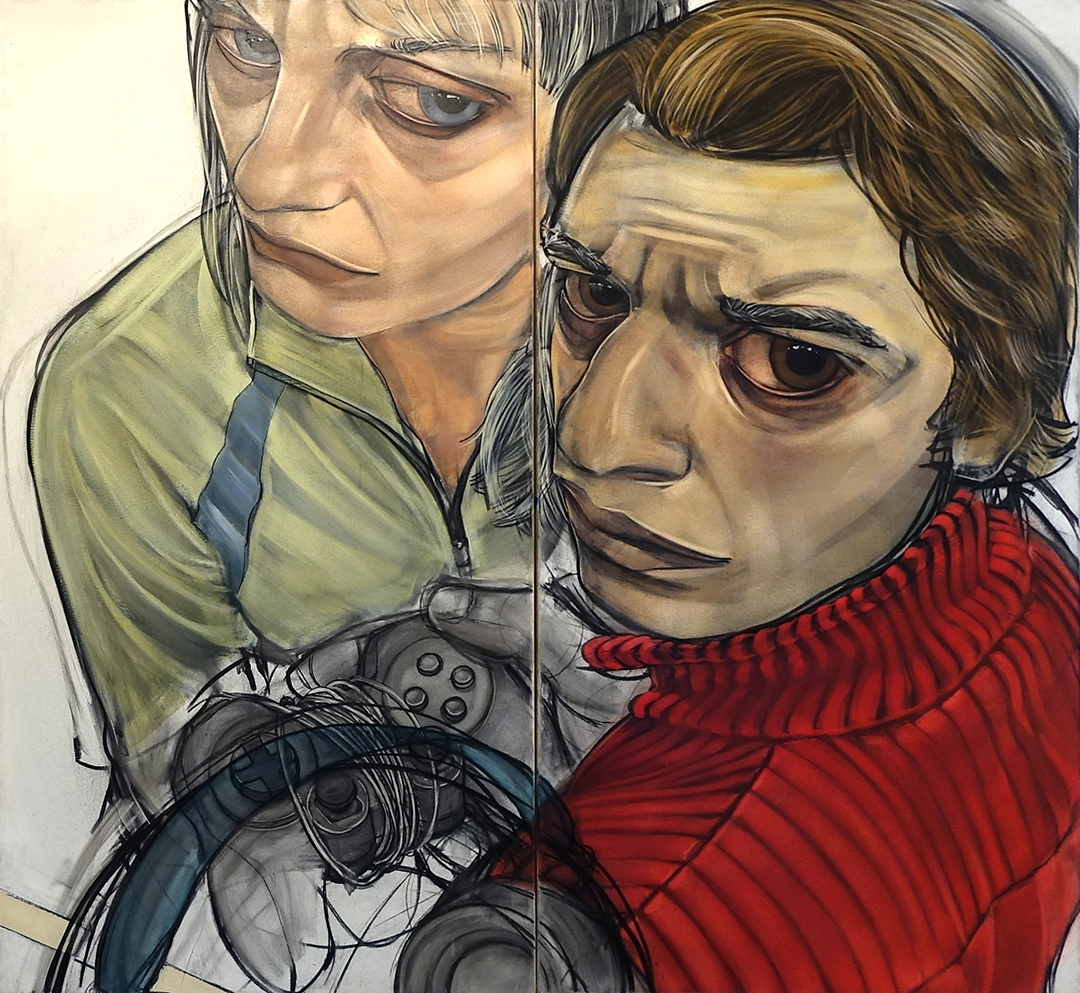
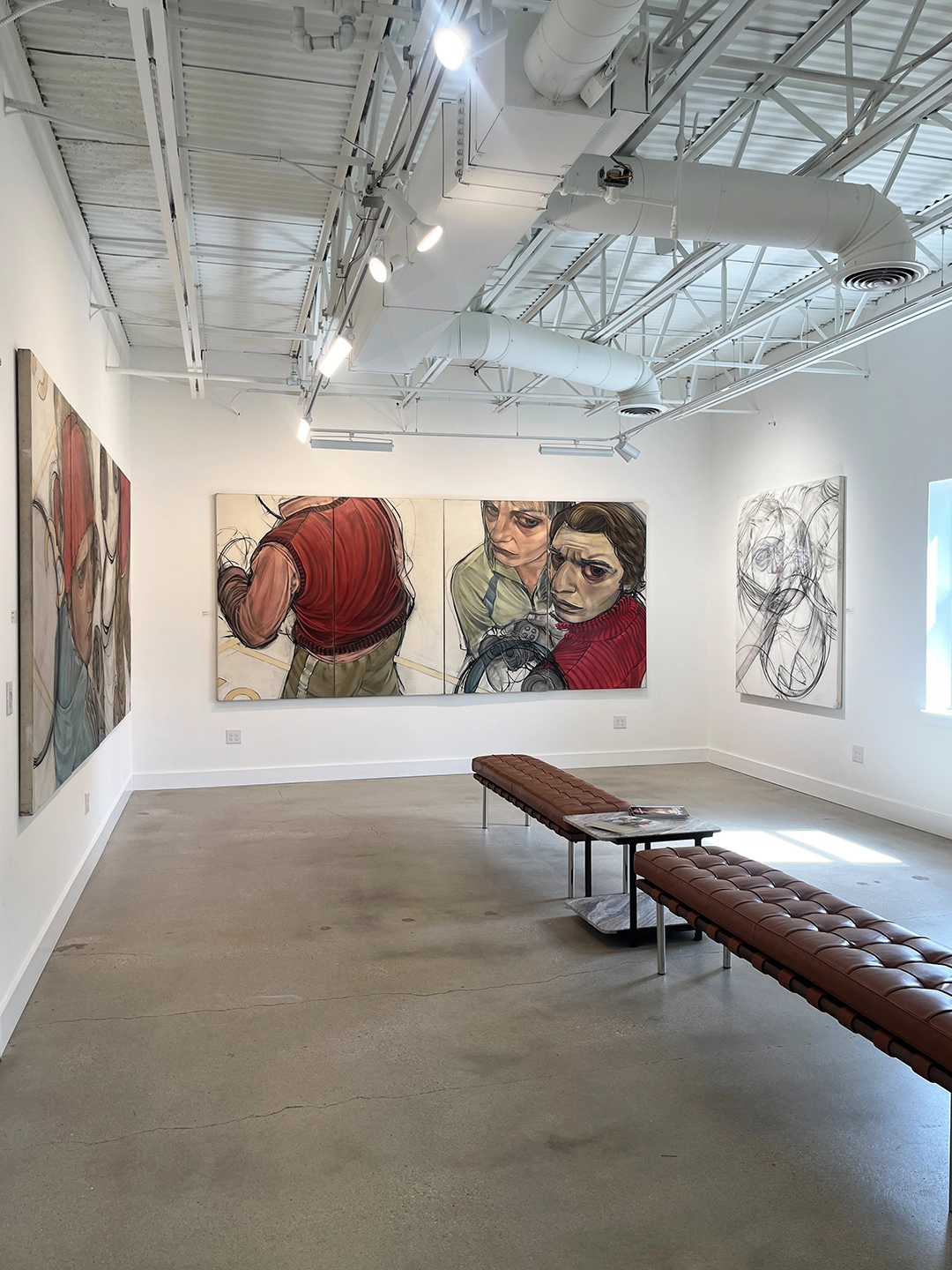
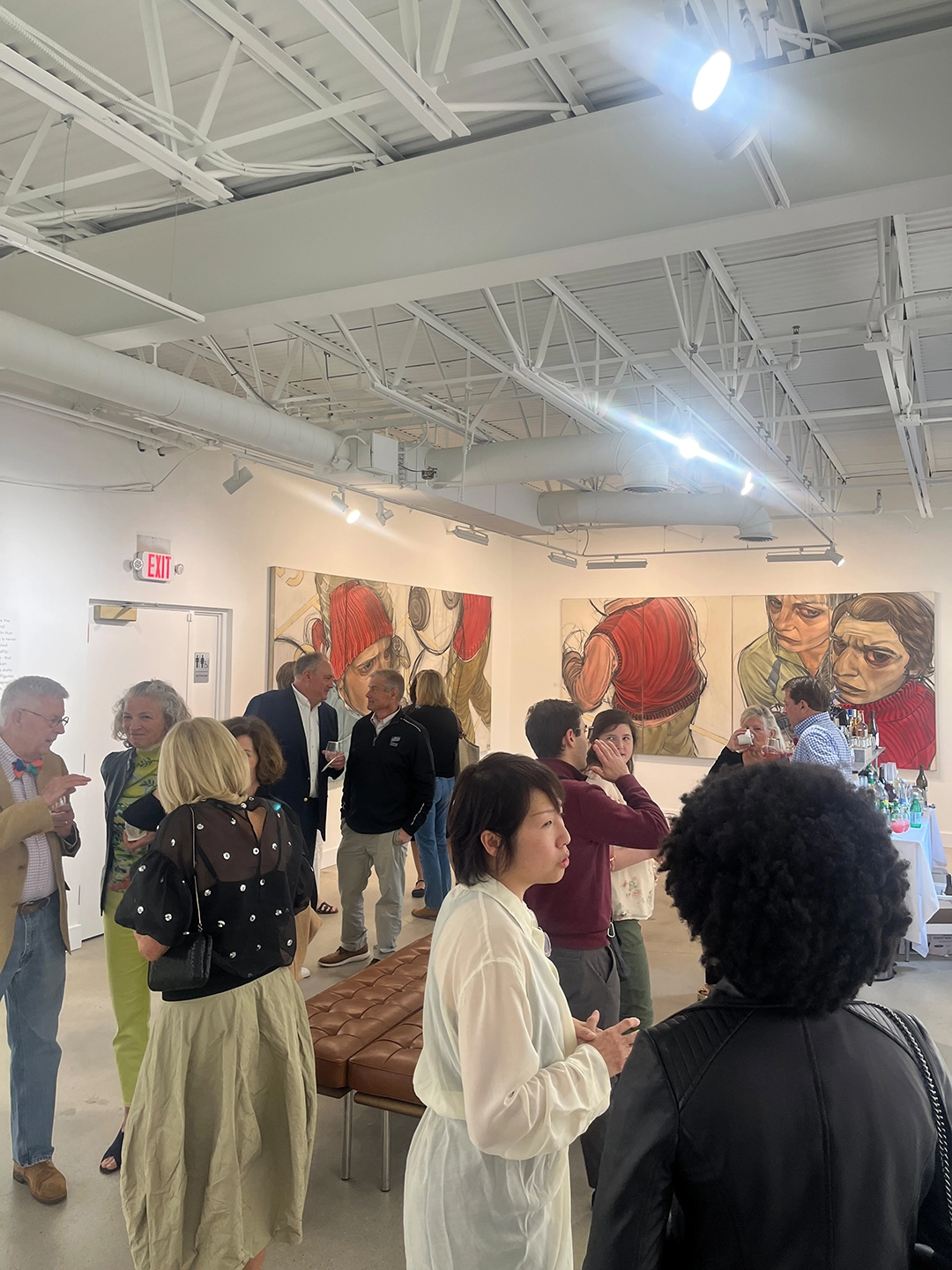
Hopscoth 2. Part 1, 2008 (Detail)
Acrylic on canvas | 70.85 x 157.5 x 1.77 in
Now and again, chance weaves a concurrence of circumstances that places us before a window opening onto the past. The opportunity to converse, undistracted, with the Austrian artist Stylianos Schicho was a privilege, since what most interests me in art are the sinews that bind it to whoever produces it.
Stylianos Schicho was born in Vienna in 1977. Before turning to painting, he studied Law for two years at the University of Vienna. In 1998 he enrolled at the University of Applied Arts, where he attended the master classes of Wolfgang Herzig. He graduated in 2005 with the Diplom mit Auszeichnung, the diploma with honours. His passage through the legal apparatus may account for the interrogative, almost forensic manner in which he examines the face of the other.
Stylianos is not an Austrian name. It descends from a Greek root, presumably paternal —I did not think it appropriate to ask—, which places him in a lateral position within his own city. However tempting the simplification may be, he is no Schiele, no Klimt, no Kokoschka. He is a Viennese painter who cannot disguise his Mediterranean aroma. That duality runs through his entire body of work and structures the central mechanics of his painting: to look and to be looked at; to observe and to be observed, simultaneously.
He takes Vienna as inheritance and as limit. He acknowledges that the city gave him music, theatre, the unbroken tradition of refusing to be startled by the new. But Vienna can also behave like a wicked stepmother. His own words. The ceiling it imposes on him, he identifies with clarity. The temperature his painting demands is more civic than stylistic. It is the temperature of art that matters to the body politic, the one he was able to sense in the Mexican muralists, in other scenes less tethered to their past. In Vienna, everything that gets produced passes first through the filter of its tradition. That is why he has sought it elsewhere. Residencies in Leipzig, Miami, Kazakhstan, the Caucasus. He has found it in fragments. Vienna does not give him the essential. And yet he always returns.
His temperament is Central European, Germanic in the most exact sense of the term. Not in the Prussian manner, but in that of the Viennese cafés. The kind that manifests itself in tireless searching, in going to the bottom and, once there, continuing to dig. Down there, there is no light. It is that absence which illuminates his painting. To be alone, one needs company. One already senses how alone his figures are, pressed in among the rest.
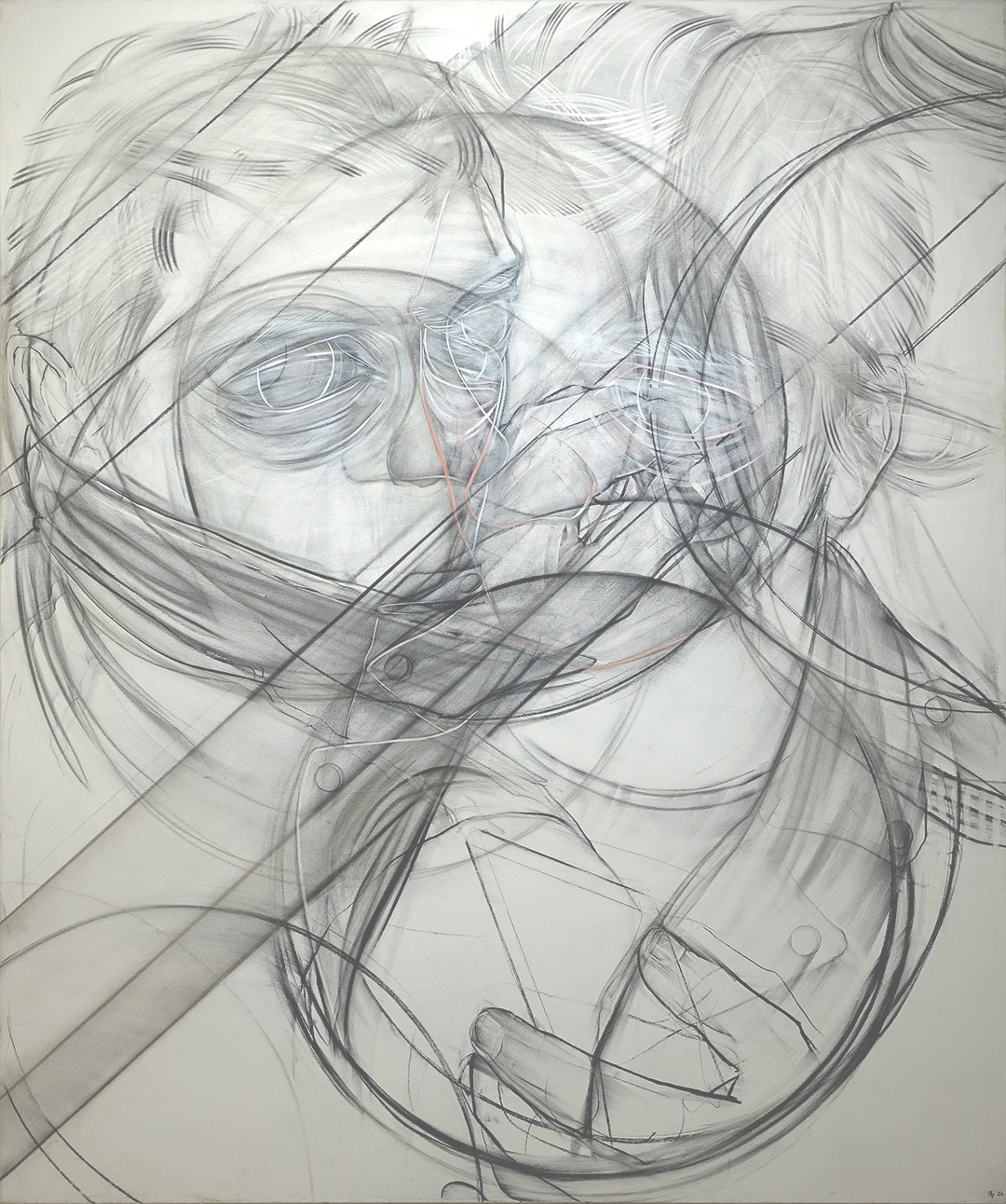
Escalator 2, 2020
Charcoal and acrylic on canvas | 70.9 x 59.1 x 1.77 in
His work orbits around the fact of being observed. It is a theme that enters his production around 2008, when digital cameras became ubiquitous and the idea of collective surveillance —the Orwellian metaphor— ceased to be literature. Schicho states this without rhetoric and without lament. We are all observed, and we all know it. The theme entered his painting and has not left.
The academic criticism that has accompanied his work —notably the texts edited by Kerber Verlag and by Galerie Hilger— has read this obsession in terms of visual inversion. The observer is in turn observed, scrutinised by the oversized eyes of his canvases. Those figures appear to demand the presence of an unspecified interlocutor, someone to complete them, to close the circuit.
This to-and-fro situates him in the lineage of Manet's Olympia, Mary Cassatt's woman in the box at the opera, and the late portraits of Gerhard Richter. The scene, now, is the lift, the surveillance camera, the screen of the telephone, the dragonfly-shaped drone.
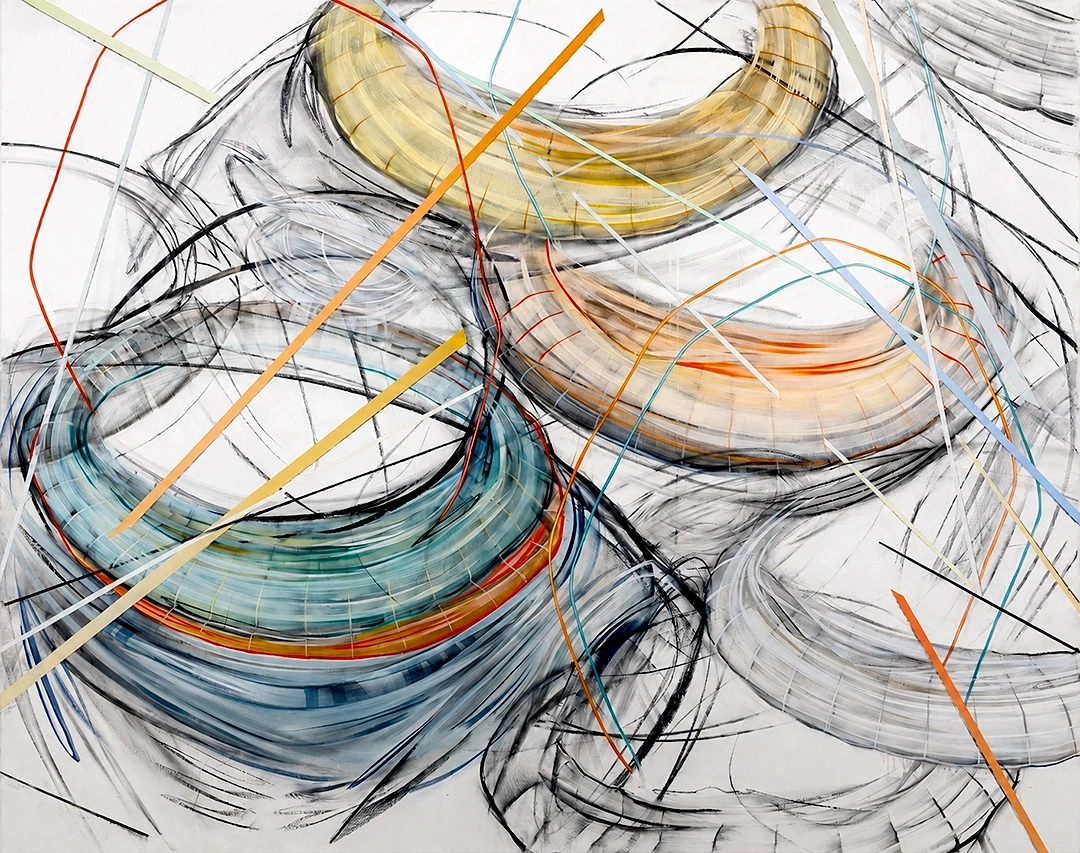
Choreography of Thought 2, 2026
Charcoal and acrylic on canvas | 59 x 47 x 1.77 in
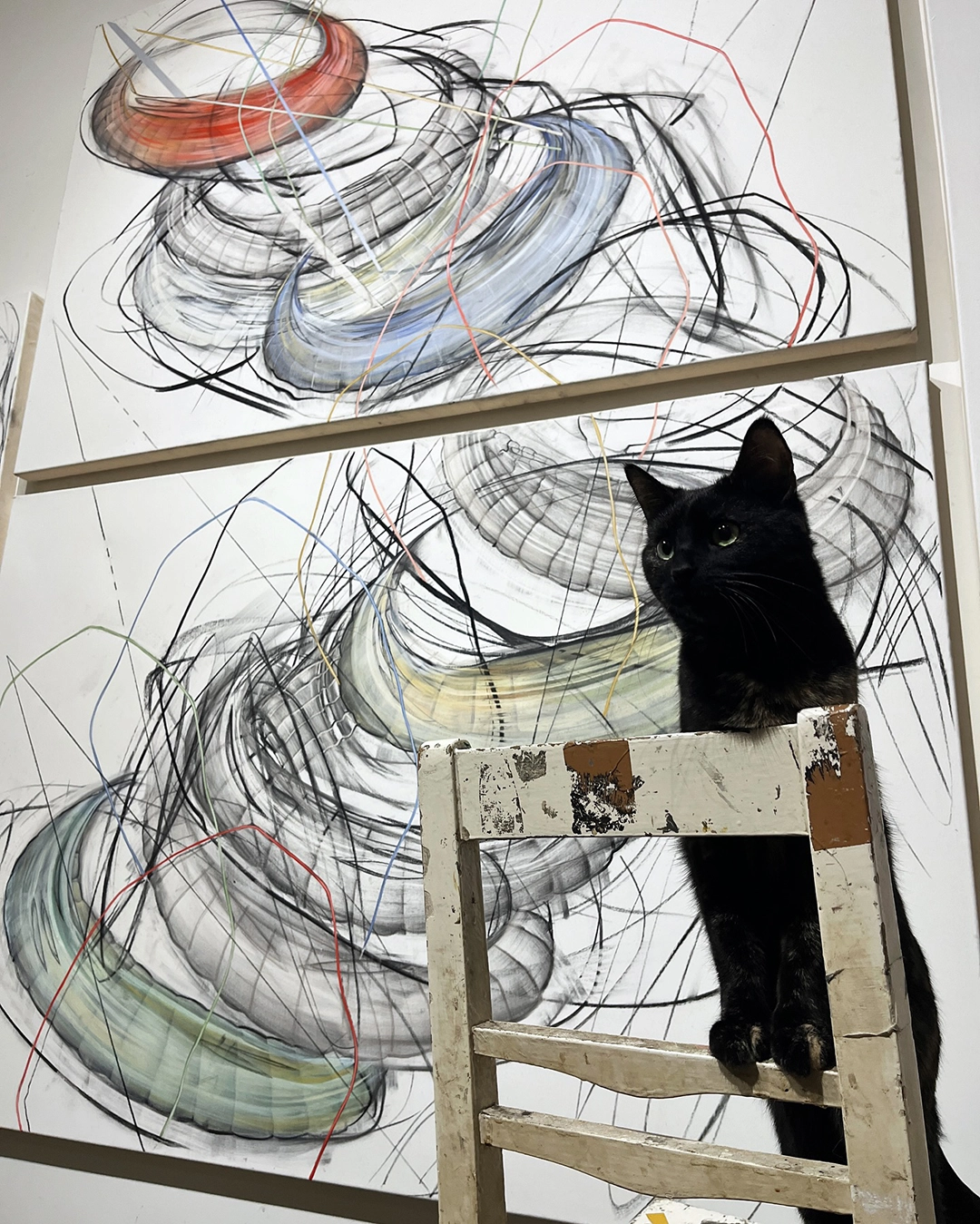
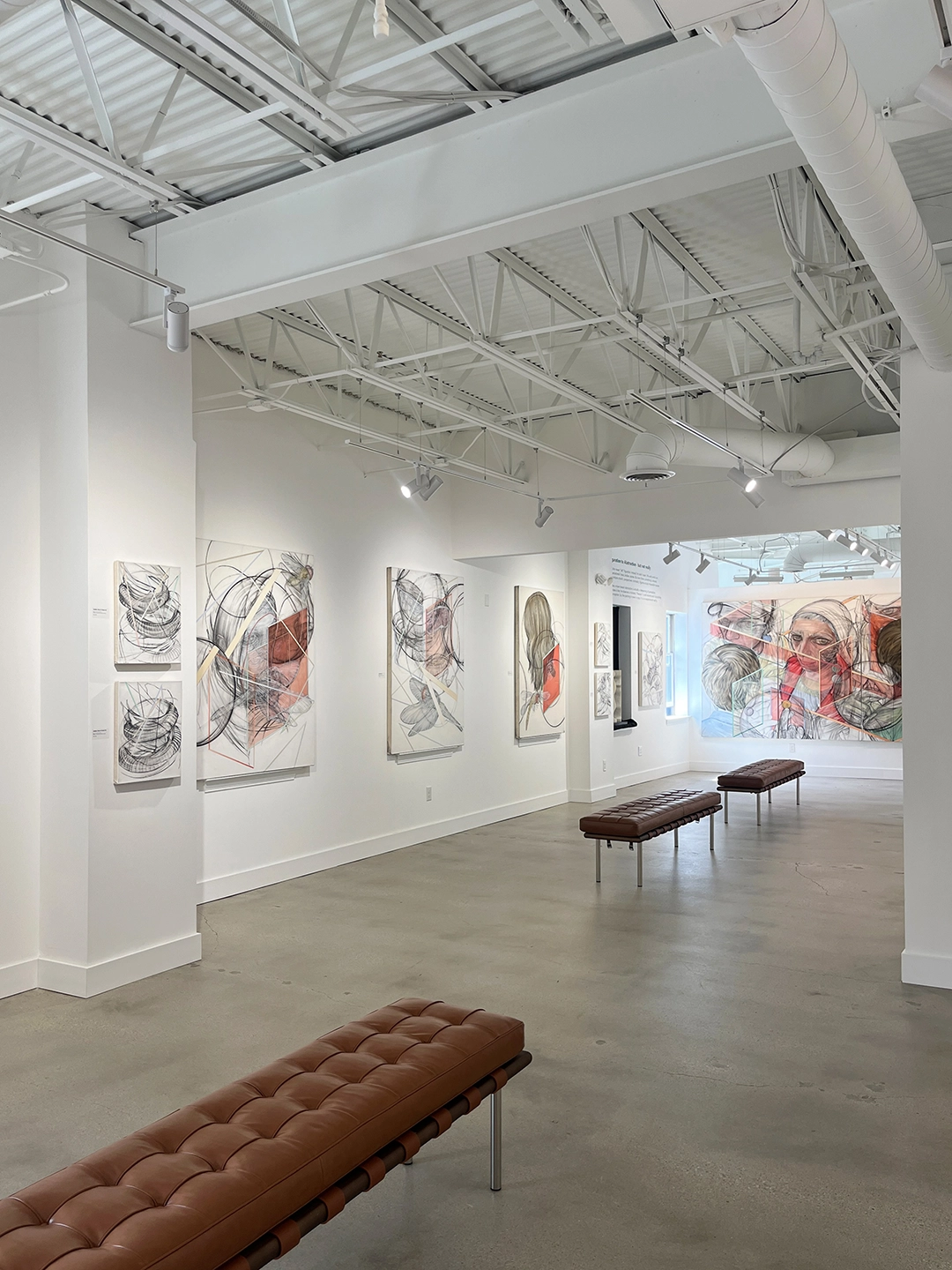
He works with charcoal and diluted acrylic on canvas, almost always at a large scale. So it appears in every technical catalogue. He is a draughtsman before he is a painter. He understands forms better than colour. Charcoal is his mother tongue. Acrylic, an acquired language. The line governs the pigment. The drawing does not let itself be wholly covered. It persists, a conspicuous skeleton beneath the colour.
He works at night, before an enormous mirror that has accompanied him for years in his exercises of self-representation. It is his primary system of visual reference. The reddened eyes of many of his figures confirm the prosaic origin of the device. They are the reflection of the tired eyes of an insomniac painter. The eyes of an exhausted observer, of a watcher under scrutiny. Red from having looked too much.
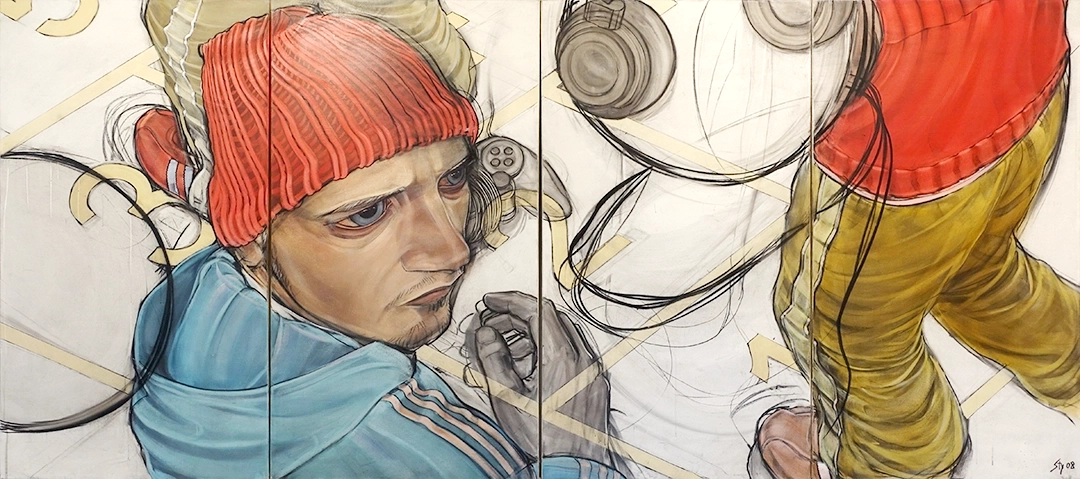
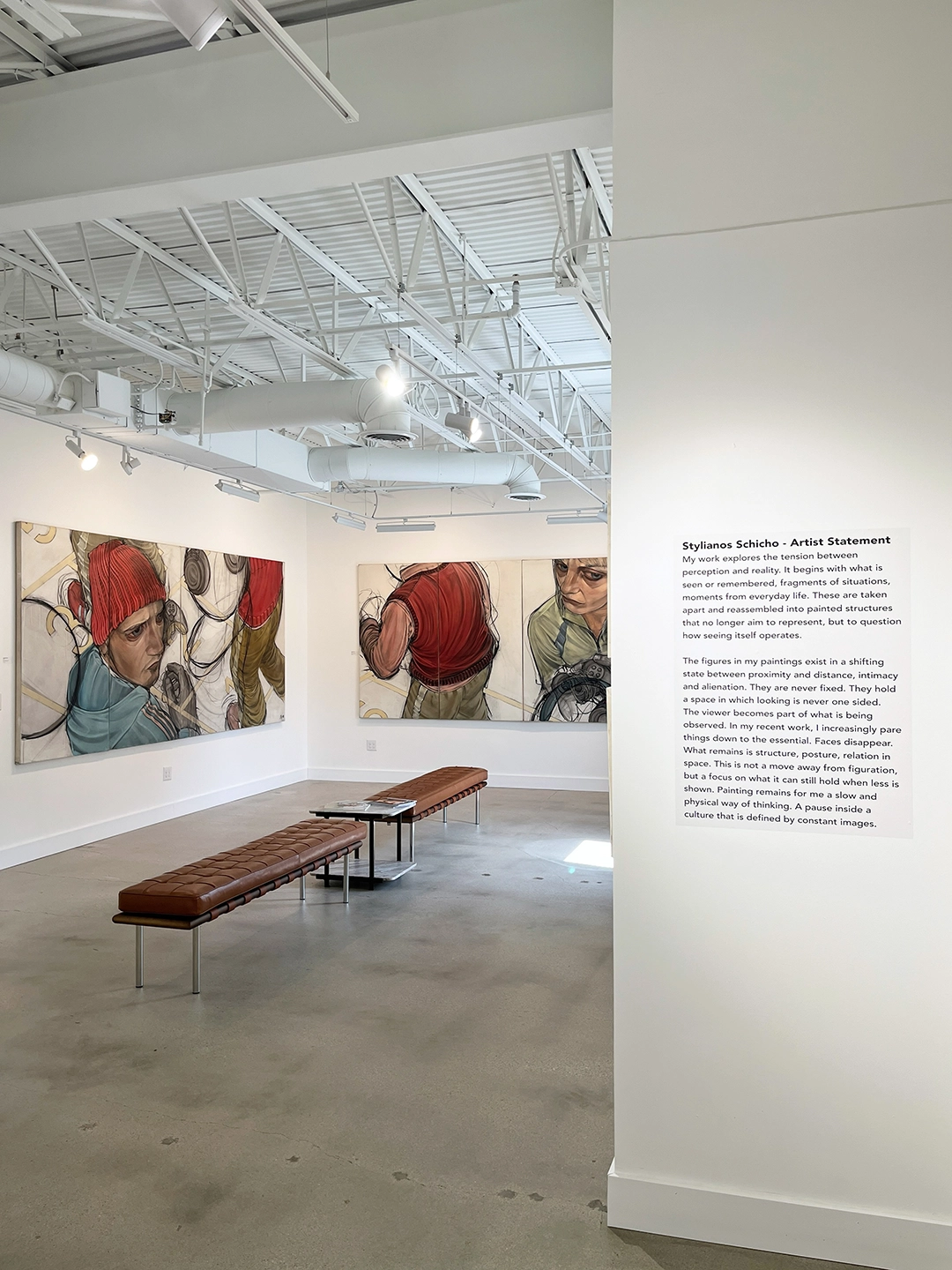
Hopscoth 1. Part 1, 2008
Acrylic on canvas | 70.85 x 157.5 x 1.77 in
The format of most of his major pieces is determined by a physical need to paint without constraint, with the whole body, while sustaining gestural fluency and energy. At smaller scales he draws differently, with different results. Scale is the breathing of the gesture.
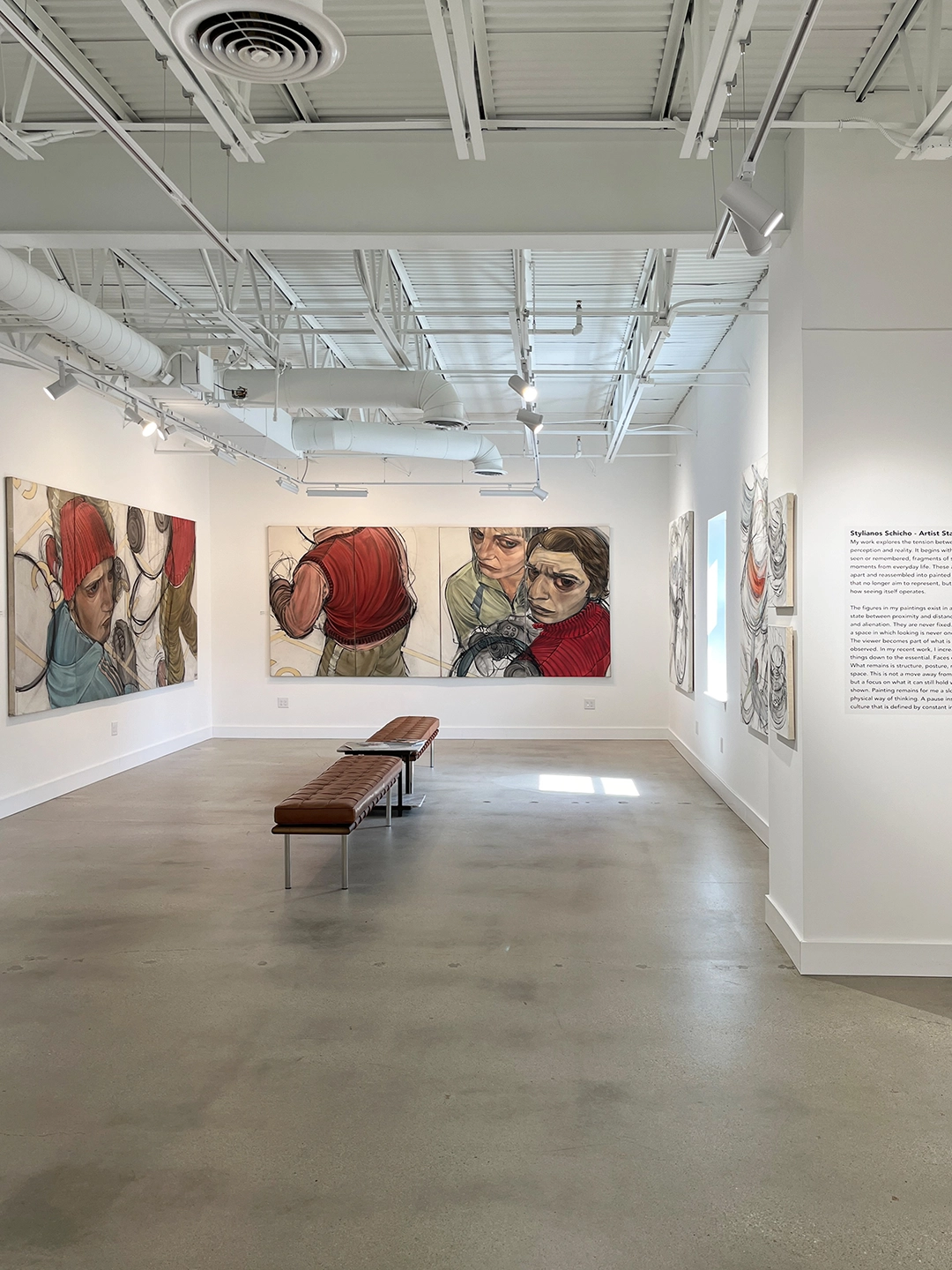
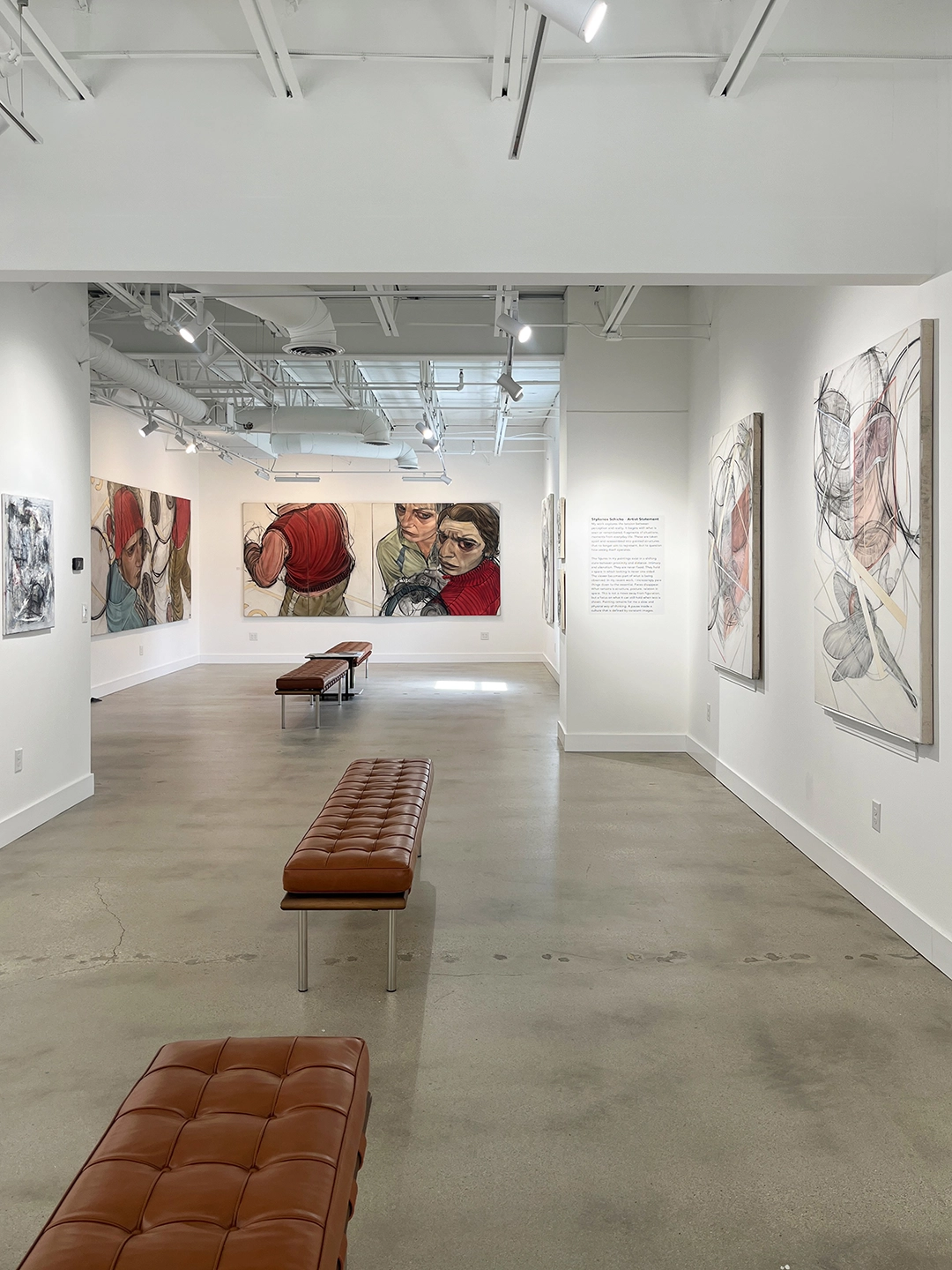
For years now he has been constructing polyptychs, with interchangeable panels. Easy to transport and to mount. The conceptual argument imposed itself afterwards, by accident. On one occasion he was forced to rearrange the panels in order to negotiate an architectural obstacle. Seeing them in the unfamiliar order, he was able to look at his own work as though it were someone else's. Since then he has worked the canvases as reconfigurable panels, without any fixed order. A work is made to be reshuffled and to yield alternative readings. Another way of defeating the fatigue of one's own archive.
Schicho paints neither from life nor from found photographs. He uses himself. For a period he painted himself relentlessly. One day he stopped. He had exhausted the exercise. He had learnt how a gaze translates into paint, how an idea is incorporated into the face being painted. He then invented a theatrical company of his own. He convenes a small cast. He consults the scene, assigns roles, recomposes the moment. The painting emerges as the record of that scene, of the steps his imagination has caught unawares. Every figure in his canvases is thinking, waiting, always on the verge of doing something indecisive, something vague that will not come to pass. The piece closes just before.
Waiting —that condition we know so well— suffuses the whole of his work. A recent series bears the name, Waiting Games. His figures play hopscotch, casting remote controls instead of stones or bottle caps. They are suspended, frozen in the instant prior to the gesture's resolution. The painting does not reproduce movement, but the shifting moment between thought and execution. In that boxed-in interval, his figures live.
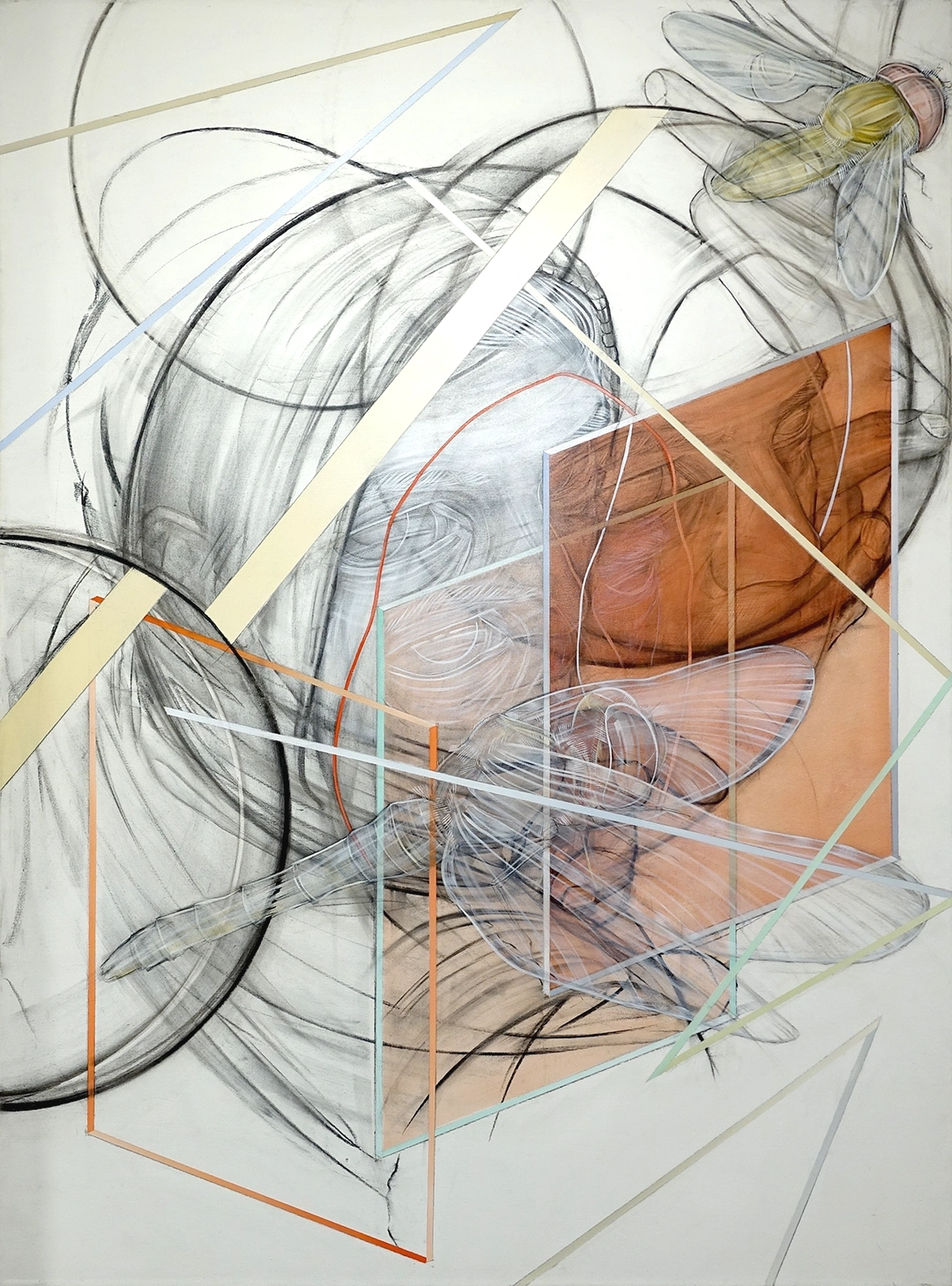
Zugunruhe #2, 2022
Charcoal and acrylic on canvas | 63 x 47.2 x 1.77 in
Zugunruhe
If I had to single out his most fertile gesture, it would be, in my view, the appropriation of the term Zugunruhe. It is a word from behavioural biology. It names the migratory restlessness that affects birds once a year, including those kept in cages. When the migration season arrives, the bird's body understands that it should already be flying south. Even when confined, its movements within the cage intensify. The migratory drive remains intact, yet finds neither the space nor the means to express itself.
Schicho applies the concept to the contemporary subject. The German word breaks down into Zug, which means pull, impulse, also train, company, and Unruhe, which means lack of peace. The human beings who inhabit the spaces of his works stir in Zugunruhe. They feel the impulse to move, to flee, to change cages, trapped in a space they do not recognise as bounded. The people in his lifts, the faces in his canvases, the figures surrounded by dragonflies which are in fact drones, all of them live in that state of anguish. They endure urgency, paralysis, the stillness of death.
This concept titles several series and one of the exhibitions he held at Galerie Hilger in Vienna. It also serves him to articulate his own trajectory. Each series, each stylistic displacement, suffers Zugunruhe.
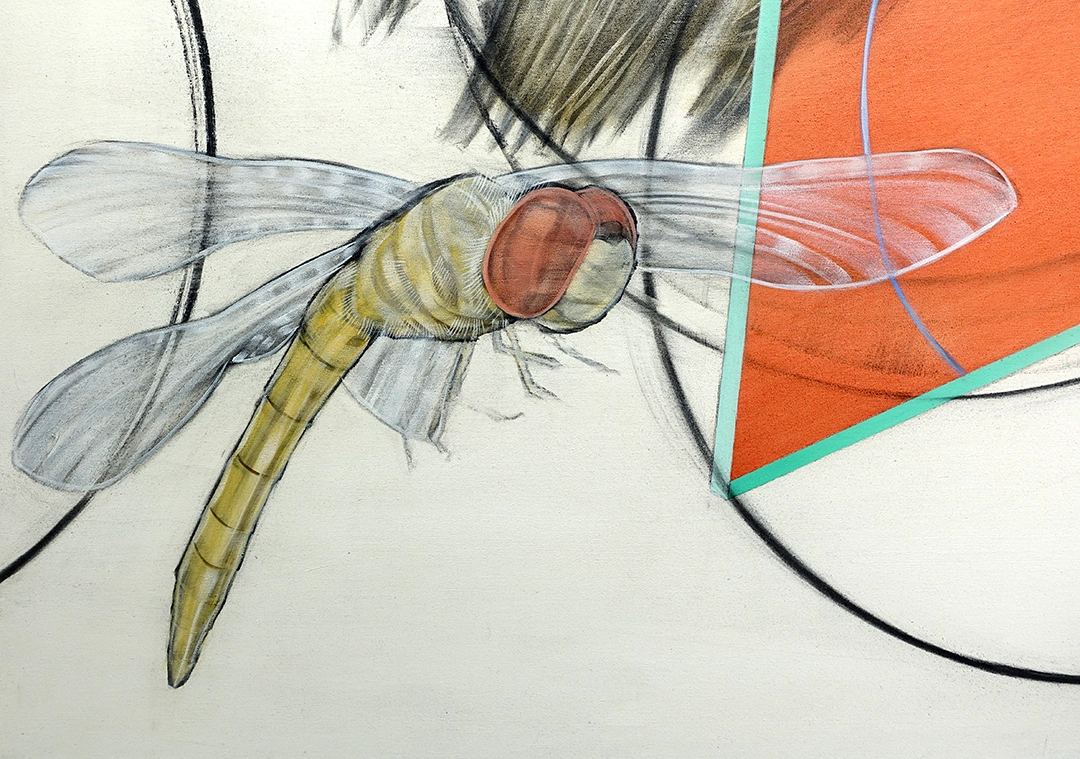
Mirror 2, 2018 ( Detail )
Charcoal and acrylic on canvas | 63 x 47.2 x 1.77 in
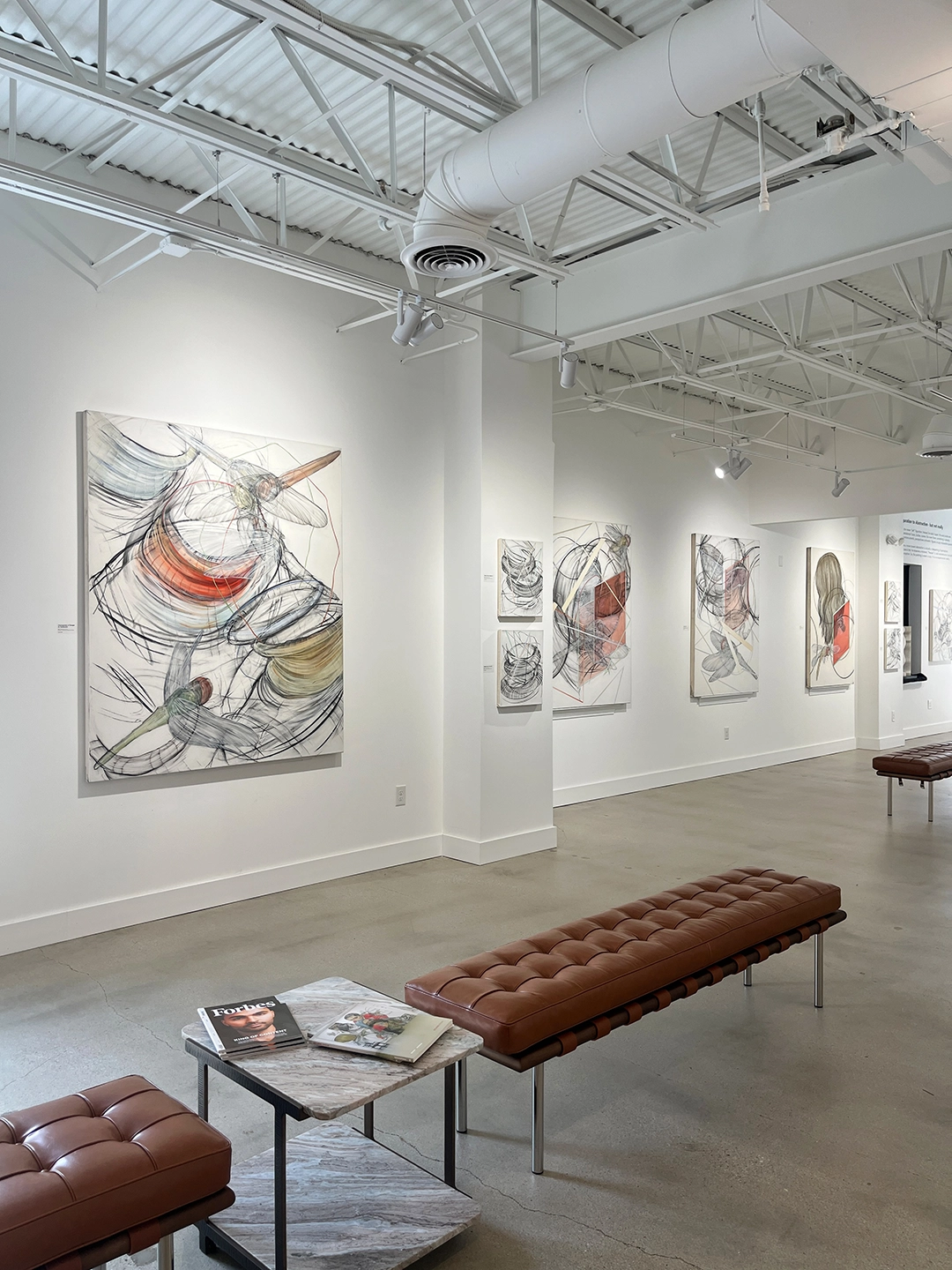
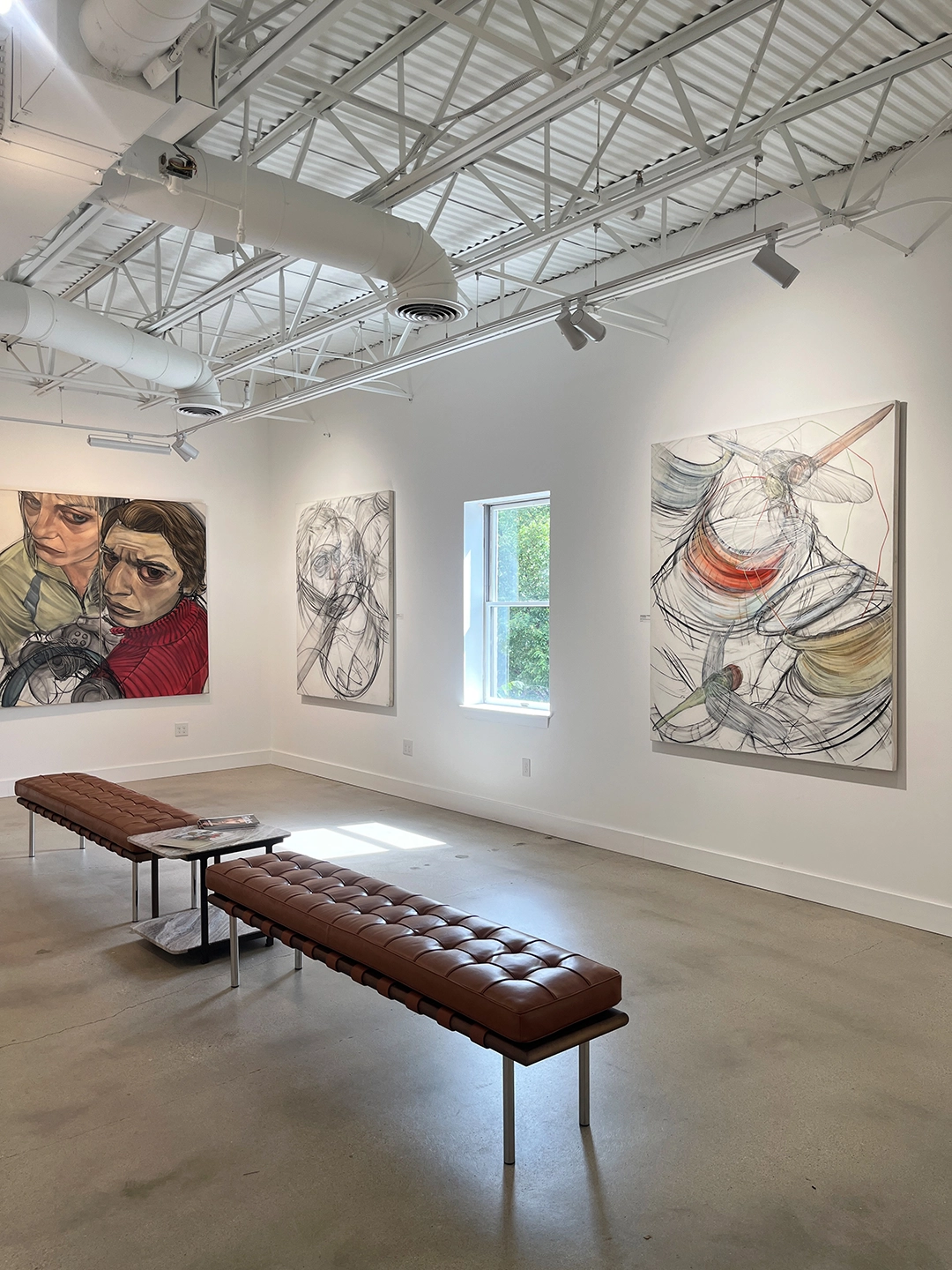
Over the course of his practice Schicho has built up a small bestiary that operates as a system of linkage between series. The dragonfly is the central piece. It functions visually as a sign of direction, an arrow, a vector. Its compound eye is the most complex in the insect world. It sees in every direction at once. An organic machine of surveillance, in the strictest sense.
For that reason he associates them with drones, without further artifice, with the small ones, those conceived to monitor our behaviour. In many cultures the dragonfly is regarded symbolically as a keeper of passage, a figure of thresholds. In his canvases they have grown, over time, increasingly transparent, vitreous, like crystalline structures vibrating over human faces. He painted many birds before he painted dragonflies, and they gradually transformed into lines, trails, vectors of movement. They are the literal embodiment of Zugunruhe.
In his human figures, the hands overflow their natural proportion. They seem to become sign, weight, or expression, reaching fetishistic dimensions. Schicho admits without evasion that he did not know how to paint them, that this was why he forced himself to work them, to make them gigantic. He incorporated them programmatically into his narrative. His way of painting hair has, likewise, an almost landscape quality. Because it is the only part of the human body that cannot interact with another person. He works it with the attention a nineteenth-century painter would have devoted to a forest. Hair is the body's last unruly territory.
Schicho's palette is generous in specific yellows, reds and greens, never pure. His reds are thermally ambiguous, introspective, almost submissive. His painting stands opposed —if we were to seat it at the same table— to the optimistic painting of the American Midwest, where canvases shine and almost invariably please the viewer with amiable, saturated colour. In Schicho, colour is Germanic, restrained, calibrated to sustain a psychological atmosphere and not to produce an immediate emotion.
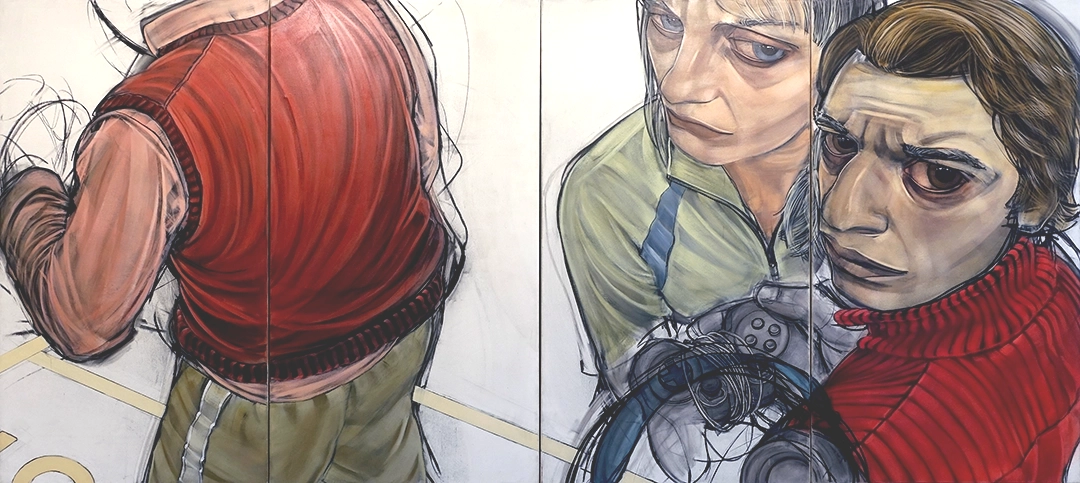
Hopscoth 2. Part 1, 2008
Acrylic on canvas | 70.85 x 157.5 x 1.77 in
I remarked to him that in his most recent production the palette is fading. Schicho confirmed it: I am slowly losing colours. The pastels, the bluish greys, the pearled tones of the lift series are a gradual farewell to saturated colour. Not as an exhaustion of the resource, but as a conscious decision. As the contemporary subject becomes more transparent, more surveilled, more reduced to an informational unit, colour loses its purpose.
This latest series, built around lifts, constitutes what literary theory would call a chronotope, a space in which time and geography acquire a particular density. Because the lift is an enclosed, reduced, uncomfortable cubicle, in which strangers are obliged to a proximity that no social convention has foreseen. It is a place where one enters as one being and leaves as another.
Schicho turns the lift into a small chamber of friction, of unpleasant approach. He crosses it, moreover, with a reference to the quantum physics of Anton Zeilinger, the Austrian Nobel laureate who demonstrated that two particles can be in correlated states without direct contact. Holding to that mental structure, a person can be in two places at once. In his lifts, the figures double themselves, the mirrors multiply them, and viewers no longer know whether they are watching the scene or are immersed within it. It is a metaphor for the contemporary condition. A brief, imposed, shared journey, in the course of which individuals look at the button panel, at the telephone screen, at anything rather than into the eyes of those beside them.
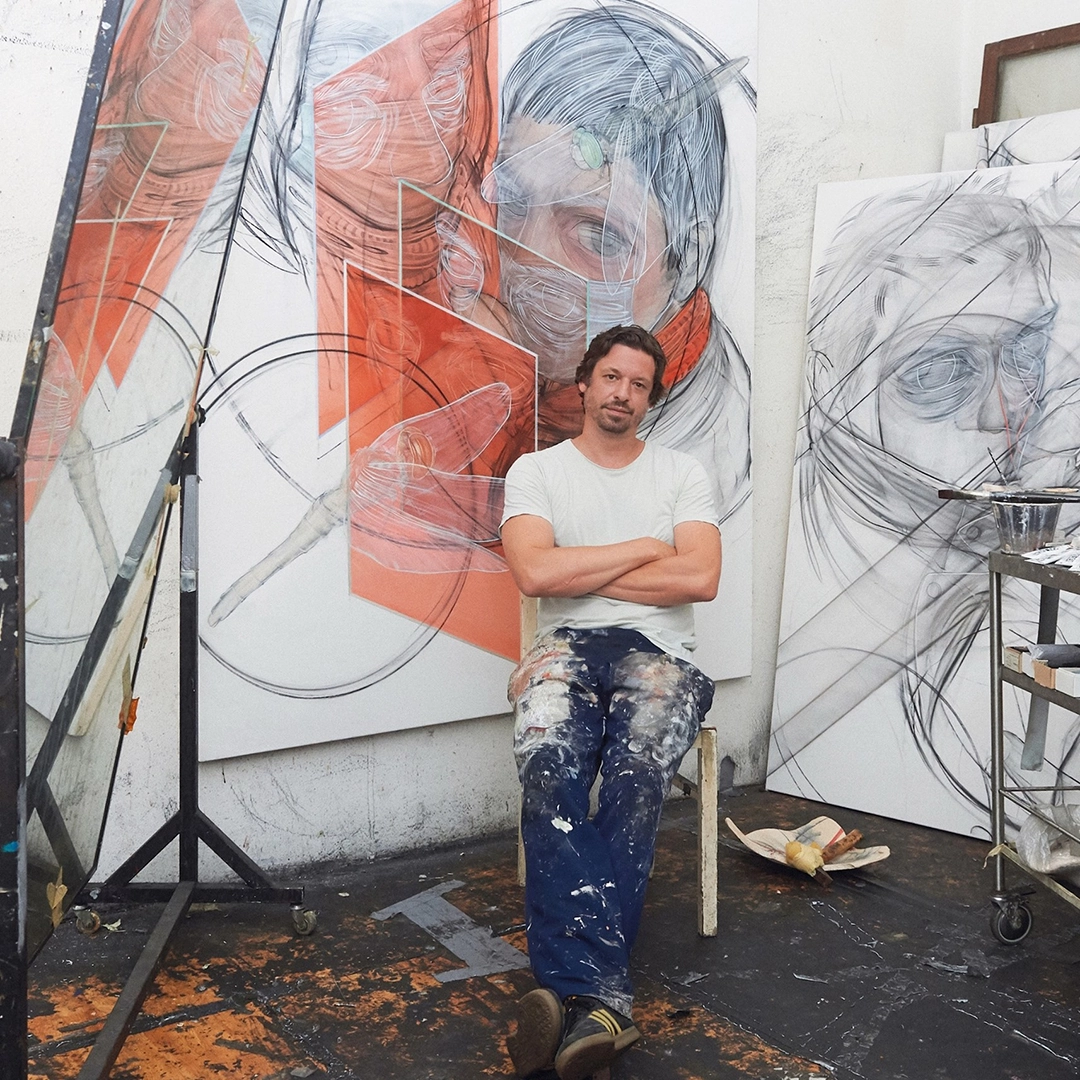
Who, then, is Stylianos Schicho?
Not a confessional painter. He does not use painting as a diary. Certain phrases he let fall in conversation reveal a biographical substratum in the theme of invasive proximity. When two people speak, he said, they keep a normal distance. Some break it. It has happened a great deal in his country. He did not develop the phrase, nor did he need to. It gestures toward Austrian social and political experience, the weight of its history, the surveillance of the state, the habits inherited from a particularly dense twentieth century.
His obsession with control is at once biographical and technical. There was a time when he wanted everything held under control. Yet the hardest thing for an artist is to deceive oneself sufficiently to escape oneself. The circles that abound in his compositions are, in his own explanation, places where he allows himself to change the rules, spatial markers where he can twist his own logic.
Schicho is not an emerging artist. He is a mid-career figure consolidated within the Central European circuit. His work is held in the collections of the Albertina, the Leopold Museum, the Wien Museum, the Strabag collection, the Angerlehner museum. He has exhibited at the Kunsthalle Krems, the Künstlerhaus in Vienna, the MAK, Galerie Hilger, Lukas Feichtner, Wim van Krimpen in Amsterdam, Galerie Clairefontaine in Luxembourg. He has a catalogue published by Kerber Verlag, one of the reference publishers for contemporary art in the German language. He has received the Strabag Artaward International in 2017, the Walter Koschatzky in 2007, the Young & Collecting prize of Art Amsterdam in 2010.
He converses, without imitating, with the lineages of Schiele in the nervous drawing of the body, Marlene Dumas in the figures that emerge from stains, Luc Tuymans in the cold tone and the politics of the second plane, Gerhard Richter in the face blurred as an antechamber. Although he belongs to the same Viennese current as Actionism (Wiener Aktionismus), he does not expose his body nor practise its rituals. The whole of his practice unfolds within the canvas, not beyond it.
Schicho thinks in German and paints in German. He was never on the defensive. He does not fear questions that compel him to reformulate what he already has thoroughly considered about a given work, and that conversational openness is consistent with his painting, with works that are only completed when they are looked at, that do not close upon themselves. His painting is built with a degree of technical competence that in Central Europe is taken for granted. He can draw, he composes, he commands large surfaces. He knows when to leave the charcoal mark visible and when to cover it. The apparent spontaneity of his figures rests upon a rigorous classical training.
Unlike the overwhelming majority of works of art, his look outward. They are not so enamoured of themselves, revelling in their pictorial perfection, in how handsome and well-appointed their protagonists are, whether in joy or in despair. The anxious gazes of Schicho's protagonists are searching for the other gaze.









Comments powered by Talkyard.